Have you ever wondered whether to write ingrained or engrained? Both words describe something that has become firmly established, deeply rooted, or difficult to change. They are often used when discussing habits, beliefs, attitudes, traditions, and behaviors that develop over time. Because the two spellings look and sound similar, many English learners and experienced writers alike wonder whether one is correct and the other is a mistake.
The good news is that both ingrained and engrained are correct English words. They share the same general meaning and are frequently used interchangeably. However, ingrained is generally the more common spelling, especially in contemporary writing. Understanding their meaning, usage, and subtle differences can help you choose the right word for academic assignments, professional documents, blog posts, and everyday conversations. In this guide, you will discover how each word works, explore practical sentence examples, and learn an easy memory trick to avoid confusion.
Quick Answer: Ingrained vs. Engrained
Ingrained and engrained both mean deeply established or firmly fixed, especially when describing habits, beliefs, attitudes, or behaviors. Neither spelling is inherently incorrect, but ingrained is generally more common in modern English. For most writing, choose ingrained for consistency and familiarity.
Why People Confuse Ingrained and Engrained
People often confuse these words because they have nearly identical spellings, similar pronunciations, and the same basic meaning.
Both words can describe a habit that is difficult to change, a belief that has existed for years, or a characteristic that has become a permanent part of someone’s behavior. They can also describe dirt or stains that have become deeply embedded in a material.
The main reasons for the confusion include:
- Similar spelling: The words differ by only one vowel.
- Similar pronunciation: In most varieties of English, they sound alike or nearly alike.
- Overlapping meanings: Both can describe something deeply rooted or firmly established.
- Different levels of popularity: Ingrained is more common in contemporary usage, while engrained remains an accepted alternative.
For example, both “an ingrained habit” and “an engrained habit” can communicate the same idea. However, readers are more likely to encounter the first version.
1. Ingrained: Meaning, Definition, and Examples
Ingrained is an adjective that describes something deeply established, firmly fixed, or difficult to change. It is especially common when discussing habits, beliefs, attitudes, values, and behaviors that have developed over a long period.
The word can also describe physical substances, such as dirt, that have become deeply embedded in a surface or material.
Definition of Ingrained
According to its common modern usage, ingrained means firmly established through repetition, experience, or long-standing practice.
Synonyms for ingrained:
- Deep-rooted
- Deep-seated
- Established
- Embedded
- Entrenched
- Fixed
- Inbuilt
The best synonym depends on the context. For example, deep-rooted often works well for beliefs, while embedded can describe something physically lodged in a material.
Examples of Ingrained in Sentences
- Honesty is an ingrained part of her character.
- He has an ingrained habit of checking his phone before breakfast.
- Their cultural traditions are deeply ingrained in the community.
- Years of practice created an ingrained sense of discipline.
- Fear of failure can become an ingrained belief.
- The coach worked to change the team’s ingrained defensive habits.
- Respect for elders is ingrained in many family traditions.
- Her ingrained optimism helped her overcome difficult situations.
- The carpet had ingrained dirt that ordinary cleaning could not remove.
- Some workplace attitudes are so ingrained that changing them takes time.
When Should You Use Ingrained?
Use ingrained when describing something that has become firmly established and is not easily changed or removed.
Common contexts include:
- Habits: An ingrained habit of arriving early.
- Beliefs: Ingrained assumptions about success.
- Attitudes: Ingrained prejudice or confidence.
- Traditions: Ingrained cultural practices.
- Behavior: Ingrained patterns of communication.
- Physical substances: Ingrained dirt in a carpet.
Example: “Punctuality is an ingrained part of his professional routine.”
This sentence means that punctuality has become a firmly established habit.
2. Engrained: Meaning, Definition, and Examples
Engrained is an accepted spelling variant of ingrained. It generally carries the same meaning: deeply rooted, firmly established, or difficult to remove or change.
Although both spellings are correct, engrained is less common in much contemporary writing. Some writers prefer it because it resembles the word grain, which can evoke the idea of something embedded deeply in a material.
Definition of Engrained
Engrained means firmly fixed or deeply established, particularly when describing habits, beliefs, attitudes, and physical substances.
Synonyms for engrained:
- Deeply rooted
- Entrenched
- Embedded
- Established
- Deep-seated
- Fixed
- Inbuilt
These synonyms help explain the meaning, but they are not always interchangeable in every sentence.
Examples of Engrained in Sentences
- His engrained fear of public speaking made presentations difficult.
- The organization struggled to change its engrained working habits.
- Her engrained sense of responsibility motivated her to help others.
- These beliefs are engrained in the family’s traditions.
- Years of repetition made the movement feel engrained.
- The community worked to challenge engrained stereotypes.
- An engrained habit of procrastination affected his productivity.
- The old rug contained engrained dust and stains.
- Their engrained routines made the transition challenging.
- Patience had become an engrained part of her personality.
When Should You Use Engrained?
You can use engrained in the same general contexts as ingrained. It works when describing habits, beliefs, behaviors, cultural traditions, and substances that are firmly embedded.
However, because ingrained is more widely used, it is usually the better default for formal documents, educational articles, and general-purpose writing.
Example: “The company struggled to change its engrained habits.”
This sentence is understandable and uses an accepted spelling, but “ingrained habits” is generally the more familiar choice.
Ingrained vs. Engrained: Comparison Table
| Feature | Ingrained | Engrained |
| Meaning | Deeply established or firmly fixed | Deeply established or firmly fixed |
| Correctness | Correct | Correct |
| Part of speech | Usually an adjective | Usually an adjective |
| Common contexts | Habits, beliefs, attitudes, dirt, and traditions | Habits, beliefs, attitudes, dirt, and traditions |
| Modern usage | Generally more common | Generally less common |
| Formal writing | Recommended default | Acceptable alternative |
| Example | An ingrained habit | An engrained habit |
The main difference is spelling preference, not meaning. In ordinary modern English, the two words are generally interchangeable.
When to Use Each
Since ingrained and engrained share the same basic meaning, choosing between them is mostly a matter of convention, readability, and consistency.
Use Ingrained for General Writing
Choose ingrained when writing:
- Blog posts and SEO articles
- Academic assignments
- Business reports
- Professional emails
- Educational materials
- Everyday messages
Examples:
- “The team needs to overcome ingrained habits.”
- “Trust is an ingrained part of their relationship.”
- “The organization is trying to address ingrained inequality.”
This spelling is familiar to most readers and is generally the safest choice.
Use Engrained When It Fits Your Established Style
Engrained is also correct. You may encounter it in published writing or choose to use it when following a particular publication’s spelling conventions.
Examples:
- “The family maintained its engrained traditions.”
- “The rug contained engrained dirt.”
- “The team struggled to change its engrained routines.”
There is no general grammatical rule requiring you to use engrained in these situations rather than ingrained.
What About Consistency?
If you are writing a long article, report, or book, select one spelling and use it consistently. For most audiences, ingrained is the most practical choice.
Consistency makes your writing look polished, even when more than one spelling is accepted.
Examples: Ingrained vs. Engrained in Sentences
The following examples show how the two spellings work in everyday English.
- Ingrained: She has an ingrained habit of reading before bed.
- Engrained: She has an engrained habit of reading before bed.
- Ingrained: The belief was ingrained in him from childhood.
- Engrained: The belief was engrained in him from childhood.
- Ingrained: Years of training developed ingrained discipline.
- Engrained: Years of training developed engrained discipline.
- Ingrained: The organization wants to eliminate ingrained prejudice.
- Engrained: The organization wants to eliminate engrained prejudice.
- Ingrained: The carpet had ingrained stains that resisted cleaning.
- Engrained: The carpet had engrained stains that resisted cleaning.
- Ingrained: Her ingrained confidence helped her lead the team.
- Engrained: Her engrained confidence helped her lead the team.
In each pair, the intended meaning remains essentially the same. The difference is the spelling chosen by the writer.
More Examples in Different Contexts
In education:
“An ingrained love of learning encouraged the student to explore new subjects.”
In business:
“The manager recognized that ingrained workplace habits would take time to change.”
In psychology:
“An ingrained response may develop through repeated experiences.”
In culture:
“Music is an ingrained part of the community’s cultural identity.”
In cleaning:
“The cleaner removed the ingrained grime from the kitchen floor.”
These examples demonstrate that ingrained is versatile and works naturally across several subjects.
Common Mistakes
Although both spellings are accepted, writers can still make mistakes when using them.
1. Assuming Engrained Is Always Incorrect
Incorrect claim: “Engrained is not a real English word.”
Correction: Engrained is a recognized spelling variant of ingrained. It is less common, but it is not inherently incorrect.
2. Assuming the Words Have Completely Different Meanings
Some writers believe ingrained refers only to habits, while engrained refers only to physical dirt.
This distinction is not reliable. Both spellings can be used for deeply established habits and embedded substances.
3. Using the Less Familiar Spelling Without a Reason
Writing engrained is not a grammatical error, but it may be less familiar to readers.
Better choice: Use ingrained unless you have a particular style preference or need to follow a publication’s house style.
4. Confusing Ingrained With Engraved
These words look similar but have different meanings.
- Ingrained: Deeply established or embedded.
- Engraved: Cut, carved, or etched into a hard surface.
Examples:
- “Respect was an ingrained part of her character.”
- “Their names were engraved on the trophy.”
Remember that an engrained habit is firmly established, while an engraved name is physically marked on a surface.
5. Using Ingrained When You Mean Merely Familiar
Something familiar is not necessarily ingrained. A person may be familiar with a new routine without having adopted it as a firmly established habit.
Example:
- Familiar: “She is familiar with the new schedule.”
- Ingrained: “Checking the schedule every morning is an ingrained habit.”
The second example suggests a repeated behavior that has become established over time.
Memory Trick: How to Remember Ingrained vs. Engrained
Use this simple memory trick:
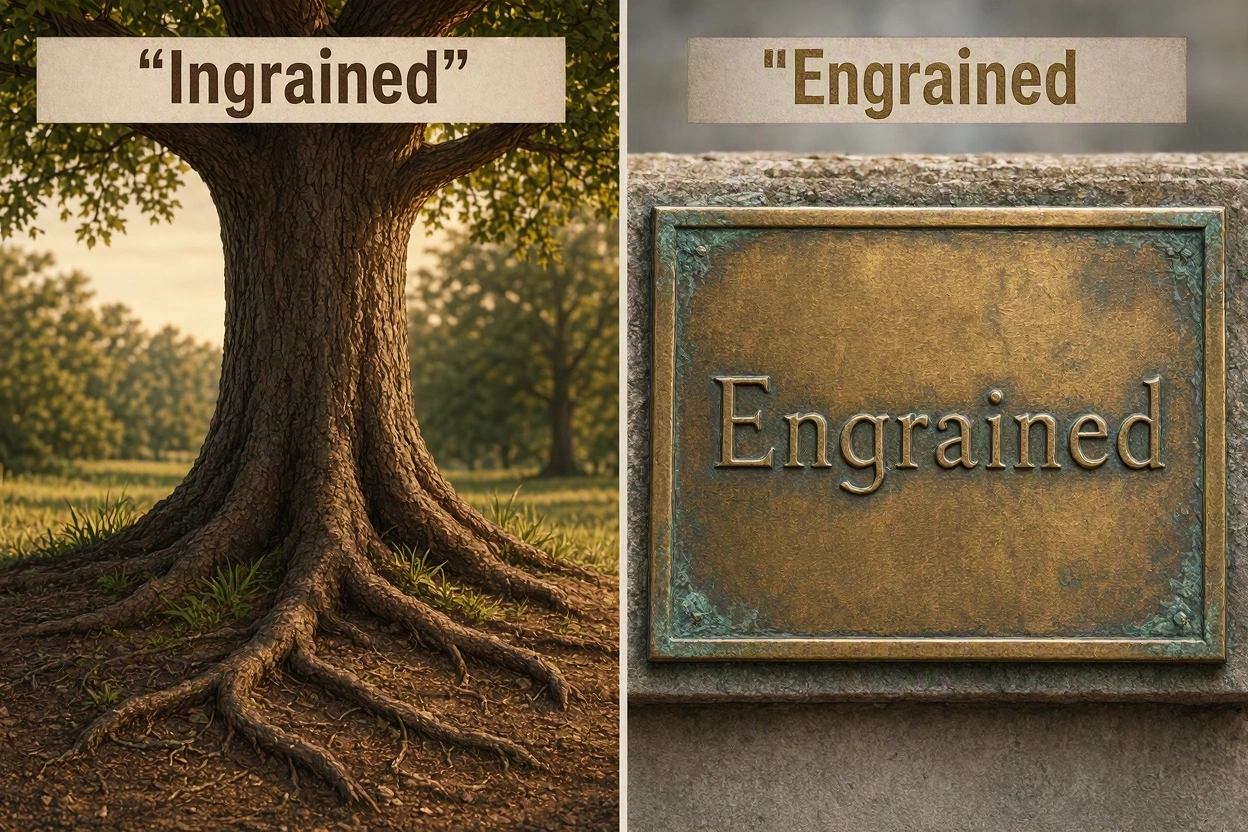
Ingrained = The common spelling.
Think of a habit, belief, or attitude that has become deeply rooted in someone’s life. When you need to describe something firmly established, ingrained is a reliable choice.
You can also connect the word with the idea of roots growing deeply into the ground.
Examples:
- An ingrained habit
- An ingrained belief
- An ingrained attitude
- Ingrained dirt
Engrained = An accepted alternative.
Remember that the additional letter e does not automatically make the word wrong. Both spellings are valid, but ingrained is generally more common.
The easiest rule is:
When in doubt, choose ingrained.
This simple preference will help you write confidently without worrying about an unnecessary spelling distinction.
American vs. British English
The difference between ingrained and engrained is not a straightforward American-versus-British spelling distinction. Both forms occur in English-language writing, and neither is exclusively American or British.
American English
In American English, ingrained is the more familiar and generally preferred spelling.
Examples:
- “The habit was ingrained from childhood.”
- “The carpet contained ingrained dirt.”
- “The company is working to change ingrained attitudes.”
The alternative engrained may also appear, but ingrained is a safe choice for general American audiences.
British English
British English also uses ingrained, and engrained is recognized as a variant.
Examples:
- “The tradition is ingrained in local culture.”
- “The carpet had ingrained stains.”
- “The organization is challenging ingrained assumptions.”
Which Spelling Should You Choose?
For readers in the United States, the United Kingdom, Pakistan, or other English-speaking regions, ingrained is a dependable default.
Unlike differences such as color and colour, the choice between ingrained and engrained is not primarily a regional spelling issue. It is mainly a matter of frequency and writing preference.
Similar Words: Deep-Rooted, Deep-Seated, Entrenched, and Embedded
Several words share meanings with ingrained and engrained, but each has its own nuances.
1. Deep-Rooted
Deep-rooted describes something established so firmly that it is difficult to change.
Example: “The community has deep-rooted traditions.”
This is especially useful when discussing beliefs, values, and customs.
2. Deep-Seated
Deep-seated often describes strong feelings, attitudes, or problems that have existed for a long time.
Example: “He has a deep-seated fear of failure.”
It is frequently used for emotional or psychological conditions.
3. Entrenched
Entrenched describes something firmly established and resistant to change. It is common in discussions of institutions, power structures, attitudes, and social problems.
Example: “The organization struggled to overcome entrenched practices.”
4. Embedded
Embedded means fixed firmly within something or incorporated into a larger structure.
Example: “The tiny particles were embedded in the fabric.”
It can describe both physical objects and abstract ideas.
5. Established
Established means accepted, recognized, or firmly set up. It does not always suggest that something is difficult to change.
Example: “The company has an established process for handling complaints.”
6. Inbuilt
Inbuilt describes something that is naturally part of a person, system, or object.
Example: “The device has an inbuilt safety feature.”
Unlike ingrained, it does not necessarily imply that something developed through repeated practice.
Frequently Asked Questions
1. Is ingrained or engrained correct?
Both spellings are correct. Ingrained is generally more common in modern English, while engrained is an accepted alternative. For most writing, ingrained is the recommended choice.
2. What does ingrained mean?
Ingrained means deeply established, firmly fixed, or difficult to change. It often describes habits, beliefs, attitudes, behaviors, traditions, or dirt embedded in a surface.
3. What does engrained mean?
Engrained has essentially the same meaning as ingrained. It describes something deeply rooted, firmly established, or difficult to remove or change.
4. Is engrained a misspelling?
No. Engrained is a recognized spelling variant of ingrained. Although it is less common, it is accepted in English.
5. Is ingrained more common in American or British English?
Ingrained is common in both American and British English. It is generally the preferred spelling in contemporary writing in either variety.
6. Can ingrained describe physical dirt?
Yes. Ingrained can describe dirt, stains, or grime that has become deeply embedded in a material and is difficult to remove.
Example: “The old carpet was covered in ingrained dirt.”
7. What is a synonym for ingrained?
Common synonyms include deep-rooted, deep-seated, entrenched, embedded, and firmly established. The most appropriate synonym depends on the sentence.
8. What is the difference between ingrained and engraved?
Ingrained means deeply established or embedded, while engraved means cut or etched into a surface. For example, a habit can be ingrained, but a name can be engraved on a medal.
Final Verdict:
The difference between ingrained and engrained is simpler than it first appears. Both spellings are accepted and generally express the same idea: something has become deeply rooted, firmly established, or difficult to change. They can describe personal habits, cultural traditions, beliefs, attitudes, and even dirt embedded in a material.
However, ingrained is the more common spelling in contemporary English and is the best default for most writers. Use it in articles, essays, business documents, and everyday communication unless you have a specific reason to choose engrained. Most importantly, remember that this is a spelling preference rather than a strict difference in meaning.
Conclusion
Understanding ingrained vs. engrained helps you avoid unnecessary spelling confusion and make better choices in your writing. Both words can describe habits, beliefs, attitudes, and substances that have become deeply embedded. Although the spellings differ slightly, their meanings overlap, and neither form is inherently wrong.
For clear, consistent, and reader-friendly writing, choose ingrained in most situations. It is widely recognized, commonly used, and appropriate for both formal and informal contexts. Once you remember that engrained is an accepted alternative, you can use either form confidently while maintaining consistency throughout your work.
Remember This
- Ingrained: Correct and generally more common.
- Engrained: Also correct; an accepted spelling variant.
- Meaning: Both describe something deeply rooted or firmly established.
- Common uses: Habits, beliefs, attitudes, traditions, and embedded dirt.
- Best tip: When in doubt, use ingrained.

I’m Micah Wheeler, a passionate author who enjoys exploring matching words, grammar, and language. I create clear, helpful content to make word choices and grammar easier for everyone.