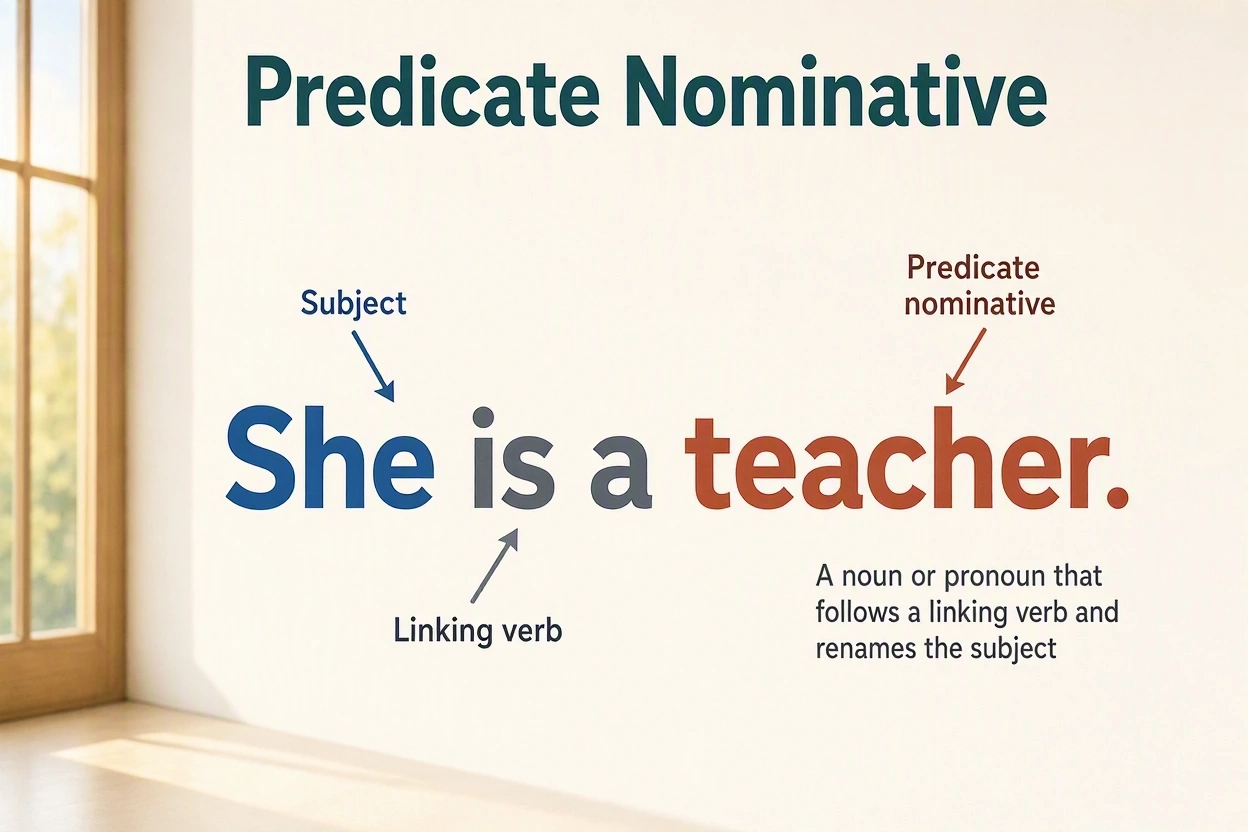
Understanding a predicate nominative can make English grammar much easier, especially when identifying the different parts of a sentence. Although the term sounds complicated, the concept is straightforward once you know how linking verbs connect a subject to a noun or pronoun that renames it. Learning this grammar rule can improve your sentence structure, writing accuracy, and confidence when analyzing English sentences.
A predicate nominative appears after a linking verb and identifies, names, or renames the subject. For example, in the sentence “Maria is a teacher,” the word “Maria” is the subject, “is” is the linking verb, and “teacher” is the predicate nominative. This grammatical element is common in everyday English, academic writing, and formal communication. In this guide, you will learn the predicate nominative definition, discover how it differs from a predicate adjective and direct object, and explore practical examples that make the concept easy to remember.
Quick Answer: What Is a Predicate Nominative?
A predicate nominative is a noun or pronoun that follows a linking verb and renames or identifies the subject of a sentence. For example, in “James is a doctor,” the word “doctor” is the predicate nominative because it identifies James. Predicate nominatives commonly follow verbs such as is, are, was, and became.
Why People Confuse It
Many English learners confuse predicate nominatives with direct objects, predicate adjectives, and other sentence elements because they can appear in similar positions.
The key difference is the relationship between the words.
- Predicate nominative: Renames or identifies the subject.
- Predicate adjective: Describes the subject.
- Direct object: Receives the action of a transitive verb.
- Subject complement: A broader grammatical category that includes predicate nominatives and predicate adjectives.
Consider these sentences:
- Predicate nominative: Sarah is a nurse.
- Predicate adjective: Sarah is kind.
- Direct object: Sarah helped her brother.
In the first sentence, “nurse” identifies Sarah. In the second, “kind” describes Sarah. In the third, “brother” receives the action of the verb “helped.”
Recognizing these relationships is the easiest way to identify a predicate nominative correctly.
First Word: Predicate
The word predicate refers to the part of a sentence that tells us something about the subject. It generally includes the verb and any words connected to it.
For example:
“Daniel became a musician.”
- Subject: Daniel
- Predicate: became a musician
- Linking verb: became
- Predicate nominative: musician
The predicate provides information about Daniel. Within that predicate, the noun “musician” identifies what Daniel became.
A predicate can contain more than a single verb. However, when identifying a predicate nominative, focus on the linking verb and the noun or pronoun that renames the subject.
Second Word: Nominative
The word nominative relates to naming or identifying someone or something. In traditional grammar, it is also associated with the grammatical case used for subjects and certain subject complements.
A predicate nominative names or identifies the subject rather than describing its qualities or receiving an action.
For example:
“My sister is the captain.”
Here, “captain” identifies the subject, “my sister.” It does not describe her personality or appearance.
Other examples include:
- My uncle is an engineer.
- The winner was David.
- Their main concern became safety.
- Those children are excellent students.
In each sentence, the predicate nominative provides another name, title, identity, or classification for the subject.
Comparison Table: Predicate Nominative vs. Related Terms
| Grammar term | Meaning | Example |
| Predicate nominative | Renames or identifies the subject | Lisa is a lawyer. |
| Predicate adjective | Describes the subject | Lisa is confident. |
| Direct object | Receives the action of a verb | Lisa interviewed a lawyer. |
| Subject | The person or thing being discussed | Lisa studies daily. |
| Linking verb | Connects the subject to its complement | Lisa became a lawyer. |
| Subject complement | Completes the meaning of a linking verb | Lisa is a lawyer. |
The most important distinction is that a predicate nominative is a noun or pronoun that identifies the subject. A predicate adjective, on the other hand, gives information about the subject’s qualities or condition.
When to Use a Predicate Nominative
Use a predicate nominative when a noun or pronoun identifies, renames, or classifies the subject after a linking verb.
1. To Identify a Person
A predicate nominative can tell readers who someone is.
Examples:
- My mother is a doctor.
- The new student is Ahmed.
- Her brother became a lawyer.
The nouns “doctor,” “Ahmed,” and “lawyer” identify the subjects.
2. To Name a Role or Occupation
Predicate nominatives often appear with professional titles, occupations, and social roles.
Examples:
- Mr. Wilson is our principal.
- Her daughter became an architect.
- My best friend is a musician.
3. To Identify an Object or Concept
A predicate nominative can also identify a thing, idea, or situation.
Examples:
- The biggest challenge is time.
- Our destination was the museum.
- The main problem became a lack of funding.
4. To Use a Pronoun as a Subject Complement
A pronoun can function as a predicate nominative.
Examples:
- The winner was she.
- The person at the door is he.
- The volunteers were they.
These examples illustrate traditional formal grammar. In everyday conversational English, speakers commonly say “The winner was her,” “The person at the door is him,” and “The volunteers were them.” Those objective-case forms are widely used in modern English, although traditional school grammar often expects the subjective forms in formal exercises.
Examples of Predicate Nominatives in Sentences
The following examples show how predicate nominatives work in everyday and academic English.
- My father is a teacher. — “Teacher” identifies my father.
- Emily became the team captain. — “Captain” identifies Emily’s role.
- The winner was Daniel. — “Daniel” identifies the winner.
- Our dog is a golden retriever. — “Retriever” identifies the dog’s breed.
- The main issue is communication. — “Communication” identifies the issue.
- Her favorite subject is mathematics. — “Mathematics” identifies the subject.
- The building became a hospital. — “Hospital” identifies the building’s new purpose.
- My neighbors are musicians. — “Musicians” identifies the neighbors.
- The final speaker was our principal. — “Principal” identifies the speaker.
- His greatest achievement was the invention. — “Invention” identifies the achievement.
- The person responsible is Michael. — “Michael” identifies the responsible person.
- Their biggest concern was safety. — “Safety” identifies their concern.
- The new manager is my cousin. — “Cousin” identifies the manager.
- The winner of the competition became a celebrity. — “Celebrity” identifies what the winner became.
- The purpose of this meeting is teamwork. — “Teamwork” identifies the purpose.
More Examples With Different Linking Verbs
Predicate nominatives can follow several linking verbs, not just forms of be.
- Become: The caterpillar became a butterfly.
- Remain: She remained the leader.
- Seem: He seems a trustworthy person. (Grammatical in some contexts, though “He seems to be a trustworthy person” is more natural.)
- Be: Those people are volunteers.
- Grow: The young artist grew into a respected professional. (Here, “professional” follows a prepositional phrase and is not a straightforward predicate nominative.)
Remember that a word does not become a predicate nominative simply because it follows a verb. The verb and the relationship between the subject and the complement must fit the grammatical definition.
Common Mistakes to Avoid
Even confident English speakers can misidentify predicate nominatives. Watch for these common errors.
Mistake 1: Confusing a Predicate Nominative With a Direct Object
Incorrect explanation: “In ‘She is a doctor,’ doctor is the direct object.”
Correct explanation: “Doctor” is a predicate nominative because “is” is a linking verb and “doctor” identifies the subject.
A direct object generally follows an action verb and receives its action.
Mistake 2: Treating Every Word After a Linking Verb as a Predicate Nominative
Consider this sentence:
“The soup smells delicious.”
“Delicious” is a predicate adjective because it describes the soup. It is not a predicate nominative because it does not rename the subject.
Mistake 3: Confusing the Subject With the Predicate Nominative
In “My brother is a pilot,” the subject is “my brother,” while “pilot” is the predicate nominative.
Both refer to the same person, but they serve different grammatical functions.
Mistake 4: Assuming Predicate Nominatives Always Follow “Is”
Predicate nominatives can follow other linking verbs, including was, were, became, and remained.
For example: “She became the president.”
Here, “president” is the predicate nominative.
Mistake 5: Ignoring Pronouns in Formal Grammar
Traditional grammar exercises may expect “It is I” rather than “It is me.” However, “It is me” is natural and widely accepted in ordinary conversation. Understand the difference between formal grammatical conventions and everyday usage.
Memory Trick: How to Identify a Predicate Nominative
Use this simple three-step method whenever you analyze a sentence.
Step 1: Find the subject.
Ask who or what the sentence is about.
Step 2: Find the linking verb.
Look for verbs such as is, are, was, were, became, or remained.
Step 3: Ask whether the following noun renames the subject.
If it identifies the subject rather than describing it, you probably have a predicate nominative.
For example:
“Olivia is an artist.”
- Subject: Olivia
- Linking verb: is
- Predicate nominative: artist
Easy memory trick: A predicate nominative names the subject; a predicate adjective describes it.
Try this quick practice:
“The sky became dark.”
Is “dark” a predicate nominative?
No. “Dark” is a predicate adjective because it describes the sky.
Now consider:
“The sky became a canvas.”
Here, “a canvas” is a predicate nominative in a figurative interpretation because it identifies what the sky became.
American vs. British English
The basic rules for predicate nominatives are the same in American and British English. Both varieties use nouns and pronouns after linking verbs to identify or rename subjects.
For example, these sentences are grammatical in both varieties:
- My sister is a teacher.
- The winner was James.
- The building became a museum.
Differences may arise in vocabulary, spelling, or everyday speech, but the grammatical function of a predicate nominative remains consistent.
Pronoun usage can vary according to formality and conversational preference. For example, “It is I” is associated with traditional formal grammar, while “It is me” is common in everyday speech in both American and British English.
For English learners, the main priority is understanding how linking verbs connect subjects with their complements rather than memorizing regional differences.
Similar Words and Related Grammar Terms
Several grammatical terms are closely related to predicate nominatives. Understanding them will help you analyze sentences more accurately.
Predicate Nominative vs. Subject Complement
A subject complement is a word or phrase that completes the meaning of a linking verb by identifying or describing the subject.
Predicate nominatives are one type of subject complement. Predicate adjectives are another.
Example:
- Predicate nominative: He is a scientist.
- Predicate adjective: He is intelligent.
Both “scientist” and “intelligent” complete the meaning of “is,” but they do so in different ways.
Predicate Nominative vs. Predicate Adjective
A predicate nominative is a noun or pronoun that identifies the subject. A predicate adjective is an adjective that describes it.
Examples:
- The room is a classroom. — “Classroom” is a predicate nominative.
- The room is spacious. — “Spacious” is a predicate adjective.
Predicate Nominative vs. Direct Object
A direct object receives the action of a verb. A predicate nominative follows a linking verb and identifies the subject.
Examples:
- He became a chef. — “Chef” is a predicate nominative.
- He hired a chef. — “Chef” is a direct object.
The same noun can serve different grammatical functions depending on the sentence.
Predicate Nominative vs. Predicate
A predicate is the part of a sentence that says something about the subject. A predicate nominative is one specific element that can appear within that part of the sentence.
For example, in “Sarah became a doctor,” the predicate is “became a doctor,” and “doctor” is the predicate nominative.
Final Verdict: Understanding Predicate Nominatives
A predicate nominative is a noun or pronoun that follows a linking verb and identifies or renames the subject. It is an important part of English grammar because it helps explain how sentences connect people, things, occupations, roles, and ideas.
To recognize one, identify the subject, locate the linking verb, and determine whether the complement names the subject rather than describing it. Once you understand this relationship, distinguishing predicate nominatives from direct objects and predicate adjectives becomes much easier.
Frequently Asked Questions (FAQs)
1. What is a predicate nominative in simple words?
A predicate nominative is a noun or pronoun that follows a linking verb and renames or identifies the subject. In “John is a student,” the word “student” identifies John and functions as the predicate nominative.
2. What are five examples of predicate nominatives?
Here are five examples:
- My sister is a doctor.
- He became the captain.
- The winner was Sarah.
- Our destination is the beach.
- Those people are volunteers.
The bolded identifying nouns or noun phrases in these sentences function as predicate nominatives.
3. What words can introduce a predicate nominative?
Predicate nominatives commonly follow linking verbs such as is, are, was, were, become, became, and remain. Other verbs can also function as linking verbs depending on how they are used in a sentence.
4. How do you identify a predicate nominative?
Find the subject and linking verb, then examine the word or phrase that follows. If it is a noun or pronoun that identifies or renames the subject, it is a predicate nominative.
5. What is the difference between a predicate nominative and a predicate adjective?
A predicate nominative identifies the subject, while a predicate adjective describes it. In “She is a doctor,” “doctor” is a predicate nominative. In “She is intelligent,” “intelligent” is a predicate adjective.
6. Can a predicate nominative be a pronoun?
Yes. A pronoun can function as a predicate nominative. Traditional formal grammar favors subjective forms in examples such as “The winner was she,” although objective forms such as “The winner was her” are common in everyday English.
7. Is a predicate nominative the same as a subject complement?
Not exactly. A predicate nominative is one type of subject complement. Predicate adjectives are another type. Both follow linking verbs and complete the meaning of the subject, but they perform different functions.
Conclusion
Learning the predicate nominative definition is easier when you focus on the relationship between the subject, linking verb, and complement. A predicate nominative does not receive an action or simply describe a quality; instead, it identifies or renames the subject. Examples such as “My father is a teacher” and “The winner was Daniel” demonstrate this relationship clearly.
With regular practice, you can recognize predicate nominatives in everyday conversations, academic assignments, and formal writing. Remember to distinguish them from predicate adjectives and direct objects, since those terms describe different grammatical functions. Mastering these basic sentence elements will strengthen your overall English grammar skills and help you write clearer, more accurate sentences.
Remember This
A predicate nominative is a noun or pronoun that follows a linking verb and identifies or renames the subject.
- Naming: She is a doctor.
- Describing: She is kind.
- Receiving an action: She helped a doctor.
If the word identifies the subject, it is a predicate nominative. If it describes the subject, it is a predicate adjective.

I am Chase Larson, an author at Grammetics, passionate about grammar and matching words. I create clear, useful content that helps readers improve vocabulary, writing, and communication.