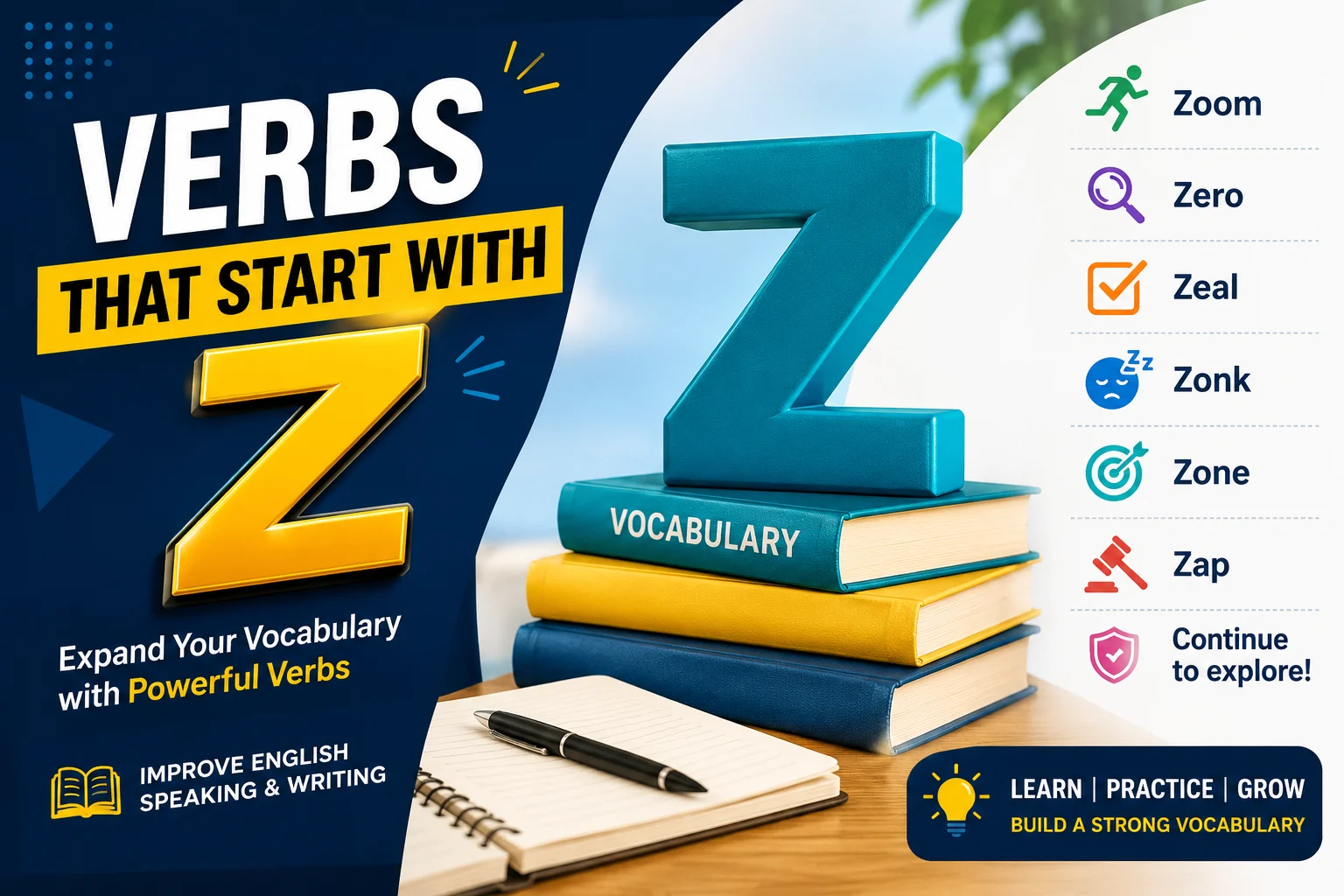
Finding verbs that start with Z can be surprisingly difficult. The letter Z is one of the least common starting letters in English, so learners often struggle to build a useful list of Z verbs. However, English does have a number of verbs beginning with Z, ranging from everyday words such as zip and zoom to more specialized terms such as zone, zero, and zinc.
Whether you are a student looking for verbs for a vocabulary assignment, a writer expanding your word bank, or simply curious about English words beginning with Z, this guide will help. You’ll discover common and less-common Z verbs, their meanings, example sentences, and practical usage tips. We’ll also look at differences between American and British English and explain which Z verbs are most useful in everyday communication.
Quick Answer
Some useful verbs that start with Z include zap, zero, zigzag, zip, zoom, zone, zest, zing, zonk, zombify, zinc, zipper, and zhuzh. Among these, zip, zoom, zap, zone, and zero are especially useful in everyday English.
Why People Confuse It
People often find verbs that start with Z difficult because relatively few common English verbs begin with this letter.
Unlike letters such as C, S, or P, Z does not provide a large collection of everyday action words. As a result, learners may assume that there are almost no Z verbs.
Another reason is that several Z verbs have different meanings depending on context.
For example:
- Zip can mean to close something with a zipper or move quickly.
- Zoom can mean to move rapidly or enlarge something visually.
- Zone can mean to divide an area into sections or organize something according to zones.
- Zero can mean to adjust something to zero or focus precisely on something.
Understanding the meaning and context of each verb makes these words much easier to remember.
First Word: Zap
Zap is one of the most recognizable verbs beginning with Z.
It can mean to destroy, hit, eliminate, or quickly affect something, often suddenly or energetically. It is also commonly used for changing television channels quickly.
Examples:
- The machine can zap harmful bacteria.
- He zapped through the television channels.
- The lightning zapped the electrical system.
In informal English, zap often suggests a quick or sudden action.
Second Word: Zero
Zero can function as a verb meaning to adjust something to zero or reduce something to nothing.
It is also commonly used in the phrase zero in on, which means to focus closely on something.
Examples:
- The technician zeroed the instrument before using it.
- The investigation zeroed in on the main suspect.
- We need to zero in on the real problem.
The phrasal verb zero in on is particularly useful in formal and conversational English.
Comparison Table
| Verb | Meaning | Example |
| Zap | Hit, destroy, or affect suddenly | The device can zap germs. |
| Zero | Adjust to zero or focus precisely | We need to zero in on the issue. |
| Zigzag | Move in alternating directions | The road zigzagged up the hill. |
| Zip | Close with a zipper or move quickly | She zipped her jacket. |
| Zoom | Move quickly or enlarge visually | The car zoomed past us. |
| Zone | Divide or organize into areas | The city zoned the land for housing. |
| Zest | Add flavor or enthusiasm | Zest the lemon before cooking. |
| Zing | Move quickly or add energy | The new design really zings. |
| Zonk | Exhaust, stun, or knock out | The long trip zonked me. |
| Zombify | Make or cause someone to behave like a zombie | The exhausting schedule zombified him. |
| Zinc | Coat or treat with zinc | The metal was zinc-plated. |
| Zipper | Close or open with a zipper | She zipped the bag. |
| Zhuzh | Improve or make something more stylish | She zhuzhed up the room with new cushions. |
When to Use Each
Choosing the right Z verb depends on what you want to describe.
Use zap for sudden action
Use zap when something is quickly hit, destroyed, eliminated, or affected.
The microwave zapped the food.
Use zero in on for focused attention
Use zero in on when someone concentrates closely on a specific person, problem, detail, or target.
The detective zeroed in on an important clue.
Use zigzag for changing directions
Use zigzag when something moves from side to side rather than traveling in a straight line.
The cyclist zigzagged through the narrow street.
Use zip for quick movement or closing
Use zip when something moves quickly or when you close something with a zipper.
He zipped across the room.
Use zoom for rapid movement or visual enlargement
Use zoom when something moves very quickly or when a camera or computer image becomes larger.
The camera zoomed in on the painting.
Use zone for dividing areas
Use zone when an area is divided or designated for a particular purpose.
The city zoned the area for commercial use.
Examples of Verbs That Start With Z
Here are more than 10 practical examples to help you understand how these verbs work in real sentences.
- The technician zeroed the scale before weighing the package.
- The police zeroed in on the location after receiving new information.
- The children zigzagged across the playground.
- She zipped her coat before going outside.
- The motorcycle zoomed down the highway.
- The city has zoned the neighborhood for residential development.
- Please zest the orange before adding it to the mixture.
- The music zinged through the speakers.
- The exhausting workday completely zonked me.
- The machine zapped the unwanted signals.
- He zipped the suitcase shut.
- The camera zoomed in on the actor’s face.
- The researchers zeroed in on a possible explanation.
- The hiking trail zigzagged through the mountains.
- The chef zested a lemon over the dessert.
- The new decorations zhuzhed up the living room.
- The metal components were zinc-coated to protect them from corrosion.
- The intense workload seemed to zombify the employees.
These examples show that Z verbs can describe movement, attention, preparation, modification, energy, technology, and physical actions.
Common Mistakes
1. Confusing zip and zoom
These words can both describe speed, but they are not interchangeable in every situation.
- Zip often suggests quick movement over a short distance.
- Zoom commonly suggests very fast movement or rapid visual enlargement.
Correct:
The car zoomed down the highway.
She zipped across the room.
2. Forgetting the phrase “zero in on”
Learners sometimes use zero alone when they actually need the phrasal verb zero in on.
Correct:
The team zeroed in on the main cause.
3. Using “zone” incorrectly
Zone often refers to dividing or designating an area for a particular purpose.
Example:
The city zoned the land for commercial development.
4. Treating every Z verb as common vocabulary
Some Z verbs are rare, informal, technical, or specialized. Words such as zhuzh and zombify may appear in particular contexts but are not equally common in everyday formal writing.
Memory Trick
A simple way to remember common Z verbs is to connect each word with its action:
- ZAP = sudden hit or shock
- ZERO = bring to zero or focus
- ZIGZAG = move side to side
- ZIP = close or move quickly
- ZOOM = move very fast or enlarge
- ZONE = divide into areas
- ZEST = add flavor
- ZONK = exhaust or stun
Think of the sequence:
Zap → Zero → Zigzag → Zip → Zoom → Zone
These are among the most useful Z verbs to learn first.
American vs British English
Most common Z verbs have essentially the same meanings in American and British English.
Words such as zap, zip, zoom, zero in, zigzag, and zone are understood in both varieties.
However, some informal vocabulary can vary in frequency.
For example, zhuzh is an informal verb meaning to improve, decorate, or make something more attractive. It is especially associated with conversational and lifestyle-related English.
British and American speakers may also differ in how frequently they use particular slang expressions, even when the words themselves are understood by both groups.
For formal writing, it is best to choose widely recognized verbs such as zero, zone, zip, zoom, and zigzag.
Similar Words
If you are building your vocabulary around Z verbs, several related words and expressions are worth learning.
Zero in on
To focus closely on something.
The researchers zeroed in on the biggest problem.
Zip up
To close something using a zipper.
Zip up your jacket before you leave.
Zip along
To move quickly.
The train zipped along the tracks.
Zoom in
To make an image appear larger or focus on a particular area.
Zoom in to see the details.
Zoom out
To make an image appear smaller or show a wider view.
Zoom out to see the entire map.
Zigzag
To move or extend repeatedly from one side to another.
The path zigzags through the forest.
Frequently Asked Questions
What are some verbs that start with Z?
Common Z verbs include zap, zero, zigzag, zip, zoom, zone, zest, zing, zonk, zombify, zinc, zipper, and zhuzh.
What is the most common verb starting with Z?
Zip and zoom are among the most familiar Z verbs in everyday English. Zap and zone are also widely recognized.
Is “zero” a verb?
Yes. Zero can be used as a verb meaning to adjust something to zero or reduce something to zero. The expression zero in on means to focus closely on something.
Is “zoom” a verb?
Yes. Zoom is a common verb. It can mean to move very quickly or to enlarge part of an image using a camera, computer, or other device.
Is “zip” a verb?
Yes. Zip can mean to close something with a zipper or move quickly.
She zipped her bag shut.
The car zipped past us.
Is “zone” a verb?
Yes. Zone can mean to divide or designate an area for a particular purpose, especially in planning and land use.
Are there many English verbs that start with Z?
There are fewer Z verbs than verbs beginning with many other letters. However, English still has a useful collection of Z verbs, including everyday words, technical terms, and informal expressions.
Final Verdict
Although Z is an uncommon starting letter for English verbs, there are still plenty of useful words to learn. The most practical examples include zap, zero, zigzag, zip, zoom, and zone. These verbs appear in everyday conversations, technical contexts, descriptions of movement, and formal writing.
If you are learning vocabulary for school, writing, word games, or English improvement, start with the common Z verbs before moving on to specialized or informal words. Learning each verb with an example sentence is much more effective than memorizing a disconnected word list.
Remember This
The easiest Z verbs to remember are:
Zap = hit or affect suddenly
Zero = adjust to zero or focus
Zigzag = move side to side
Zip = close or move quickly
Zoom = move quickly or enlarge
Zone = divide into areas
Zest = add flavor
These seven give you a strong foundation for understanding and using verbs that start with Z.
Conclusion
Learning verbs that start with Z is a useful way to expand your English vocabulary because these words often have vivid and memorable meanings. From zip and zoom to zero in and zigzag, many Z verbs are easy to recognize once you connect them with their typical actions.
The key is to learn these words in context. Instead of memorizing a long list, practice writing short sentences with each verb. This will help you understand not only what the word means but also how native English speakers naturally use it.

I’m Aria White, a passionate word enthusiast who enjoys exploring grammar, vocabulary, and meaningful word connections. I create simple, helpful content that makes matching words easier, clearer, and enjoyable.