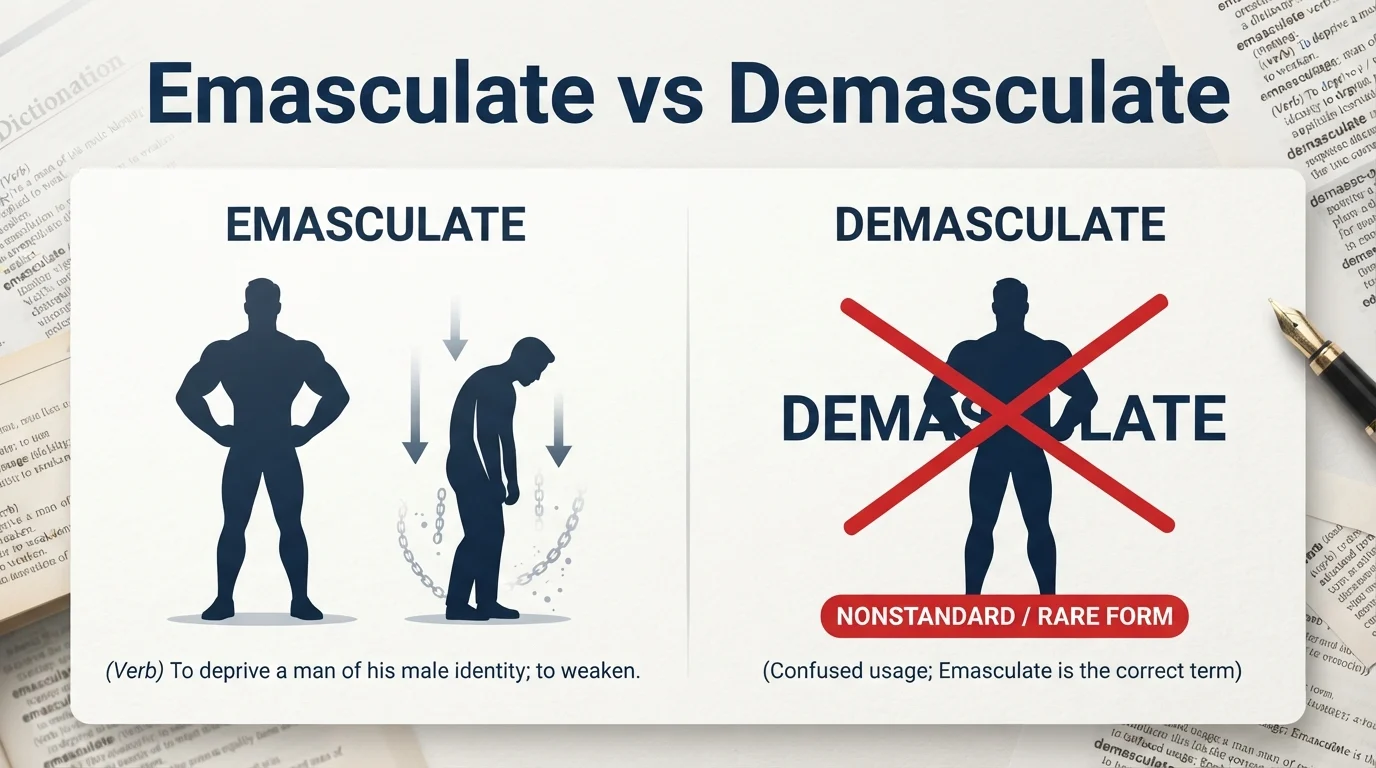
If you have ever wondered whether the correct spelling is “emasculate” or “demasculate,” you are not alone. The two forms look surprisingly similar, and English often uses the prefix de- to express removal, reversal, or reduction. That makes “demasculate” seem like a perfectly reasonable word at first glance. However, standard English does not treat the two forms equally. Emasculate is the established word found in major dictionaries, while demasculate is generally considered nonstandard.
The word emasculate has several meanings. It can mean to weaken someone’s confidence, authority, or sense of masculinity; to make something less powerful or effective; or, in a specialized biological context, to remove male reproductive parts. Because its figurative meaning is much more common in everyday writing, understanding the difference is useful for essays, articles, workplace communication, and general English.
Quick Answer
Emasculate is the correct standard-English word. It means to weaken, reduce effectiveness, or make a man feel less masculine or powerful. Demasculate is not generally accepted as a standard English word, although it occasionally appears in informal online usage. For professional, academic, and polished writing, use emasculate.
Why People Confuse It
The confusion between emasculate vs demasculate is understandable because English frequently uses de- to create words associated with removal or reversal:
- deactivate
- defrost
- demotivate
- devalue
- deconstruct
So, someone may naturally assume that demasculate means “remove masculinity.”
There is also a pronunciation issue. When emasculate is spoken quickly, the initial sound may be less obvious to some listeners. A person who has heard the word but never seen it written may later spell it as demasculate.
However, English vocabulary does not always follow a predictable prefix formula. Emasculate comes from Latin emasculare, rather than being a modern English construction formed by adding de- to “masculate.”
First Word: Emasculate
Emasculate is a standard English verb.
In its most common figurative sense, it means to weaken someone or something by taking away strength, authority, effectiveness, confidence, or power.
For example:
The new restrictions emasculated the organization.
Here, emasculated means the restrictions made the organization less powerful or effective.
It can also refer specifically to a man’s sense of masculinity or traditional male role:
He felt emasculated after losing control of the project.
In a specialized biological context, emasculate can mean to castrate a male or remove the male reproductive parts of a plant. Cambridge and Oxford both recognize these meanings.
Word forms
| Form | Example |
| Emasculate | They tried to emasculate the committee. |
| Emasculates | The policy emasculates local authorities. |
| Emasculated | He felt emasculated by the criticism. |
| Emasculating | The experience was deeply emasculating. |
| Emasculation | The emasculation of the institution continued. |
Second Word: Demasculate
Demasculate is not the standard word you should use in ordinary English.
It sometimes appears online as an informal or nonstandard formation meaning roughly “to remove masculinity.” Wiktionary records it, but that does not make it equivalent in status to an established standard-English word recognized by major learner dictionaries.
The important distinction is:
Demasculate may be encountered, but emasculate is the established choice for standard English.
So, if you are writing:
- an academic paper
- a professional email
- an article
- a school assignment
- a formal report
- an examination answer
choose emasculate, not demasculate.
Comparison Table
| Feature | Emasculate | Demasculate |
| Standard English word? | Yes | Generally no |
| Dictionary-recognized | Yes | Not standard in major learner dictionaries |
| Part of speech | Verb; also an uncommon adjective | Nonstandard verb |
| Meaning | Weaken, reduce power/effectiveness, or make less masculine | Usually intended to mean something similar |
| Formal writing | Correct | Avoid |
| Academic writing | Correct | Avoid |
| Everyday English | Correct | Best avoided |
| Example | “The criticism emasculated him.” | “The criticism demasculated him.” ❌ |
When to Use Each
Use “emasculate”
Use emasculate when you mean:
- To weaken something
- The amendments emasculated the bill.
- To reduce effectiveness
- The changes emasculated the original proposal.
- To undermine someone’s authority or confidence
- Public criticism left him feeling emasculated.
- To make a man feel less masculine
- He worried that asking for help would make him feel emasculated.
- In a biological or botanical context
- The researchers emasculated the flowers before controlled pollination.
What about “demasculate”?
In standard writing, simply don’t use it.
If your intended meaning is “make less powerful,” alternatives such as weaken, undermine, diminish, reduce, cripple, or neutralize may sometimes be clearer.
If your intended meaning is specifically about masculinity, emasculate is the established word.
Examples (10+)
Here are practical examples showing how emasculate works in different contexts:
- The new regulations emasculated the agency by removing most of its authority.
- He felt emasculated when his colleagues openly questioned his leadership.
- The opposition tried to emasculate the proposed legislation.
- Constant criticism can make someone feel emotionally emasculated.
- The budget cuts emasculated the department’s ability to provide services.
- The revised agreement emasculated the committee’s decision-making power.
- He did not want financial difficulties to make him feel emasculated.
- Censorship emasculated the novel by removing several important passages.
- The manager’s excessive control left the team feeling powerless and emasculated.
- The amendments substantially emasculated the original proposal.
- The botanist emasculated the flowers before carrying out the controlled cross-pollination.
- The defeat did not emasculate the team’s confidence for long.
Notice that emasculate does not always refer to men. It can describe a law, organization, argument, institution, proposal, or policy when something has been made weaker or less effective.
Common Mistakes
Mistake 1: Writing “demasculate”
❌ The policy demasculated the organization.
✅ The policy emasculated the organization.
Mistake 2: Assuming “de-” must be correct
Because English has words such as deactivate and demotivate, “demasculate” looks logical. But word formation is not always predictable.
Mistake 3: Thinking “emasculate” only applies to men
The figurative verb can describe anything whose power, strength, or effectiveness has been reduced.
The amendments emasculated the law.
The law obviously does not have a gender. Here, emasculated means weakened.
Mistake 4: Using “emasculate” when “weaken” is clearer
“Emasculate” is relatively formal and can carry gender-related implications. In some contexts, weaken or undermine may communicate your meaning more directly.
Memory Trick
Remember:
E = Emasculate = Established English
Think of the first letter E as your signal to choose emasculate.
You can also remember this sentence:
“E” in emasculate = the Established choice.
Whenever you hesitate between emasculate and demasculate, choose the form beginning with E.
American vs British English
There is essentially no spelling difference between American and British English here.
Both varieties use emasculate.
The main difference is not the word itself but its pronunciation and some dictionary presentation. Collins, for example, lists the verb in both American and British English, with meanings involving castration and the weakening of strength or effectiveness.
In both varieties, demasculate should not be treated as the normal standard alternative.
Similar Words
Depending on the context, these words may be better alternatives to emasculate:
- Weaken — make less strong
- Undermine — gradually damage confidence, authority, or effectiveness
- Diminish — make something smaller or less important
- Reduce — make something less in amount, degree, or effectiveness
- Debilitate — make someone or something seriously weaker
- Cripple — severely reduce effectiveness or ability
- Neutralize — make something ineffective
- Disempower — take away power or authority
- Humiliate — make someone feel ashamed or embarrassed
- Castrate — remove the reproductive organs of a male
The best synonym depends on what you are trying to say. For example, undermine may be more natural for someone’s authority, while weaken is usually clearer for a general loss of strength.
FAQs
Is “demasculate” a correct word?
Demasculate is not generally accepted as standard English. It sometimes appears in informal online usage, but emasculate is the established word to use in formal, academic, and professional writing.
What does emasculate mean?
Emasculate can mean to weaken or reduce the effectiveness of someone or something. It can also mean to make a man feel less masculine or to remove male reproductive parts in a specialized biological context.
Is emasculate only used for men?
No. Although the word has a gender-related meaning, it can also describe laws, organizations, policies, arguments, and other things that have been weakened or made less effective.
Is “emasculated” the past tense of emasculate?
Yes. The main forms are emasculate, emasculates, emasculated, emasculating, and emasculation.
What is the difference between emasculate and weaken?
Weaken is a broad, neutral word. Emasculate can mean weaken, but it may also suggest loss of masculine confidence, authority, or qualities. In some contexts, “weaken” is the clearer choice.
Is emasculate a formal word?
Yes. Dictionaries such as Cambridge and Oxford label its common figurative usage as formal.
What is a synonym for emasculate?
Depending on context, synonyms include weaken, undermine, diminish, debilitate, disempower, and reduce. For the biological sense, castrate can be appropriate.
Final Verdict
When comparing emasculate vs demasculate, the choice is straightforward: use emasculate. It is the established English verb recognized by major dictionaries and used to describe weakening, reducing effectiveness, undermining authority, or making someone feel less masculine.
Demasculate may appear occasionally, especially in informal online writing, but it is not the standard form you should choose when accuracy matters. If you are unsure, remember the simple rule: emasculate is the established word; demasculate is best avoided.
Remember This
Emasculate = correct standard English.
Demasculate = nonstandard; avoid it in polished writing.
If you mean weaken, undermine, reduce effectiveness, or make someone feel less masculine, emasculate is the word you want.
Conclusion
The confusion between emasculate and demasculate comes mainly from the way English prefixes appear to work. Since de- often signals removal or reversal, “demasculate” may look perfectly logical. But vocabulary is shaped by history and established usage, not simply by combining prefixes and roots. Emasculate has been part of English for centuries and comes from Latin.
For confident English writing, keep the distinction simple: emasculate is the standard word, while demasculate is not the form to use in formal or professional English. When a clearer synonym is appropriate, choose words such as weaken, undermine, diminish, or reduce according to the context.

I’m Aria White, a passionate word enthusiast who enjoys exploring grammar, vocabulary, and meaningful word connections. I create simple, helpful content that makes matching words easier, clearer, and enjoyable.