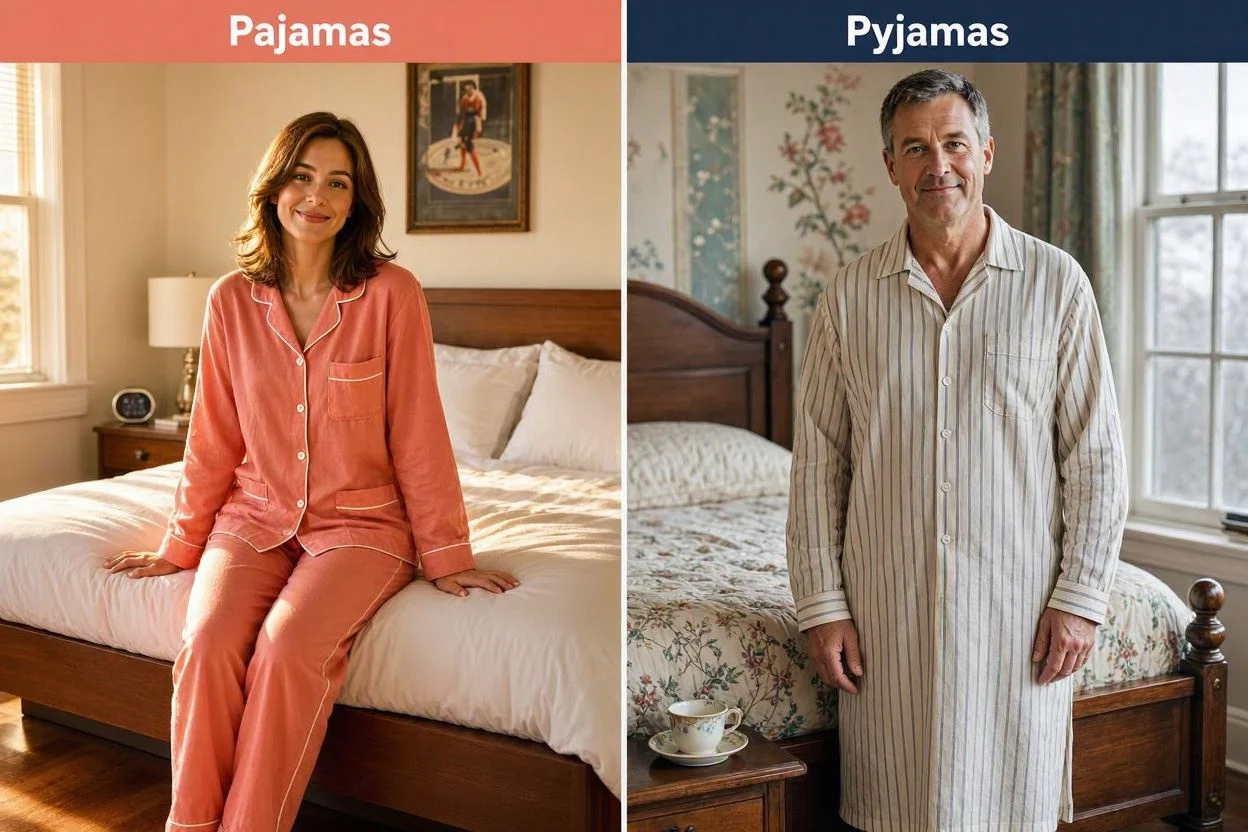
Have you ever wondered whether the correct spelling is pajamas or pyjamas? You may have seen both words in books, online stores, articles, and everyday conversations. If you are unsure which version to use, the good news is that both spellings are correct. The difference comes from regional variations in English rather than meaning, grammar, or pronunciation. Both words describe comfortable clothing worn while sleeping or relaxing at home.
The main distinction is that pajamas is the standard spelling in American English, whereas pyjamas is commonly used in British English and other varieties influenced by British spelling conventions. Understanding this difference can help you improve your spelling, write more naturally, and avoid inconsistencies in professional or academic content. Whether you are learning English, creating SEO content, or shopping for comfortable sleepwear, this guide explains the meanings, usage rules, sentence examples, and common mistakes associated with pajamas vs pyjamas.
Quick Answer
Pajamas and pyjamas mean exactly the same thing: clothing worn for sleeping or relaxing. Pajamas is the standard American English spelling, while pyjamas is the standard British English spelling. Both are correct, so choose the version that matches your audience and maintain consistency throughout your writing.
Why People Confuse It
People often confuse pajamas and pyjamas because the words have identical meanings but different spellings. The only noticeable spelling difference is the letter a in the American version and y in the British version.
English has many regional spelling variations. For example, Americans write color, while British writers generally use colour. Similarly, favorite becomes favourite, and center becomes centre.
The same principle applies to pajamas and pyjamas.
Here are the key points to remember:
- Both words refer to sleepwear.
- Pajamas is preferred in American English.
- Pyjamas is preferred in British English.
- Both spellings are grammatically correct.
- The pronunciation is generally the same, although accents may differ.
- Your choice should depend on your intended audience.
Neither spelling is universally superior. The appropriate choice depends on the variety of English you are using.
First Word: Pajamas
Pajamas is the standard American English spelling for clothing worn while sleeping or relaxing. A typical pair consists of a comfortable top and bottoms, although pajamas are available in many different styles.
In the United States, this spelling appears in clothing stores, product descriptions, advertisements, books, and everyday conversations.
Examples of Pajamas in Sentences
- I bought a new pair of pajamas for winter.
- The children changed into their pajamas before bedtime.
- These pajamas are made from soft cotton.
- She likes wearing comfortable pajamas on weekends.
- Please pack your pajamas before leaving for the trip.
- My brother received a matching set of pajamas as a birthday gift.
Is Pajamas Singular or Plural?
Pajamas is generally treated as a plural noun in American English.
For example:
- Correct: I bought new pajamas.
- Correct: I bought a pair of pajamas.
- Common compound: pajama pants.
- Common compound: pajama party.
When referring to one complete set, English speakers commonly say a pair of pajamas or a pajama set.
Second Word: Pyjamas
Pyjamas is the standard British English spelling of the same word. It describes comfortable garments worn for sleeping, resting, or relaxing at home.
This spelling is widely associated with British English and is also used in other English-speaking regions that follow British spelling conventions.
Examples of Pyjamas in Sentences
- I need to buy a new pair of pyjamas.
- She put on her pyjamas before going to bed.
- These pyjamas feel comfortable against the skin.
- The children were already wearing their pyjamas.
- He packed his pyjamas for the weekend.
- My favourite pyjamas have a blue-and-white pattern.
Is Pyjamas Different in Meaning?
No. Pyjamas does not describe a different type of clothing from pajamas. The two words are interchangeable in meaning, although regional preferences determine which spelling sounds more natural to a particular audience.
For British readers, pyjamas is generally the familiar form.
Comparison Table
| Feature | Pajamas | Pyjamas |
| English variety | American English | British English |
| Meaning | Sleepwear | Sleepwear |
| Spelling difference | Uses a | Uses y |
| Pronunciation | Generally the same | Generally the same |
| Common usage | United States | United Kingdom |
| Correct spelling? | Yes | Yes |
| Example | I need new pajamas. | I need new pyjamas. |
When to Use Each
The simplest way to choose between pajamas and pyjamas is to consider who will read your writing.
Use Pajamas When Writing in American English
Choose pajamas when writing for an American audience or following American spelling conventions.
Common situations include:
- Writing articles for U.S. readers.
- Creating product descriptions for American clothing stores.
- Preparing school assignments that follow American English.
- Publishing content on American websites.
- Writing social media posts for an American audience.
Example: The store offers affordable pajamas in several colours.
For fully American-style writing, you would normally use colors instead of colours.
Use Pyjamas When Writing in British English
Choose pyjamas when following British spelling conventions.
This is suitable for:
- Articles aimed at readers in the United Kingdom.
- British educational materials.
- Product descriptions for UK customers.
- Publications that follow British English.
- Websites that consistently use British spelling.
Example: The shop sells comfortable pyjamas in several colours.
What If You Have an International Audience?
Either spelling is acceptable. However, consistency is important, especially in professional writing and SEO articles.
If your website targets American readers, use pajamas as your main spelling. If your content targets British readers, use pyjamas.
You can mention both versions naturally when explaining the difference, but avoid switching between them unnecessarily.
Examples: Pajamas vs Pyjamas in Everyday English
The following paired examples demonstrate how the spelling changes while the meaning remains the same.
- American: I changed into my pajamas after dinner.
British: I changed into my pyjamas after dinner. - American: She bought new pajamas yesterday.
British: She bought new pyjamas yesterday. - American: The children wore matching pajamas.
British: The children wore matching pyjamas. - American: Please bring your pajamas for the sleepover.
British: Please bring your pyjamas for the sleepover. - American: My pajamas are made of cotton.
British: My pyjamas are made of cotton. - American: He forgot to pack his pajamas.
British: He forgot to pack his pyjamas. - American: I prefer lightweight pajamas during summer.
British: I prefer lightweight pyjamas during summer. - American: These pajamas make a lovely gift.
British: These pyjamas make a lovely gift. - American: She wore her pajamas while reading a book.
British: She wore her pyjamas while reading a book. - American: My favorite pajamas have a striped design.
British: My favourite pyjamas have a striped design. - American: We ordered a new pajama set online.
British: We ordered a new pyjama set online. - American: The children had a pajama party on Friday.
British: The children had a pyjama party on Friday.
These examples show that the spelling difference does not change the basic meaning or grammatical structure of the sentences.
Common Mistakes
Even though pajamas and pyjamas are easy to understand, writers sometimes make avoidable mistakes when using them.
1. Assuming One Spelling Is Incorrect
Some people believe that pyjamas is a misspelling of pajamas, or the other way around.
Both spellings are correct within their respective regional conventions.
2. Mixing American and British Spellings
Using both forms in the same article without a clear reason can make your writing appear inconsistent.
For example:
I bought new pajamas, but my sister prefers pyjamas.
This sentence is grammatically correct because it may reflect different personal or regional preferences. However, when writing a consistent American- or British-English article, choosing one spelling is usually better.
3. Thinking the Words Have Different Meanings
Pajamas and pyjamas do not refer to different garments. Both words describe sleepwear.
4. Forgetting Related Spelling Differences
Writers sometimes use pajamas alongside British spellings such as favourite and colour without considering consistency.
Mixing spelling conventions is not always wrong, but a consistent style usually looks more polished.
5. Confusing Pajamas With Nightwear
Pajamas and pyjamas generally refer to sleepwear, often a matching top and bottom. Nightwear and sleepwear are broader terms that can include pajamas, nightgowns, and other garments designed for sleeping.
Memory Trick
Use this simple memory trick to remember which spelling belongs to each English variety:
Pajamas = American English
Pyjamas = British English
You can also remember the first letter of the regional names: the American spelling uses A, while the British spelling uses Y.
There is no need to memorize separate meanings because both words mean the same thing.
American vs British English
Pajamas vs pyjamas is one example of how English spelling differs between regions. American and British English share the same language, but their spelling conventions developed in different ways.
Here are some other common examples:
| American English | British English |
| Pajamas | Pyjamas |
| Color | Colour |
| Favorite | Favourite |
| Center | Centre |
| Theater | Theatre |
| Neighbor | Neighbour |
| Traveling | Travelling |
| Organize | Organise |
Some of these differences involve individual letters, while others reflect broader spelling preferences.
Neither American nor British English is inherently more correct. Both are established varieties of English with their own conventions.
For students, bloggers, and professional writers, the best approach is to follow the spelling standard expected by the audience, school, employer, or publication.
Similar Words
Several English words describe clothing worn during sleep or relaxation. Understanding their meanings can help you choose the most appropriate term.
Sleepwear
Sleepwear is a general term for clothing designed to be worn while sleeping.
Example: The store has a wide selection of comfortable sleepwear.
Nightwear
Nightwear is another general term for clothing worn at night, especially in British English.
Example: She bought some lightweight nightwear for summer.
Nightclothes
Nightclothes refers to garments worn for sleeping.
Example: He changed into his nightclothes before bed.
Pajama Set or Pyjama Set
A pajama set or pyjama set generally consists of matching sleepwear pieces, such as a top and trousers or shorts.
Example: She ordered a matching pajama set online.
Nightgown
A nightgown is a loose garment, often designed like a dress, worn for sleeping.
Example: She chose a soft nightgown for a comfortable night’s sleep.
Loungewear
Loungewear refers to comfortable clothing worn while relaxing at home. It does not necessarily have to be designed for sleeping.
Example: He changed into loungewear after returning from work.
FAQs
1. Is pajamas or pyjamas correct?
Both are correct. Pajamas is the standard American English spelling, while pyjamas is the standard British English spelling.
2. Is pyjamas British or American?
Pyjamas is primarily associated with British English. It is also used in other English-speaking regions that follow British spelling conventions.
3. Why do Americans spell it pajamas?
American English uses pajamas as its standard spelling. This reflects a regional spelling convention rather than a difference in meaning.
4. Do pajamas and pyjamas have the same pronunciation?
They are generally pronounced the same way, although pronunciation can vary slightly by accent.
5. How do you spell pajamas in the UK?
The usual British English spelling is pyjamas, with a y instead of the a used in the American spelling.
6. Which spelling should I use in an article?
Use pajamas for an article targeting American readers and pyjamas for one targeting British readers. Mention both naturally if the article compares the spellings.
7. Is pyjama singular or plural?
Pyjamas is normally used as a plural noun. When referring to one complete set, speakers commonly say a pair of pyjamas or a pyjama set.
Final Verdict
The difference between pajamas and pyjamas is straightforward: pajamas is American English, and pyjamas is British English. Both spellings refer to comfortable clothes worn for sleeping or relaxing, and neither is incorrect.
Choose pajamas for American English content and pyjamas for British English content. If you are writing for an international audience, either form can work, provided your spelling remains consistent.
Remember This
- Pajamas: Standard American English spelling.
- Pyjamas: Standard British English spelling.
- Meaning: The same in both cases.
- Best practice: Match your spelling to your target audience.
Conclusion
Understanding the difference between pajamas and pyjamas is a simple way to improve your English spelling. Although the words look slightly different, they share the same meaning and are used to describe clothing worn for sleeping or relaxing. The American spelling is pajamas, while the British spelling is pyjamas. Once you recognize this regional difference, choosing the correct version becomes much easier.
Whether you are writing a blog post, preparing an assignment, or creating product descriptions, remember to consider your audience. Use American spelling when writing for American readers and British spelling when following British conventions. Both forms are correct, so there is no need to worry about choosing the wrong word when you understand the context.

I’m Elliot Pierce, Administrator at Grammetics, dedicated to improving word matching and grammar. I help maintain useful content, support readers, and make language learning simple, clear, accurate, and engaging.