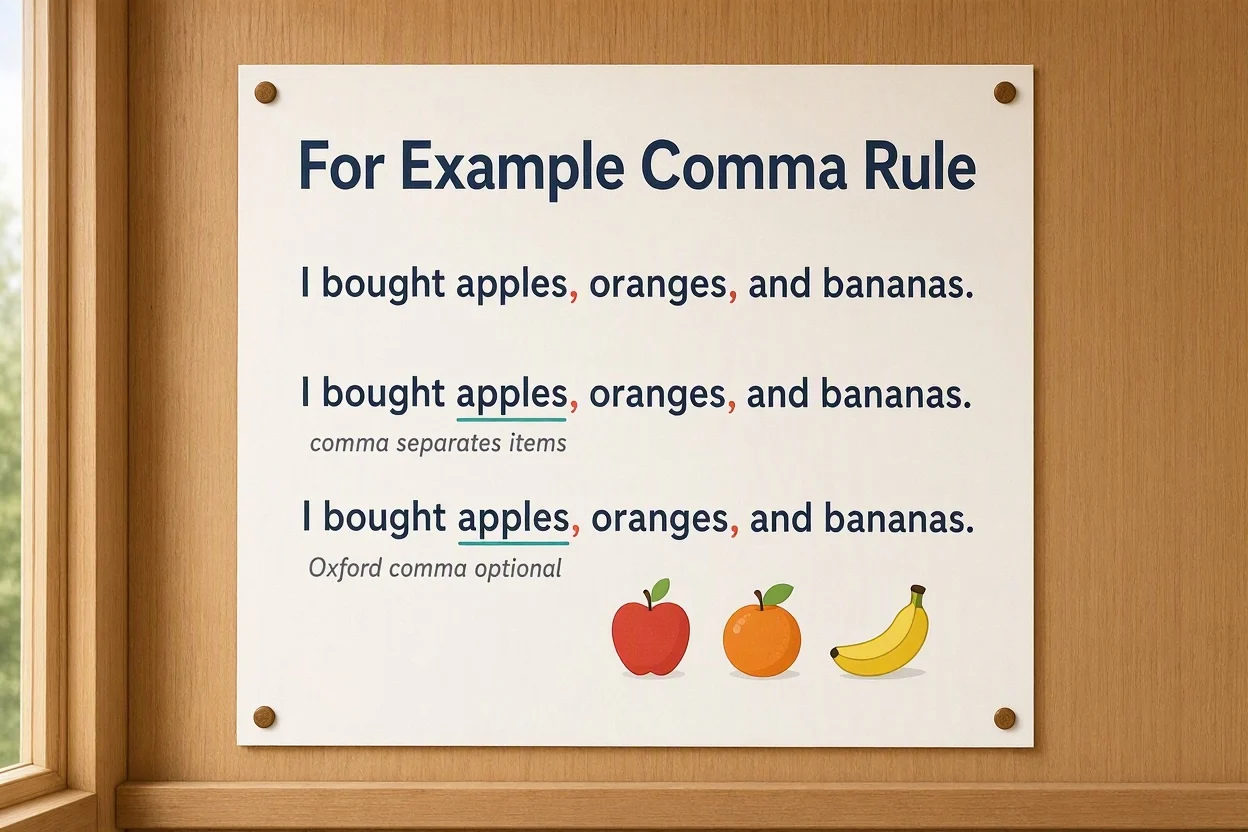
Knowing the for example comma rule can make your writing clearer, more professional, and easier to read. The phrase “for example” is commonly used to introduce an illustration, explain an idea, or provide specific instances of something. However, many writers are unsure whether a comma should come before or after it. The correct punctuation depends on where the phrase appears in a sentence and how it connects to the surrounding words. Learning these simple rules can help you avoid common comma mistakes in emails, essays, blog posts, and everyday writing.
The good news is that you do not need to memorize complicated grammar terminology to use “for example” correctly. In most situations, a comma follows the phrase when it introduces an example at the beginning of a sentence. When it appears in the middle of a sentence, commas may be needed on both sides. This guide explains the rules with practical examples, common mistakes, and easy tips to help you punctuate “for example” with confidence.
Quick Answer
The phrase “for example” usually takes a comma after it when it introduces an example at the beginning of a sentence. When it appears in the middle as an interrupting phrase, use commas on both sides if the sentence structure calls for them. A comma before “for example” may also be appropriate when it introduces an example after an independent clause.
Why People Confuse It
Writers often struggle with “for example” because it can appear in different positions within a sentence. Unlike a word with one fixed punctuation pattern, this introductory phrase can function as a sentence opener, a parenthetical expression, or a connector between ideas.
Consider these sentences:
- Beginning: For example, apples contain fiber.
- Middle: Some fruits, for example, apples and pears, contain fiber.
- After a complete clause: Some fruits contain fiber; for example, apples are a good choice.
All three sentences use “for example” correctly, but the comma placement changes with the sentence structure.
The key is to identify how the phrase functions rather than automatically placing a comma in the same position every time.
First Word: “For Example” at the Beginning of a Sentence
When “for example” appears at the beginning of a sentence, a comma usually follows it.
The phrase introduces an illustration of an idea mentioned earlier or presents a specific instance of a general statement.
Rule: Write For example, followed by the rest of the sentence.
Examples:
- For example, regular exercise can improve your energy levels.
- For example, you can use a dictionary to check unfamiliar words.
- For example, some birds migrate during the winter.
- For example, reading daily can improve your vocabulary.
- For example, students can practice grammar through short exercises.
The comma separates the introductory expression from the main statement, making the sentence easier to follow.
Can you omit the comma after “for example”?
In standard formal writing, the comma is normally included when “for example” introduces a complete sentence. Omitting it may make the sentence less clear or look incorrectly punctuated.
Preferred:
For example, you can save money by planning your meals.
Less suitable in formal prose:
For example you can save money by planning your meals.
Second Word: “For Example” in the Middle of a Sentence
When “for example” appears in the middle of a sentence, its punctuation depends on how it is used.
If the phrase interrupts the sentence as a parenthetical expression, commas generally appear before and after it.
Example:
- Many vegetables, for example, carrots and spinach, contain important nutrients.
Here, “for example” introduces specific instances of vegetables.
More examples:
- Some countries, for example, Canada and Australia, have large rural areas.
- Certain hobbies, for example, painting and gardening, can help reduce stress.
- Several languages, for example, Spanish and French, are taught in schools.
However, if “for example” introduces a separate clause or example after a complete thought, a comma before the phrase may be appropriate instead.
Example:
- Many fruits contain vitamin C; for example, oranges are a popular source.
You do not automatically need a comma on both sides whenever the phrase appears in the middle. Follow the sentence structure.
Comparison Table
| Sentence position | Correct punctuation | Example |
| Beginning | Comma after the phrase | For example, cats enjoy warm places. |
| Parenthetical middle | Commas around the phrase | Some pets, for example, cats, need regular care. |
| After an independent clause | Often a semicolon or period before the phrase, then a comma after it | I enjoy fruit; for example, apples are easy to pack. |
| After a period | Capitalize the phrase and add a comma | I enjoy fruit. For example, I eat apples daily. |
| Inside a list | Depends on sentence structure | Bring snacks, for example, nuts and fruit. |
When to Use Each Comma Rule
Understanding three common patterns will help you apply the “for example” comma rule correctly.
1. Use a comma after “for example”
Choose this pattern when the phrase introduces a sentence or an independent example.
Correct:
- For example, exercise can improve sleep.
- For example, you might start with a short walk.
2. Use commas around “for example” when it interrupts a sentence
If the phrase is inserted into an existing sentence as a parenthetical expression, place commas around it.
Correct:
- Some animals, for example, dolphins, are highly intelligent.
A clearer alternative is often to use a colon or restructure the sentence:
- Some animals are highly intelligent. Dolphins are one example.
3. Use a comma before “for example” when the context supports it
When “for example” follows a complete clause and introduces a separate example, a semicolon or period may be clearer than a comma alone.
Correct:
- There are several ways to learn vocabulary; for example, you can read short stories.
- There are several ways to learn vocabulary. For example, you can read short stories.
A comma alone between two independent clauses can create a comma splice:
Incorrect:
- I enjoy learning languages, for example, I study Spanish every day.
Better:
- I enjoy learning languages; for example, I study Spanish every day.
Examples: For Example Comma Rule in Sentences
Here are 15 practical examples showing how to punctuate “for example” correctly.
- For example, walking for 30 minutes can support your fitness goals.
- For example, you can use flashcards to memorize new words.
- For example, some mammals live in the ocean.
- For example, drinking enough water helps maintain hydration.
- Many fruits, for example, apples and bananas, are easy to carry.
- Some school subjects, for example, mathematics and science, require regular practice.
- Several animals, for example, lions and tigers, belong to the cat family.
- You can develop useful habits; for example, reading before bed may help you relax.
- There are several ways to save money. For example, you can prepare meals at home.
- Some jobs require technical skills; for example, software development involves programming.
- I enjoy outdoor activities. For example, hiking helps me unwind.
- Many people enjoy creative hobbies, for example, drawing and photography.
- You can improve your writing through practice; for example, keeping a daily journal can help.
- Some foods are rich in protein, for example, eggs, beans, and fish.
- There are many ways to organize a workspace. For example, you can label storage boxes.
These examples demonstrate that punctuation depends on whether “for example” begins a sentence, interrupts one, or introduces an example after a complete thought.
Common Mistakes
Mistake 1: Forgetting the comma at the beginning
Incorrect: For example students can learn through games.
Correct: For example, students can learn through games.
Mistake 2: Using only a comma between independent clauses
Incorrect: I like outdoor activities, for example, I go hiking every weekend.
Correct: I like outdoor activities; for example, I go hiking every weekend.
A period is also correct:
I like outdoor activities. For example, I go hiking every weekend.
Mistake 3: Adding commas without considering sentence structure
Incorrect or awkward: My favorite fruit, for example, is mango.
This sentence is possible if “for example” is deliberately parenthetical, but the wording is often unnecessarily awkward.
Clearer: Mango, for example, is one of my favorite fruits.
Mistake 4: Confusing “for example” with “such as”
These expressions are related, but their punctuation patterns differ.
- For example, apples are rich in fiber.
- Fruits such as apples and pears contain fiber.
The phrase “such as” generally introduces examples directly and does not automatically require a comma before it.
Mistake 5: Using “e.g.” without appropriate punctuation
“E.g.” is an abbreviation meaning “for example.” It is often followed by a comma in American English.
Example: Bring some fruit, e.g., apples or oranges.
In British English, punctuation conventions may differ, so follow your preferred style guide consistently.
Memory Trick
Use this simple memory trick:
Beginning = comma after.
When “for example” starts a sentence, put a comma after it.
Middle = check both sides.
If the phrase interrupts a sentence, commas may be needed on both sides.
New example after a complete thought = separate the ideas.
Use a semicolon or period when “for example” introduces another independent clause.
Remember these patterns:
- For example, …
- …, for example, …
- …; for example, …
This quick method will help you punctuate most everyday sentences correctly.
American vs British English
The basic comma rules for “for example” are largely the same in American and British English. In both varieties, a comma commonly follows the phrase when it introduces a sentence.
Examples:
- American English: For example, many students use online dictionaries.
- British English: For example, many students use online dictionaries.
One noticeable difference concerns abbreviations and house styles. American publications commonly write “e.g.,” with a comma following the abbreviation when it introduces examples. British publications may use “e.g.” without the following comma, depending on their style guide.
Both varieties also use semicolons and periods to separate independent clauses. The best approach is to follow the punctuation rules of your publication, school, or organization.
Similar Words
Several expressions serve a similar purpose to “for example,” but their punctuation can differ.
1. Such as
“Such as” introduces specific examples within a sentence.
Example: I enjoy outdoor activities such as hiking and cycling.
A comma is not normally necessary before “such as” when it introduces an essential example or list.
2. For instance
“For instance” has almost the same meaning as “for example.”
Example: For instance, you can practice English by reading newspapers.
When it introduces a sentence, a comma usually follows it.
3. E.g.
“E.g.” is a shortened form of the Latin expression exempli gratia, meaning “for the sake of example.”
Example: Some citrus fruits, e.g., oranges and lemons, contain vitamin C.
Use the abbreviation when appropriate for the audience and writing style.
4. Including
“Including” introduces items that form part of a larger group.
Example: Several fruits, including apples and grapes, are available at the market.
Its punctuation depends on whether the information is essential or supplementary.
5. Namely
“Namely” introduces more specific information or identifies exactly what is being discussed.
Example: Two students received awards, namely, Sara and Ahmed.
In many sentences, the punctuation around “namely” depends on how the identifying information fits into the sentence.
Final Verdict
The for example comma rule is straightforward once you understand the phrase’s position and function.
- Put a comma after “for example” when it introduces a sentence.
- Use commas around it when it interrupts a sentence as a parenthetical expression.
- Use a semicolon or period before it when it introduces an example in a new independent clause.
- Avoid joining two independent clauses with a comma alone.
The most important lesson is to consider the complete sentence rather than memorizing one punctuation pattern. Correct comma placement improves readability and makes your writing more professional.
FAQs
1. Should there always be a comma after “for example”?
A comma usually follows “for example” when it introduces a sentence or an independent clause. In other sentence structures, punctuation depends on how the phrase is used.
2. Do you put a comma before or after “for example”?
It depends on its position. At the beginning of a sentence, use a comma after it. In a parenthetical expression, commas may appear on both sides. After a complete clause, a semicolon or period may be needed before it.
3. Is “for example” followed by a comma in formal writing?
Yes. When it introduces a complete sentence, a comma after “for example” is standard in formal writing.
4. Can I start a sentence with “for example”?
Yes. Starting a sentence with “for example” is grammatically acceptable and common in academic, professional, and everyday writing.
5. Is a comma needed before “for example” in the middle of a sentence?
Sometimes. If the phrase is parenthetical, commas can surround it. If it introduces another independent clause, a semicolon or period may be more appropriate.
6. Is “for example” the same as “such as”?
They have similar meanings, but their grammatical uses differ. “For example” can introduce a complete sentence, while “such as” generally introduces examples within a sentence.
7. Should I write “e.g.” or “for example”?
Both are acceptable in suitable contexts. “For example” is often clearer for general readers, while “e.g.” is common in academic, technical, and concise writing. Follow the relevant style guide for abbreviation punctuation.
Remember This
For example, the comma rule becomes easy when you remember three things: use a comma after an introductory “for example,” use commas around an interrupting phrase when appropriate, and separate independent clauses with a semicolon or period rather than a comma alone.
Conclusion
Learning the correct punctuation for “for example” helps you write clearer sentences, avoid comma splices, and communicate your ideas effectively. Whether you are writing a school assignment, a professional email, or an SEO article, the position of the phrase determines how it should be punctuated. In most cases, a comma follows “for example” when it introduces a sentence.
With regular practice, you will recognize these patterns naturally. Remember that punctuation should reflect the structure of your sentence, not just the words you use. Apply these rules consistently, and your writing will become more polished, readable, and grammatically sound.

I’m Aria White, a passionate word enthusiast who enjoys exploring grammar, vocabulary, and meaningful word connections. I create simple, helpful content that makes matching words easier, clearer, and enjoyable.