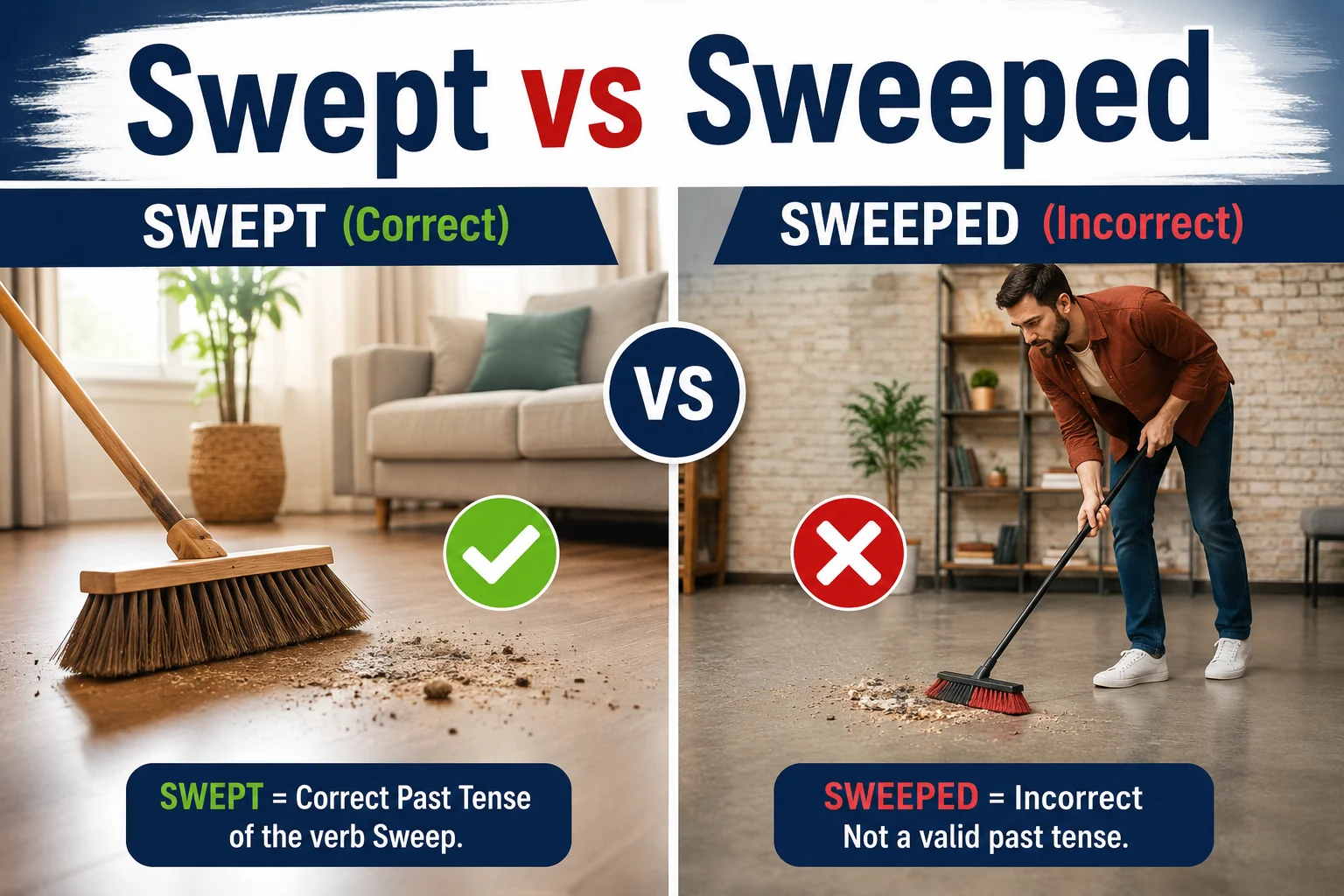
If you have ever wondered whether the correct past tense is “swept” or “sweeped,” you are not alone. At first glance, “sweeped” seems perfectly logical because many English verbs form their past tense by adding -ed. We say clean → cleaned, walk → walked, and jump → jumped. So it is easy to assume that sweep → sweeped should work too. However, English has many irregular verbs that do not follow this regular pattern. Sweep is one of them.
The correct past tense of sweep is “swept,” and “swept” is also its past participle. Whether you are talking about cleaning a floor, moving leaves, or describing something moving forcefully across an area, swept is the standard form. Learning this small irregular-verb pattern can help you avoid a common grammar mistake in everyday conversation, academic writing, emails, and professional English.
Quick Answer
Swept is the correct past tense and past participle of sweep. “Sweeped” is not the standard English form. Use sweep for the base/present form and swept for the simple past and past participle. For example: “I swept the floor yesterday” and “She has swept the kitchen.”
Why People Confuse It
The confusion comes from a very understandable English rule: many verbs form their past tense by adding -ed.
For example:
- clean → cleaned
- wash → washed
- open → opened
- work → worked
Because sweep ends in a familiar verb pattern, learners may naturally create sweeped. But sweep is an irregular verb, so its form changes instead:
sweep → swept → swept
Cambridge Dictionary lists swept as both the past tense and past participle of sweep.
So:
- ❌ I sweeped the floor.
- ✅ I swept the floor.
First Word: “Swept”
Swept is the correct word when you need the past tense or past participle of sweep.
As a verb, sweep can mean to clean something with a brush or broom. It can also mean to move something rapidly or forcefully in a particular direction.
Swept as the simple past
Use swept when an action happened in the past.
- I swept the floor yesterday.
- She swept the porch before dinner.
- They swept the leaves from the driveway.
Swept as a past participle
Use swept with auxiliary verbs such as have, has, had, and in passive constructions.
- I have swept the kitchen.
- She has swept the entire room.
- They had swept the floor before the guests arrived.
- The hallway was swept this morning.
Dictionaries confirm that swept functions as both the simple past and past participle of sweep.
Second Word: “Sweeped”
“Sweeped” is not the standard past-tense or past-participle form of sweep.
It may look grammatically reasonable because of the regular -ed pattern, but standard English uses swept instead.
For example:
- ❌ She sweeped the kitchen.
- ✅ She swept the kitchen.
- ❌ We have sweeped the garage.
- ✅ We have swept the garage.
The easiest solution is to memorize the three main forms:
sweep → swept → swept
Comparison Table
| Word/Form | Correct? | Use | Example |
| sweep | ✅ Yes | Base/present form | I sweep the floor daily. |
| sweeps | ✅ Yes | Third-person singular present | She sweeps the porch. |
| swept | ✅ Yes | Simple past | He swept the room. |
| swept | ✅ Yes | Past participle | She has swept the floor. |
| sweeping | ✅ Yes | Present participle/gerund | They are sweeping the street. |
| sweeped | ❌ No | Incorrect standard form | I sweeped the floor. |
The standard conjugation is sweep, swept, swept, sweeping.
When to Use Each
Use “sweep” for the present
Use sweep when discussing an action happening now in a general sense, a habit, or a routine.
- I sweep my room every Saturday.
- We sweep the shop every evening.
For third-person singular subjects, use sweeps:
- She sweeps the kitchen every morning.
- He sweeps the sidewalk before opening the store.
Use “swept” for the past
When the action has already happened, use swept.
- I swept the floor this morning.
- She swept the stairs yesterday.
- They swept the leaves away.
Use “swept” with have, has, or had
The past participle is also swept, not sweeped.
- I have swept the room.
- He has swept the patio.
- We had swept the floor before lunch.
Use “sweep” after “did”
This is another important grammar point.
After did, use the base form sweep, not swept.
- ✅ Did you sweep the floor?
- ❌ Did you swept the floor?
That is because did already carries the past-tense marking.
Examples: Swept vs Sweeped
Here are practical examples you can use as a reference:
- I swept the floor after breakfast. ✅
- She swept the kitchen before the guests arrived. ✅
- He swept the leaves from the garden. ✅
- We swept the porch yesterday. ✅
- They swept the classroom after school. ✅
- The janitor swept the hallway. ✅
- I have swept my bedroom already. ✅
- She has swept the entire house. ✅
- They had swept the sidewalk before it rained. ✅
- The wind swept the leaves across the road. ✅
- The storm swept across the region. ✅
- Did you sweep the garage? ✅
- I sweep the floor every evening. ✅
- She is sweeping the front steps. ✅
Notice that none of these sentences needs “sweeped.”
Common Mistakes
1. Using “sweeped” as the past tense
❌ I sweeped the floor yesterday.
✅ I swept the floor yesterday.
2. Using “sweeped” after “has”
❌ She has sweeped the kitchen.
✅ She has swept the kitchen.
3. Using “swept” after “did”
❌ Did you swept the floor?
✅ Did you sweep the floor?
4. Adding “-ed” to an irregular verb
The problem is usually not a lack of understanding. It is simply applying a regular-verb rule to an irregular verb.
Remember:
sweep + ed ≠ sweeped
Instead:
sweep → swept
5. Confusing “sweeping” with “swept”
- She is sweeping the floor. → action in progress
- She swept the floor. → completed past action
Memory Trick
Here is an easy way to remember it:
Think: “Keep, Sleep, Sweep”
These verbs have similar irregular patterns:
- keep → kept
- sleep → slept
- sweep → swept
You can also memorize this simple chain:
Sweep today → swept yesterday → swept already.
So:
- Today: I sweep.
- Yesterday: I swept.
- Already: I have swept.
If you remember sweep → swept, you will never need sweeped.
American vs British English
There is no meaningful American-versus-British difference here.
Both American and British English use:
sweep → swept → swept
Cambridge gives swept as the past tense and past participle, and Collins likewise identifies swept as the form used in both varieties.
So whether you are writing for an American or British audience, use:
- ✅ swept
- ❌ sweeped
Similar Words
If you are learning irregular verbs, sweep is useful to study alongside other verbs with similar-looking changes.
| Base Verb | Past | Past Participle |
| sweep | swept | swept |
| keep | kept | kept |
| sleep | slept | slept |
| weep | wept | wept |
| creep | crept | crept |
These patterns can make irregular verbs easier to memorize, although each verb still needs to be learned individually.
Also remember:
- sweep = clean or move across something
- sweeping = happening in progress
- swept = past/past participle
- sweeped = not the standard form
FAQs
Is “sweeped” a word?
“Sweeped” is not the standard past tense or past participle of sweep. In standard English, use swept.
What is the past tense of sweep?
The past tense of sweep is swept.
Example: I swept the floor yesterday.
What is the past participle of sweep?
The past participle is also swept.
Example: She has swept the kitchen.
Is it “I sweeped the floor” or “I swept the floor”?
The correct sentence is:
“I swept the floor.”
Sweeped is not the standard form.
Is it “Did you sweep” or “Did you swept”?
The correct form is:
“Did you sweep?”
After did, use the base verb.
Is “swept” used in American English?
Yes. Swept is the standard past and past participle form in American English.
What are the three forms of sweep?
The main forms are:
sweep – swept – swept
The present participle is sweeping.
Final Verdict
When choosing between swept vs sweeped, the answer is straightforward: swept is correct. Sweep is an irregular verb, so you cannot simply add -ed to form its past tense.
Use sweep for the base or present form, swept for the simple past, and swept again as the past participle. For example, say “I sweep the floor every day,” “I swept the floor yesterday,” and “I have swept the floor already.”
Once you memorize the pattern sweep → swept → swept, the confusion disappears. Whether you are speaking American English or British English, the standard form remains the same.
Remember This
Sweep → Swept → Swept
- Present: I sweep the floor.
- Past: I swept the floor.
- Perfect: I have swept the floor.
- Continuous: I am sweeping the floor.
- Never use “sweeped” as the standard past or past participle.
One-line rule: 👉 The past tense of “sweep” is “swept,” not “sweeped.”
Conclusion
The difference between swept and sweeped is really a lesson in irregular verbs. Although sweeped looks as though it follows the normal -ed rule, standard English uses swept for both the simple past and past participle. Dictionaries consistently identify swept as the correct form.
The best way to remember it is to practice the complete verb pattern: sweep, swept, swept, sweeping. Once that sequence becomes familiar, sentences such as “I swept the floor,” “She has swept the room,” and “The wind swept across the field” will sound natural and grammatically correct.

I’m Elliot Pierce, Administrator at Grammetics, dedicated to improving word matching and grammar. I help maintain useful content, support readers, and make language learning simple, clear, accurate, and engaging.