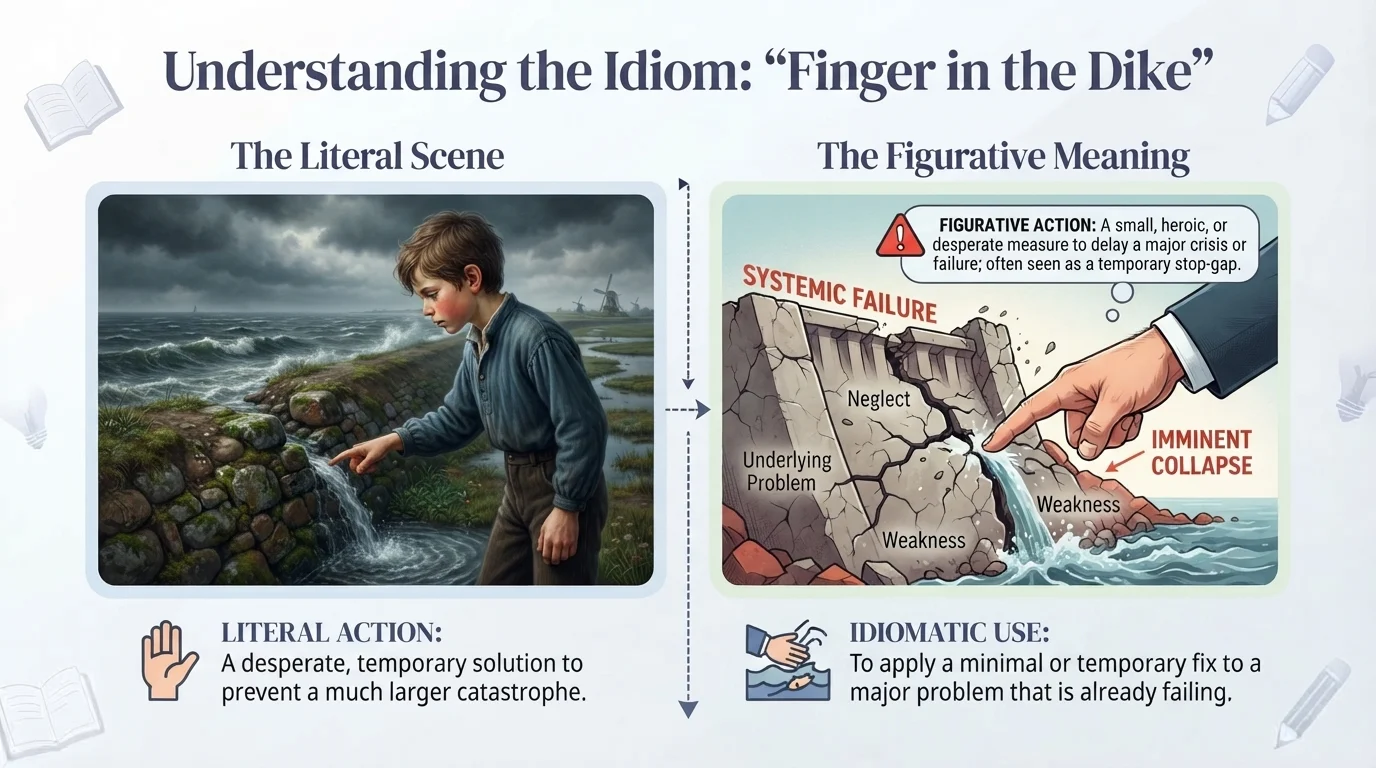
If you have heard someone say they are “putting a finger in the dike,” you may wonder what fingers, dikes, and emergencies have to do with each other. The phrase “finger in the dike” is an English idiom used to describe a temporary action that prevents a much bigger problem from happening. It often suggests that someone is trying to hold back trouble with a small or inadequate solution.
The expression comes from the image of a person using a finger to plug a hole in a dike or embankment and stop water from flooding through. Although a finger might slow the leak, it cannot provide a permanent solution. Today, the phrase is commonly used figuratively in conversations about work, business, politics, technology, finances, and everyday problems. Understanding the finger in the dike meaning can help you recognize when English speakers are describing a temporary fix rather than a complete solution.
Quick Answer
“Finger in the dike” means taking a small, temporary action to prevent a larger problem from getting worse. It comes from the image of plugging a leaking dike with a finger. The phrase often implies that a permanent solution is still needed.
Why People Confuse It
The phrase can be confusing because its literal meaning is very different from its figurative meaning.
A dike is a wall, embankment, or barrier designed to hold back water. If water starts breaking through a dike, someone might theoretically try to block the opening temporarily.
In everyday English, however, “putting a finger in the dike” usually has nothing to do with an actual flood.
Instead, it describes situations where:
- A small action prevents a larger problem.
- Someone is temporarily controlling a crisis.
- A solution is only a short-term fix.
- The underlying problem has not been solved.
- A person is trying to stop a situation from getting worse.
For example:
“Hiring another employee is just putting a finger in the dike. We need to fix the inefficient system.”
Here, hiring another employee may help temporarily, but the deeper organizational problem remains.
First Word: Finger
The word finger refers literally to one of the digits on a person’s hand.
In the idiom, however, the finger represents a small intervention. Imagine a tiny hole in a large barrier. Putting a finger over the hole may stop water from escaping, but it does not repair the barrier itself.
So, figuratively, a “finger” can represent:
- A quick intervention
- A temporary measure
- A limited resource
- A small attempt to control a problem
The important idea is the contrast between a small action and a large problem.
Second Word: Dike
A dike is a structure built to prevent water from flooding an area. The word can also be spelled dyke, particularly in British English and certain geographical contexts.
In the expression “finger in the dike,” the dike represents a larger system or situation that is under pressure.
For example:
“Replacing one broken machine is just a finger in the dike.”
The broken machine is only the visible problem. The company may actually have an outdated maintenance system causing repeated failures.
The dike, therefore, works as a metaphor for a problem that requires a more substantial solution.
Comparison Table
| Expression | Meaning | Typical Use | Example |
| Finger in the dike | Temporary action preventing a larger problem | Crisis management | “This repair is just a finger in the dike.” |
| Temporary fix | Short-term solution | Everyday problems | “The patch is only a temporary fix.” |
| Band-Aid solution | Quick solution that does not address the root cause | Work, health, systems | “That policy is a Band-Aid solution.” |
| Plug the hole | Stop an immediate problem | Business, finance, technical issues | “We need to plug the hole before losses increase.” |
| Address the root cause | Solve the underlying problem | Professional and formal contexts | “We need to address the root cause.” |
| Permanent solution | A lasting answer to a problem | General use | “We need a permanent solution.” |
When to Use “Finger in the Dike”
Use “finger in the dike” when you want to emphasize that an action is helping control a problem but is not solving the underlying issue.
At work
“Adding another customer-service agent is just a finger in the dike. We need to improve the software.”
In business
“The emergency loan is a finger in the dike while the company restructures its finances.”
In technology
“Restarting the server every morning is just putting a finger in the dike.”
In everyday conversation
“Cleaning the kitchen every hour feels like putting a finger in the dike with three children at home.”
The expression is especially useful when describing crisis management, recurring problems, temporary fixes, and unsustainable solutions.
Examples of “Finger in the Dike”
Here are more than ten natural examples showing how the phrase works in context:
- “Hiring temporary workers is just a finger in the dike.”
- “Replacing the damaged equipment is putting a finger in the dike instead of fixing the entire production line.”
- “The emergency funding is only a finger in the dike until the company changes its business model.”
- “Adding more servers may be a finger in the dike if the software itself is poorly designed.”
- “Taking painkillers may provide relief, but it can be a finger in the dike if the underlying problem is ignored.”
- “We keep repairing the old roof, but each repair feels like another finger in the dike.”
- “The manager’s decision solved today’s problem, but it was only a finger in the dike.”
- “Increasing the advertising budget is a finger in the dike if customers are leaving because of poor service.”
- “Putting another employee on the project is just a finger in the dike. The deadline itself needs to be reconsidered.”
- “The emergency measures were essentially fingers in the dike while officials searched for a long-term solution.”
- “Blocking individual spam accounts is like putting a finger in the dike when the entire system needs better security.”
- “We can keep fixing individual errors, but that is just putting a finger in the dike.”
- “The software patch is a useful temporary measure, but it is still a finger in the dike.”
- “Cutting expenses for one month may be a finger in the dike rather than a real financial strategy.”
Common Mistakes
1. Thinking it refers to an actual finger
The expression is normally figurative.
❌ “He literally put his finger in the dike at work.”
Unless someone is actually dealing with a physical water barrier, the phrase usually describes a temporary solution.
2. Assuming it means solving a problem
The idiom generally suggests the opposite.
It means controlling or delaying a problem, not necessarily eliminating it.
3. Using it for every small solution
A small solution is not automatically a “finger in the dike.”
The expression works best when there is a larger underlying problem that remains unresolved.
4. Forgetting the temporary nature
The key idea is that the action may prevent immediate damage, but a more comprehensive solution is needed.
5. Confusing “dike” with unrelated meanings
In this idiom, dike refers to a water-retaining embankment or barrier.
The meaning comes from the physical image of stopping water from breaking through.
Memory Trick
Think of this simple picture:
Big problem → tiny hole → finger blocks hole → problem temporarily controlled
That is the entire idea behind “finger in the dike.”
A finger can stop the leak for a moment, but it cannot rebuild the dike.
So remember:
Finger = small action
Dike = big problem/barrier
Finger in the dike = temporary control, not a permanent solution
American vs. British English
The idiom “finger in the dike” can be understood in both American and British English.
The main difference is the spelling of dike/dyke.
- American English: “dike” is commonly used for an embankment or flood barrier.
- British English: “dyke” is a common spelling for certain types of embankments or drainage structures, although “dike” also appears in some contexts.
The figurative meaning remains essentially the same: a temporary measure used to prevent a larger problem from becoming worse.
Because the phrase can sound somewhat old-fashioned or metaphorical, speakers may also choose more modern alternatives such as “temporary fix,” “Band-Aid solution,” or “plugging a hole.”
Similar Words and Expressions
Several English expressions communicate a similar idea.
Band-Aid solution
A Band-Aid solution is a quick fix that does not address the root cause.
“Reducing staff hours is just a Band-Aid solution.”
Temporary fix
This is a straightforward way to describe something that works only for a limited period.
“The technician provided a temporary fix.”
Plug the hole
This expression focuses on stopping an immediate source of loss or trouble.
“We need to plug the hole in the budget.”
Put out fires
Putting out fires means dealing with one urgent problem after another.
“I spend most of my day putting out fires instead of working on long-term projects.”
Treat the symptom
This means dealing with an obvious effect without addressing its underlying cause.
“The new rule treats the symptom rather than the cause.”
Address the root cause
This expression refers to dealing with the fundamental reason a problem exists.
“We need to address the root cause instead of repeatedly fixing the same issue.”
Final Verdict
The “finger in the dike” meaning is simple once you understand the image behind it. The expression describes a temporary action that holds back a larger problem without actually fixing the underlying cause.
It is useful when talking about business problems, technical issues, financial difficulties, workplace challenges, or any situation where repeated short-term fixes are being used instead of a lasting solution.
If you hear someone say, “That’s just putting a finger in the dike,” they are generally saying that the current action may help for now, but something more substantial needs to be done.
Frequently Asked Questions
What does “finger in the dike” mean?
“Finger in the dike” means taking a small or temporary action to prevent a larger problem from getting worse. It usually implies that the underlying issue still needs a permanent solution.
Is “finger in the dike” an idiom?
Yes. “Finger in the dike” is an English idiomatic expression. It uses the image of plugging a leak in a water barrier with a finger to describe temporary problem-solving.
What does “putting a finger in the dike” mean?
“Putting a finger in the dike” means trying to control an immediate problem with a temporary measure rather than solving the underlying cause.
Is “finger in the dike” negative?
It can have a critical or cautionary tone because it often suggests that a solution is inadequate or temporary. However, the expression can simply describe an emergency measure without necessarily criticizing the person using it.
What is another way to say “finger in the dike”?
Depending on the context, alternatives include “temporary fix,” “Band-Aid solution,” “plugging a hole,” “putting out fires,” and “treating the symptom rather than the cause.”
Where does “finger in the dike” come from?
The expression is based on the image of someone using a finger to plug a hole in a dike and prevent water from breaking through. The image became a metaphor for temporarily preventing a larger disaster.
Is it “finger in the dike” or “finger in the dyke”?
Both spellings can occur depending on the variety and context of English. “Dike” is common in American English, while “dyke” is also used in British English for certain embankments. The figurative meaning is the same.
Conclusion
The phrase “finger in the dike” describes a situation where someone takes a small, immediate action to hold back a much larger problem. Its imagery comes from a person attempting to stop water from passing through a damaged dike by blocking a hole. Because the finger does not repair the barrier, the expression naturally carries the idea of a temporary or incomplete solution.
In modern English, you can use the idiom when discussing workplace challenges, business difficulties, technology problems, financial pressure, or everyday situations where short-term fixes are replacing long-term solutions. Understanding this distinction will help you recognize the phrase in articles, conversations, and professional discussions.
Remember This
“Finger in the dike” = a temporary action that prevents a bigger problem but does not solve the root cause.
Think:
Tiny finger → big leak → temporary control → permanent repair still needed.

I’m Elliot Pierce, Administrator at Grammetics, dedicated to improving word matching and grammar. I help maintain useful content, support readers, and make language learning simple, clear, accurate, and engaging.