If you have ever hesitated between “separate” and “seperate,” you are not alone. These two spellings look almost identical, and the pronunciation of separate can make the correct spelling surprisingly difficult to remember. The good news is that there is a simple answer: separate is the correct spelling, while seperate is a common misspelling. Understanding why the mistake happens can help you avoid it in emails, essays, schoolwork, professional writing, and everyday communication.
The word separate can function as a verb, adjective, or noun depending on the sentence. It can describe things that are apart, the act of moving things apart, or a person or thing that is distinct from another. In this guide, we will compare separate vs seperate, explain their meanings, show correct examples, discuss pronunciation, and give you an easy memory trick. By the end, you should have no trouble choosing the correct spelling.
Quick Answer
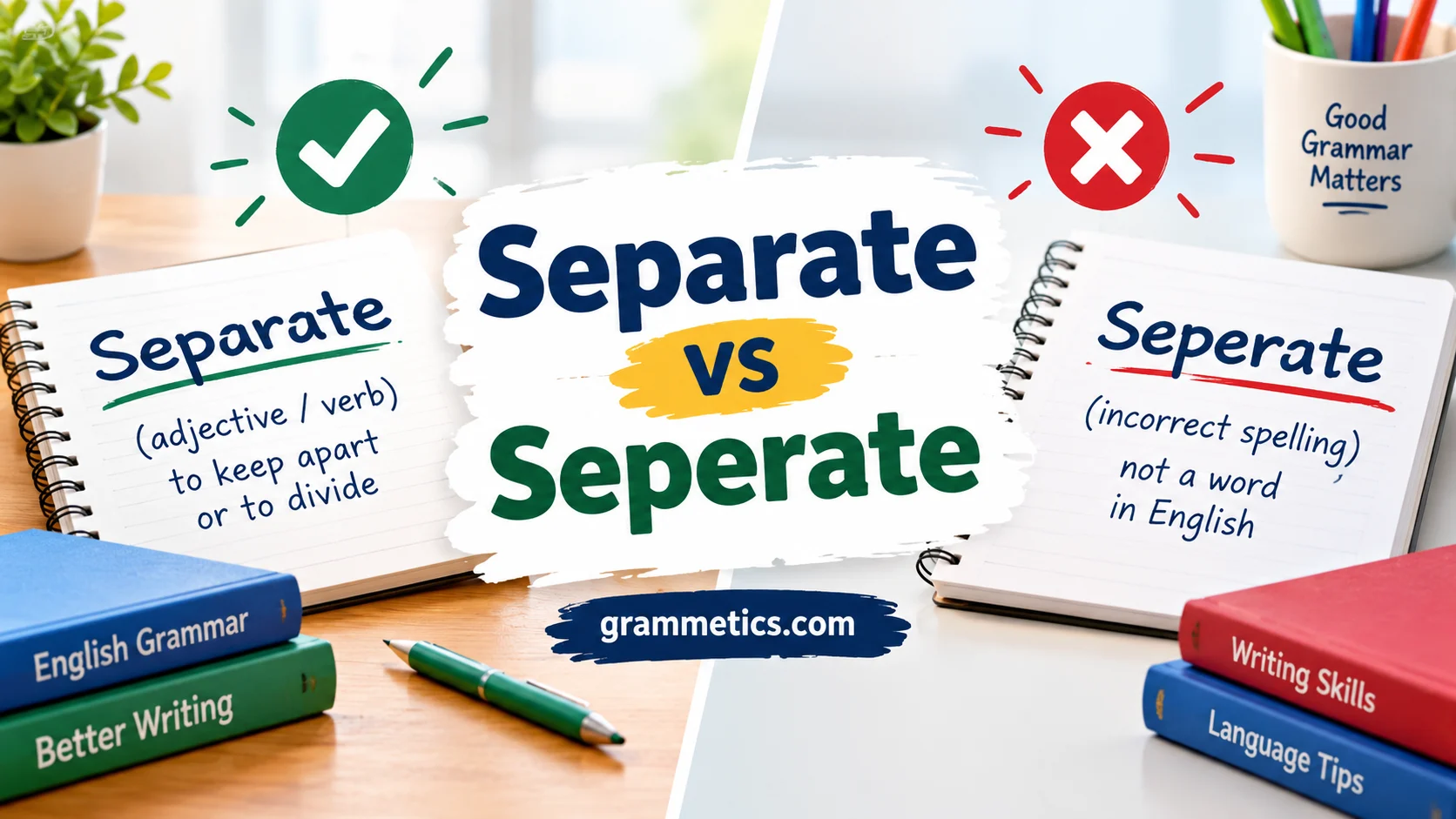
Separate is the correct spelling. Seperate is a misspelling and should not be used in standard English. A useful memory trick is to remember that “separate” contains “par”, just like two things can be separated by a partition.
Why People Confuse It
The confusion between separate and seperate is extremely common because the word is not spelled exactly the way many people expect it to sound.
When separate is pronounced as a verb, the middle vowel can sound weak or almost disappear in casual speech. This can lead writers to spell it as seperate.
Another reason is that English has many words where pronunciation does not clearly reveal spelling. Writers may remember the sound rather than the letters.
Common searches include:
- separate vs seperate
- is seperate a word?
- separate spelling
- correct spelling of separate
- separate meaning
- how to spell separate
- separate or seperate
The key point is simple: “seperate” is not the standard spelling of the word.
First Word: Separate
Separate is the correct English spelling.
It has several related meanings.
As an adjective
It means apart, distinct, or not joined together.
Example:
The two rooms have separate entrances.
As a verb
It means to move apart, divide, or cause things to become apart.
Example:
Please separate the white clothes from the colored clothes.
As a noun
In some contexts, particularly in fashion, a separate can refer to an individual garment that can be worn with other garments.
Example:
The store sells separates that can be mixed and matched.
Pronunciation
The pronunciation can vary depending on whether the word is used as an adjective/noun or verb.
- separate as an adjective: often pronounced approximately SEP-uh-rət
- separate as a verb: often pronounced approximately SEP-uh-rate
This difference in pronunciation is one reason people sometimes misspell the word.
Second Word: Seperate
Seperate is incorrect in standard English.
It is a common spelling mistake for separate.
You may see seperate in:
- Online comments
- Informal messages
- Student writing
- Social media posts
- Typographical errors
- Unedited websites
However, its appearance in these places does not make it a correct spelling.
Incorrect:
Please keep the documents seperate.
Correct:
Please keep the documents separate.
If you are writing something for school, work, a website, an application, or a formal document, always use separate.
Separate vs Seperate: Comparison Table
| Feature | Separate | Seperate |
| Correct spelling | ✅ Yes | ❌ No |
| Standard English | ✅ Yes | ❌ No |
| Meaning | Apart, distinct, or divide | No standard meaning |
| Part of speech | Adjective, verb, noun | Common misspelling |
| Example | Keep the files separate. | Keep the files seperate. ❌ |
| Recommended in formal writing | Yes | No |
When to Use Each
There is really only one spelling you should use in standard English: separate.
Use “separate” when:
- Two things are apart.
- You want to describe something as distinct.
- You want to divide things.
- You are describing independent items or groups.
- You are writing formally or professionally.
Examples:
We have separate accounts.
The teacher asked us to separate into groups.
These are two separate issues.
Do not use “seperate”
Use separate instead.
❌ The children sat at seperate tables.
✅ The children sat at separate tables.
❌ Please seperate the ingredients.
✅ Please separate the ingredients.
Examples of Separate in Sentences
Here are more examples showing how separate is correctly used:
- Please keep the two documents separate.
- The hotel has separate rooms for guests and staff.
- We need to separate the recyclable materials from the trash.
- They decided to live in separate apartments.
- These are two separate problems.
- The teacher asked the students to separate into smaller groups.
- The wall separates the kitchen from the dining room.
- She keeps her personal and professional lives separate.
- The company operates through several separate departments.
- The twins have separate bedrooms.
- Please place the clean clothes in a separate basket.
- The police separated the two groups after the argument.
- Each application must be submitted in a separate envelope.
- Their opinions are completely separate from the main issue.
- The road separates the two neighborhoods.
These examples demonstrate that separate can describe things that are distinct or describe the action of dividing them.
Common Mistakes
1. Writing “seperate”
This is the most common error.
❌ Seperate
✅ Separate
2. Forgetting the “a”
The correct spelling contains a after the p:
sep-a-rate
Not:
sep-e-rate
3. Trusting pronunciation
English spelling does not always follow pronunciation perfectly. Even if the middle vowel sounds like an unstressed “uh,” the spelling still contains a.
4. Assuming “seperate” is an alternative spelling
It is not a standard alternative spelling. It is simply a misspelling.
5. Using the wrong spelling in formal writing
A spelling error may look especially noticeable in professional documents, academic assignments, resumes, and published content.
Memory Trick: Separate Has “Par”
Here is an easy way to remember the spelling:
Separate has “par” in it.
Think:
SEP + A + RATE
Or remember:
There is a “PAR” in separate.
You can also connect par with the idea of two things being apart.
Separate → par → apart
Another useful visual is:
S E P A R A T E
Notice the A immediately after P.
If you remember that middle A, you are much less likely to write seperate.
American vs British English
There is no spelling difference between American and British English for this word.
Both varieties use:
separate
The incorrect spelling seperate should not be used as a standard spelling in either variety.
For example:
American English:
The students were placed in separate classrooms.
British English:
The students were placed in separate classrooms.
So, unlike words such as color/colour or center/centre, separate remains the same in American and British English.
Similar Words
Understanding related words can also make the meaning of separate easier to remember.
Separately
Separately is the adverb form.
The bills were paid separately.
Separation
Separation is the noun referring to the act or condition of being separated.
The separation of the two groups was necessary.
Separateness
Separateness refers to the state of being separate or distinct.
The design emphasizes the separateness of each section.
Separate
The base word can function as an adjective or verb.
The two teams have separate coaches.
Please separate the papers.
Apart
Apart is closely related in meaning to separate.
The two houses are several miles apart.
Remember that apart and separate are not interchangeable in every grammatical situation, even though their meanings can overlap.
Final Verdict
When choosing between separate vs seperate, the answer is straightforward:
Separate is correct.
Seperate is a misspelling.
Use separate when you mean “apart,” “distinct,” or “to divide.” Whether you are writing an academic assignment, business email, website article, or casual message, separate is the spelling you want.
The easiest way to remember it is to focus on the a in the middle:
sep-a-rate
Once you train yourself to notice that letter, the common seperate mistake becomes much easier to avoid.
FAQs
Is “seperate” a correct word?
No. Seperate is a common misspelling of separate and is not the standard spelling in English.
What is the correct spelling: separate or seperate?
The correct spelling is separate.
✅ separate
❌ seperate
Why do people spell separate as “seperate”?
The mistake often happens because the pronunciation of separate can make the middle vowel sound less distinct. People may spell the word based on how they hear it.
How do you remember the spelling of separate?
Remember that separate contains an “a” after “p”. You can think of “par” inside separate as a memory clue.
What does separate mean?
Separate can mean apart or distinct. As a verb, it can mean to divide or move things apart.
Is “separate” the same in American and British English?
Yes. Separate is spelled the same in both American and British English.
Is “seperate” a typo?
Yes. In standard English, seperate is generally a spelling error for separate.
Conclusion
The difference between separate and seperate is not a difference in meaning. It is a difference between the correct spelling and a common spelling mistake. Separate is the standard English word and can mean apart, distinct, or to divide. Seperate should be avoided in formal and standard writing.
If you often make this mistake, remember the simple pattern sep-a-rate or the memory clue “separate has an A.” A small spelling detail can make a big difference in polished English writing, especially in academic, professional, and online content.
Remember This
Separate = correct ✅
Seperate = incorrect ❌
Memory trick: Separate has an “A” after “P” — sep-A-rate.

I’m Micah Wheeler, a passionate author who enjoys exploring matching words, grammar, and language. I create clear, helpful content to make word choices and grammar easier for everyone.