When talking about yourself and your father, you may wonder whether the correct phrase is “my father and I” or “my father and me.” Both phrases can be correct, but they are used in different grammatical situations. The key is to understand whether the phrase is functioning as the subject or the object of a sentence. This simple distinction makes it much easier to choose the right pronoun.
The confusion often comes from the common habit of putting another person before yourself, which can make it difficult to decide between I and me. You may hear both forms in everyday conversation, but formal and standard English follows a clear grammatical rule. In this guide, we will explain my father and I vs. my father and me, show when each expression is appropriate, provide practical examples, and share an easy memory trick. By the end, you will know exactly when to use each phrase.
Quick Answer
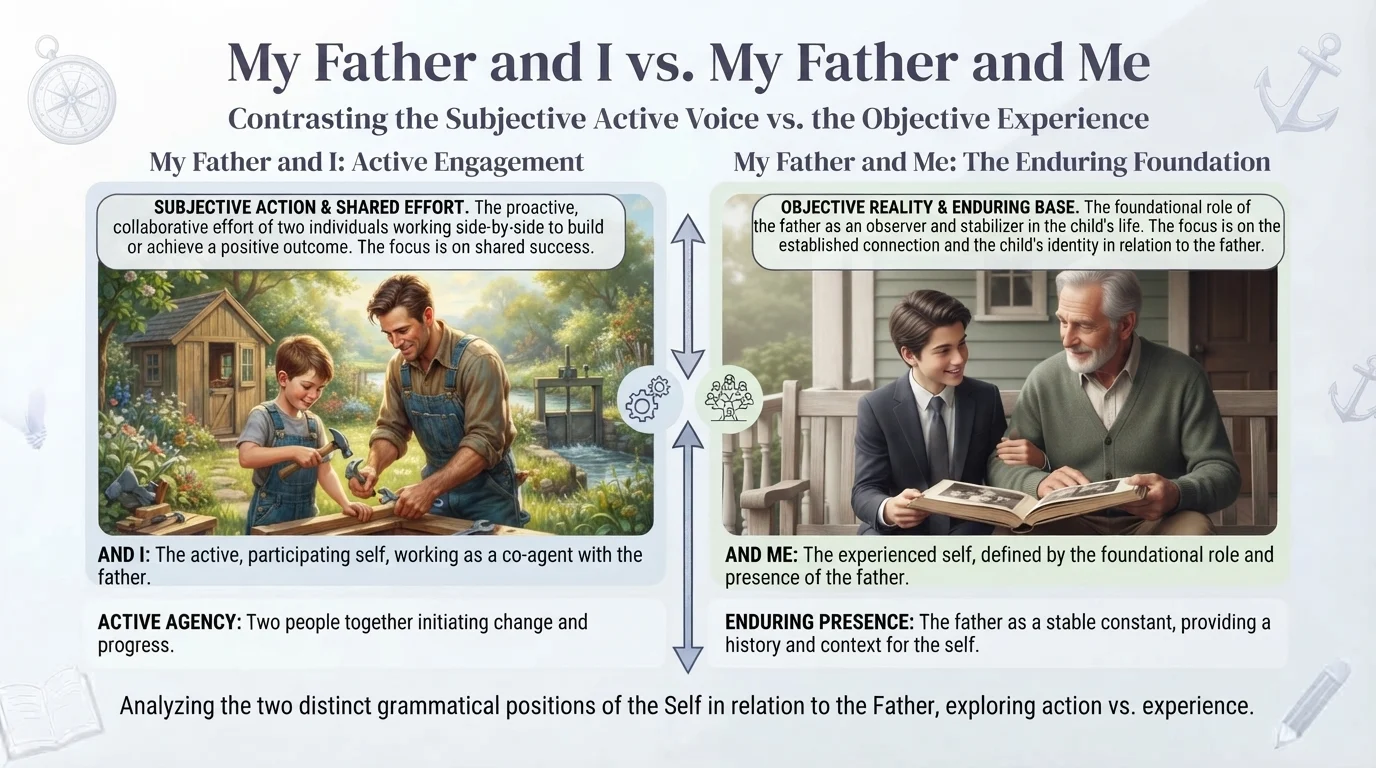
“My father and I” is used when the phrase is the subject performing an action. “My father and me” is used when the phrase is the object receiving an action or following a preposition. The correct choice depends on the sentence, not on the phrase itself.
Why People Confuse It
The confusion usually happens because I and me both refer to the speaker, but they have different grammatical roles.
- I is a subject pronoun.
- Me is an object pronoun.
Adding “my father” makes the sentence slightly harder to analyze. For example:
- My father and I went shopping. ✅
- The teacher spoke to my father and me. ✅
A useful test is to temporarily remove “my father and.”
Compare:
My father and I went home.
I went home. ✅
But:
The teacher called my father and me.
The teacher called me. ✅
This quick test can help you identify the correct pronoun.
First Word: My Father and I
“My father and I” is correct when the phrase acts as the subject of a sentence.
The subject is the person or people performing the action.
Examples
- My father and I went to the market.
- My father and I enjoy watching football.
- My father and I are planning a trip.
- My father and I visited the museum yesterday.
- My father and I worked on the project together.
In each sentence, “my father and I” are doing something.
You can remove “my father and” to check the grammar:
My father and I visited the museum.
I visited the museum. ✅
Therefore, “my father and I” is appropriate.
Second Word: My Father and Me
“My father and me” is correct when the phrase functions as an object.
An object receives an action or follows a preposition.
Examples
- The teacher called my father and me.
- She invited my father and me to dinner.
- The gift was for my father and me.
- The doctor spoke with my father and me.
- They asked my father and me several questions.
Try removing “my father and”:
The teacher called my father and me.
The teacher called me. ✅
So “my father and me” is grammatically correct in this situation.
Comparison Table
| Phrase | Grammatical Role | When to Use | Example |
| My father and I | Subject | When performing the action | My father and I went home. |
| My father and me | Object | When receiving the action | She invited my father and me. |
| My father and I | Subject | Before a verb | My father and I work together. |
| My father and me | Object | After a preposition | This letter is for my father and me. |
The important point is that neither phrase is always correct or always incorrect. The sentence determines which form you need.
When to Use Each
Use “My Father and I” When:
Use my father and I when you and your father are the subjects.
Common patterns include:
- My father and I went…
- My father and I are…
- My father and I visited…
- My father and I decided…
- My father and I enjoy…
For example:
My father and I are going to the store.
Here, “my father and I” are performing the action of going.
Use “My Father and Me” When:
Use my father and me when you and your father are objects.
It commonly appears:
- After verbs such as called, invited, helped, asked, saw
- After prepositions such as for, with, to, between, from
For example:
The manager spoke to my father and me.
Here, “my father and me” follow the preposition to, so me is correct.
Examples of My Father and I vs. My Father and Me
Here are more examples to make the difference clear:
- My father and I went fishing. ✅
We performed the action. - The coach congratulated my father and me. ✅
We received the action. - My father and I watched the movie together. ✅
- She invited my father and me to her wedding. ✅
- My father and I bought a new car. ✅
- The teacher spoke with my father and me. ✅
- My father and I enjoyed the vacation. ✅
- They gave my father and me some useful advice. ✅
- My father and I discussed the problem. ✅
- The gift was intended for my father and me. ✅
- My father and I visited our relatives. ✅
- The doctor talked to my father and me. ✅
- My father and I cooked dinner together. ✅
- Nobody asked my father and me about the incident. ✅
- My father and I were waiting outside. ✅
Common Mistakes
Mistake 1: Always Using “I”
Some people think I sounds more formal, so they use it everywhere.
Incorrect:
The teacher spoke to my father and I. ❌
Correct:
The teacher spoke to my father and me. ✅
The phrase follows the preposition to, so me is needed.
Mistake 2: Always Using “Me”
The opposite mistake is using me whenever another person is mentioned.
Incorrect:
My father and me went shopping. ❌
Correct:
My father and I went shopping. ✅
Here, the phrase is the subject of went.
Mistake 3: Thinking “My Father and I” Is Always More Polite
Putting the other person first is a common courtesy in English, but it does not determine the pronoun.
You still need to ask whether the phrase is a subject or an object.
Mistake 4: Ignoring the Verb or Preposition
Instead of memorizing the entire phrase, look at what comes before or after it.
Ask:
Who is doing the action?
Use I.
Who is receiving the action or following a preposition?
Use me.
Memory Trick
The easiest trick is to remove “my father and.”
If the remaining sentence sounds correct with I, use my father and I.
My father and I went home.
I went home. ✅
If it sounds correct with me, use my father and me.
The teacher called my father and me.
The teacher called me. ✅
Simple Rule
I = doer
Me = receiver
Or remember:
I do. Me receives.
This works for many similar pronoun questions, not just my father and I vs. my father and me.
American vs. British English
The basic grammatical distinction between I and me is the same in both American and British English.
Both varieties use:
My father and I went home.
And:
The teacher spoke to my father and me.
Informal speech can sometimes produce nonstandard constructions in either variety, but standard written English generally follows the subject/object distinction.
Therefore, you do not need a different rule for American English and British English. The grammatical function of the pronoun remains the key factor.
Similar Words
The same principle applies to many other pronoun combinations.
My Mother and I vs. My Mother and Me
- My mother and I went shopping.
- She invited my mother and me.
My Brother and I vs. My Brother and Me
- My brother and I played football.
- The coach spoke to my brother and me.
My Sister and I vs. My Sister and Me
- My sister and I traveled together.
- They gave my sister and me tickets.
John and I vs. John and Me
- John and I finished the work.
- The manager called John and me.
The rule stays the same: I is generally used for subjects, while me is used for objects.
Final Verdict
Both “my father and I” and “my father and me” are correct English phrases. The difference is their grammatical function.
Use “my father and I” when you and your father are the subjects performing an action:
My father and I went to the store.
Use “my father and me” when you and your father are objects or follow a preposition:
She spoke to my father and me.
So, instead of asking which phrase is always correct, look at the complete sentence. The simple “remove the other person” test will usually reveal whether you need I or me.
FAQs
Is “my father and I” always correct?
No. “My father and I” is correct when the phrase functions as the subject. If the phrase is an object, “my father and me” is usually correct.
Is “my father and me” grammatically correct?
Yes. “My father and me” is grammatically correct when the phrase functions as an object or follows a preposition.
Which is correct: “my father and I went” or “my father and me went”?
“My father and I went” is correct because the phrase is the subject performing the action.
Which is correct: “between my father and I” or “between my father and me”?
In standard English, “between my father and me” is correct because between is a preposition and requires an object pronoun.
Should I say “my father and I” in formal writing?
Use “my father and I” when the phrase is the subject. Formal writing does not make I correct when the grammatical role requires me.
How can I quickly remember the difference?
Remove “my father and.” If I works in the remaining sentence, use my father and I. If me works, use my father and me.
Is “my father and me” acceptable in conversation?
Yes, when it is grammatically functioning as an object. For example, “She invited my father and me” is standard English.
Conclusion
The difference between my father and I vs. my father and me becomes simple once you focus on grammatical function. I is a subject pronoun, while me is an object pronoun. The presence of “my father” does not change this basic rule. Whether you are writing an email, completing an assignment, or speaking in everyday English, examine the role of the phrase in the sentence.
When you are unsure, use the removal test: take away “my father and” and see whether I or me fits naturally. If “I went” works, choose “my father and I.” If “she called me” works, choose “my father and me.” This simple habit will help you use both phrases accurately and confidently.
Remember This
My father and I = subject/doer
My father and I went to the park.
My father and me = object/receiver
They invited my father and me.
Quick test: Remove “my father and” and check whether I or me remains correct.

I’m Micah Wheeler, a passionate author who enjoys exploring matching words, grammar, and language. I create clear, helpful content to make word choices and grammar easier for everyone.