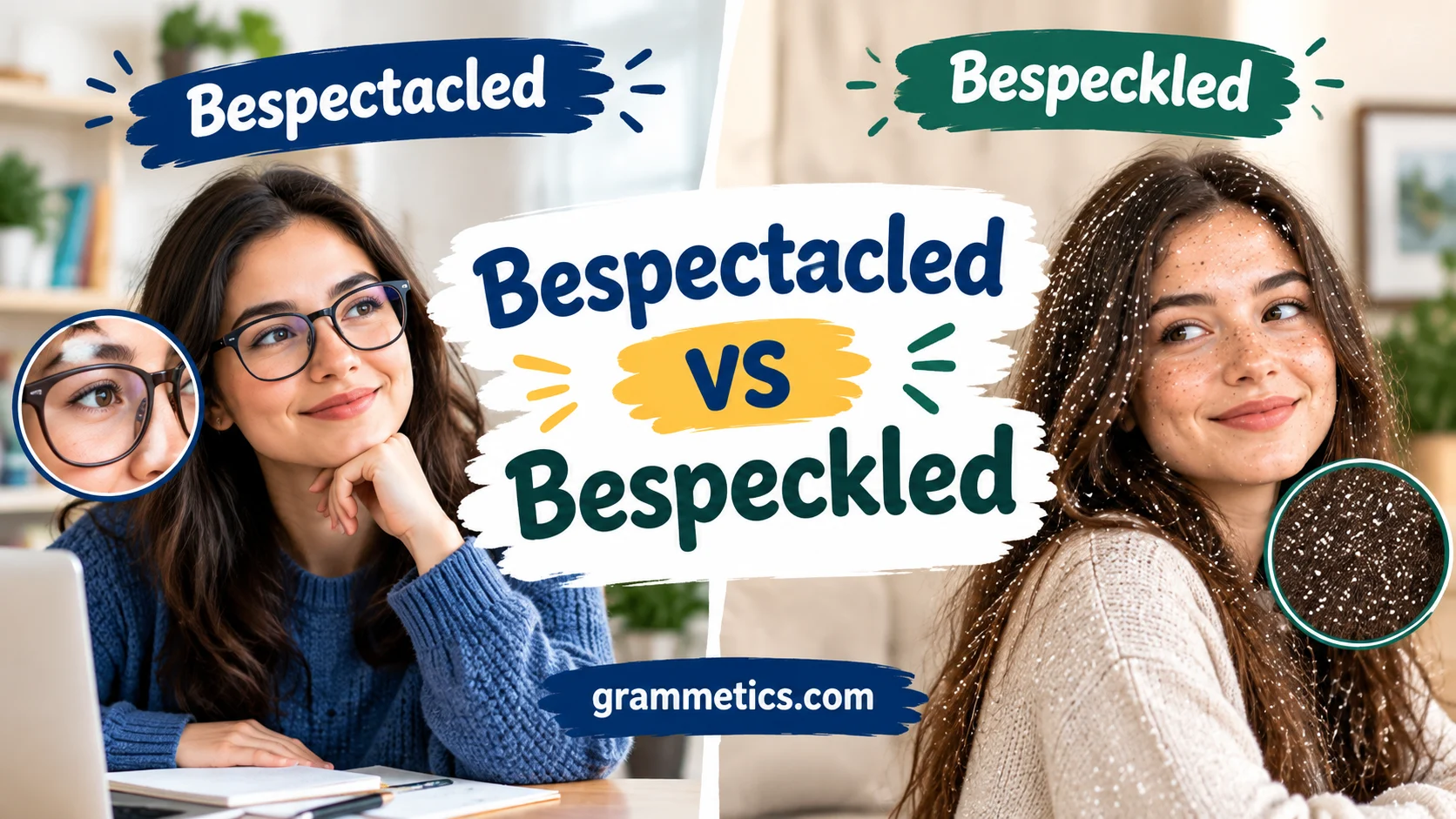
Bespectacled vs bespeckled can be confusing because the two words look and sound remarkably similar. However, they describe completely different things. Bespectacled refers to a person who is wearing glasses, while bespeckled means covered or marked with small spots, dots, or specks. Knowing the difference helps you choose the right word when describing someone’s appearance, a surface, or an object.
Although both words are legitimate English adjectives, they come from different roots and have different meanings. Bespectacled is connected to spectacles, an older word for eyeglasses. Bespeckled, on the other hand, comes from speck, meaning a tiny spot or mark. In this guide, you’ll learn their definitions, pronunciation, examples, common mistakes, usage differences, and a simple memory trick to keep them straight.
Quick Answer
Bespectacled means wearing glasses, usually describing a person. Bespeckled means covered or marked with small spots or specks and can describe people, animals, objects, or surfaces. They sound similar but have completely different meanings.
Why People Confuse It
The confusion between bespectacled and bespeckled mainly comes from their similar spelling and pronunciation.
Both words begin with “bes-” and contain similar-looking letters:
- bespectacled
- bespeckled
However, their roots provide an easy way to distinguish them:
- Bespectacled → spectacles → glasses
- Bespeckled → speck → small spot
For example:
The bespectacled professor entered the classroom.
Here, bespectacled tells us that the professor was wearing glasses.
Compare that with:
The old wall was bespeckled with dark stains.
Here, bespeckled means the wall had many small spots or marks.
Bespectacled
Bespectacled is an adjective meaning wearing spectacles or eyeglasses.
It is most commonly used to describe a person.
Definition
Bespectacled = wearing glasses
The word comes from spectacles, a traditional term for eyeglasses.
Examples
- The bespectacled teacher explained the lesson clearly.
- A bespectacled man was sitting near the window.
- The novel features a young bespectacled detective.
- The bespectacled student raised his hand.
- She noticed a bespectacled woman waiting outside.
The word can sometimes have a descriptive or literary tone. In everyday conversation, people are more likely to say “wearing glasses.”
Sentence Pattern
You can use it before a noun:
A bespectacled scientist gave the presentation.
You can also use it after a linking verb:
The scientist was bespectacled.
The first pattern is much more natural in ordinary descriptive writing.
Bespeckled
Bespeckled means covered or marked with many small spots, dots, or specks.
It can describe people, animals, clothing, walls, paper, leaves, surfaces, and many other things.
Definition
Bespeckled = marked or covered with small spots or specks
For example:
His shirt was bespeckled with paint.
This means the shirt had many small spots of paint on it.
Examples
- The artist’s hands were bespeckled with paint.
- The old book was bespeckled with brown stains.
- Her face was bespeckled with freckles.
- The leaves were bespeckled with tiny droplets.
- The white wall became bespeckled with mud.
Unlike bespectacled, this word has nothing to do with glasses.
Comparison Table
| Word | Meaning | Root Word | Usually Describes | Example |
| Bespectacled | Wearing glasses | Spectacles | People | The bespectacled man smiled. |
| Bespeckled | Covered with small spots | Speck | People, objects, surfaces | The wall was bespeckled with stains. |
The simplest distinction is:
Bespectacled = glasses
Bespeckled = spots
When to Use Each
Use bespectacled when you want to describe someone who is wearing glasses.
The bespectacled librarian helped me find the book.
Use bespeckled when something has numerous small spots or specks.
The painter’s apron was bespeckled with blue paint.
Choose “bespectacled” when:
- Someone is wearing eyeglasses.
- You are describing a person visually.
- You are writing descriptive or formal prose.
- You want a concise alternative to “wearing glasses.”
Choose “bespeckled” when:
- Something has small spots.
- A surface is marked with tiny dots.
- An object is splattered or dotted with something.
- You are describing freckles, stains, paint, dust, or similar marks.
Examples: Bespectacled vs Bespeckled
Here are more examples to make the distinction clear.
- The bespectacled professor entered the lecture hall.
→ He was wearing glasses. - The professor’s jacket was bespeckled with chalk dust.
→ His jacket had many small spots of chalk dust. - A bespectacled woman answered the telephone.
→ She was wearing glasses. - The mirror was bespeckled with water droplets.
→ The mirror had many small water spots. - The bespectacled boy was reading a novel.
→ The boy was wearing glasses. - The bird’s feathers were bespeckled with white markings.
→ The feathers had small spots or marks. - The bespectacled scientist examined the sample.
→ The scientist wore glasses. - The old manuscript was bespeckled with ink stains.
→ The manuscript contained many small ink marks. - The bespectacled detective questioned the witness.
→ The detective was wearing glasses. - The gardener’s boots were bespeckled with mud.
→ The boots had small spots of mud. - The bespectacled student stood near the door.
→ The student wore glasses. - The pale wall was bespeckled with tiny black marks.
→ The wall was covered with small spots.
Common Mistakes
1. Using “bespeckled” for glasses
Incorrect:
The bespeckled man was reading a newspaper.
This sentence could mean the man was covered with small spots, not that he wore glasses.
Better:
The bespectacled man was reading a newspaper.
2. Using “bespectacled” for spotted surfaces
Incorrect:
The wall was bespectacled with stains.
Better:
The wall was bespeckled with stains.
3. Confusing “spectacles” with “specks”
Remember that spectacles are glasses, while specks are tiny spots.
4. Assuming the words are interchangeable
They are not interchangeable. Changing one word for the other can completely change the meaning of a sentence.
Memory Trick
Use this simple trick:
SPEC → SPECTACLES → GLASSES
So:
Bespectacled = wearing glasses
And:
SPECK → SPOT
So:
Bespeckled = covered with spots
Think:
Spectacles = bespectacled
Specks = bespeckled
This connection makes the difference much easier to remember.
American vs British English
Both bespectacled and bespeckled are understood in both American and British English.
The main difference is not American versus British usage but style and frequency.
In everyday American and British conversation, people commonly say:
He is wearing glasses.
rather than:
He is bespectacled.
Bespectacled is more likely to appear in descriptive, literary, journalistic, or formal writing.
Similarly, bespeckled is a standard adjective in both varieties of English, although simpler expressions such as covered with spots or spotted may be more common in casual speech.
Similar Words
Several words are related to these terms but have different meanings.
Spectacled
Spectacled means wearing spectacles or glasses.
The spectacled scientist addressed the audience.
Spotted
Spotted means having spots or marks.
The spotted dog ran across the yard.
Speckled
Speckled means marked with numerous small spots.
The eggs had speckled shells.
Flecked
Flecked means marked with small patches or spots.
Her hair was flecked with gray.
Dappled
Dappled describes something marked with irregular patches or spots of color or light.
Sunlight fell across the dappled grass.
Final Verdict
Bespectacled and bespeckled are not synonyms.
Use bespectacled when referring to someone wearing glasses. Use bespeckled when something is covered or marked with small spots or specks.
A quick way to remember the difference is to look at the middle of each word:
- Bespectacled → spectacles → glasses
- Bespeckled → specks → spots
Once you connect each adjective with its root word, the spelling and meaning become much easier to remember.
Frequently Asked Questions
Is “bespectacled” a correct word?
Yes. Bespectacled is a standard English adjective meaning wearing glasses or spectacles.
What does “bespeckled” mean?
Bespeckled means covered or marked with numerous small spots, specks, or tiny marks.
Is bespectacled the same as bespeckled?
No. Bespectacled refers to wearing glasses, while bespeckled refers to being marked with small spots or specks.
What is the difference between bespectacled and spectacled?
Both can mean wearing glasses, but bespectacled is often used as a descriptive adjective for a person, while spectacled can be used more directly in similar contexts.
Can a person be bespeckled?
Yes. A person can be bespeckled if their skin, clothing, or another visible part of them is covered with small spots or marks.
Is “bespeckled” the same as “speckled”?
They are very close in meaning. Speckled means marked with small spots, while bespeckled emphasizes the condition of being covered or marked with such spots.
Which word should I use for someone wearing glasses?
Use bespectacled.
The bespectacled man was waiting outside.
Conclusion
Understanding bespectacled vs bespeckled becomes simple once you focus on their roots. Bespectacled comes from spectacles and describes someone wearing glasses. Bespeckled comes from speck and describes something marked with small spots or specks. Although the words look and sound similar, their meanings are clearly different.
When proofreading your writing, ask yourself what you are describing. If the answer involves glasses, choose bespectacled. If it involves small spots, stains, dots, or marks, choose bespeckled. This quick distinction will help you use both adjectives accurately and naturally.
Remember This
Bespectacled = spectacles = glasses 👓
Bespeckled = specks = spots •

I’m Micah Wheeler, a passionate author who enjoys exploring matching words, grammar, and language. I create clear, helpful content to make word choices and grammar easier for everyone.