Have you ever wondered whether the correct spelling is embed or imbed? Both words exist in English, and both can mean to insert, fix, or incorporate something firmly into another thing. However, one spelling is much more common in modern writing, especially in technology, education, journalism, and digital content. Choosing the right form can help you communicate clearly and make your writing look more professional.
The confusion between embed and imbed often arises because the words share the same meaning and pronunciation. You might encounter both spellings in dictionaries, books, or online articles, leaving you unsure which one to use. Fortunately, the distinction is simple: embed is the standard and widely preferred spelling, while imbed is a less common variant. In this guide, you will learn the meaning of each word, explore their differences, review practical sentence examples, and discover how to choose the most appropriate spelling for your writing.
Quick Answer
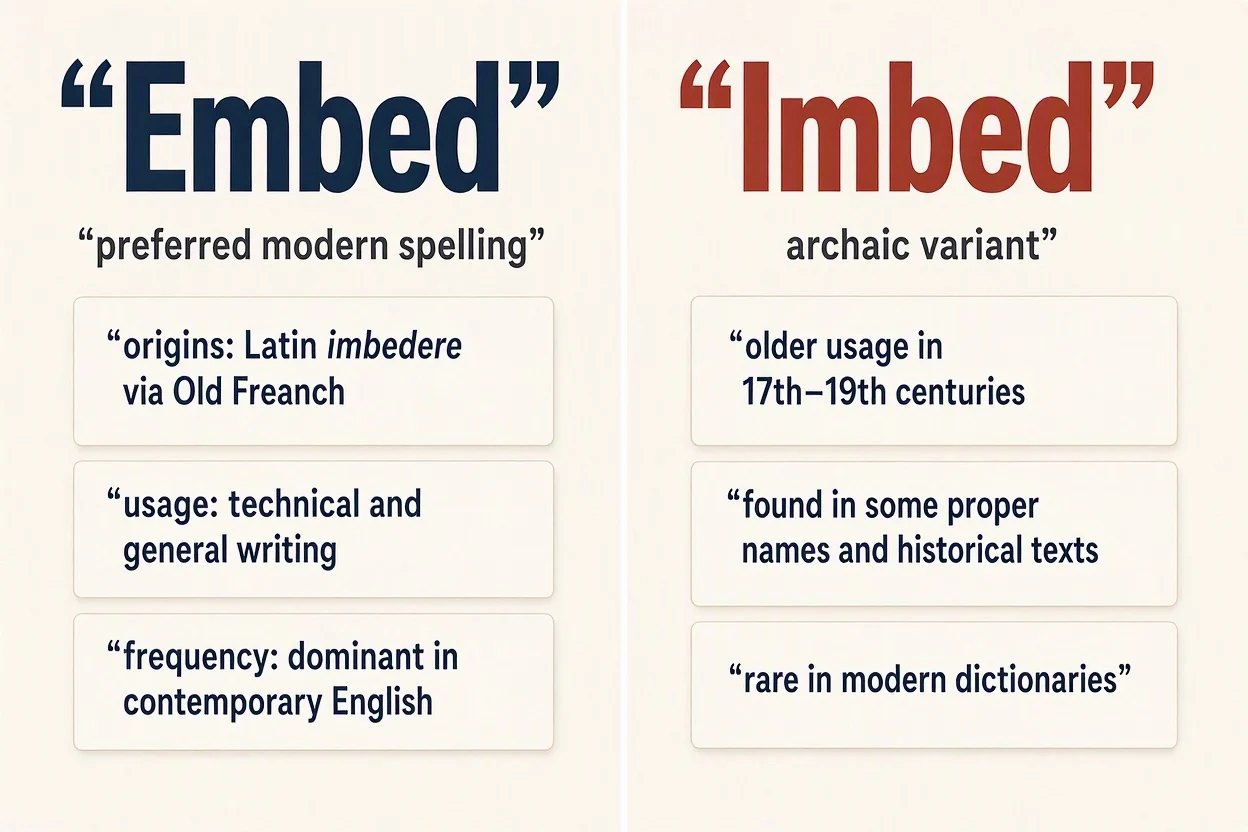
Embed and imbed are both accepted English spellings with essentially the same meaning: to insert or fix something firmly within another thing. However, embed is far more common and is the preferred choice in modern English, especially in technology and professional writing. Use embed unless you have a specific reason to choose imbed.
Why People Confuse It
The confusion between embed and imbed comes from their nearly identical pronunciation and meaning. Both spellings have appeared in English usage, so neither is simply a random misspelling.
The difference is mainly one of spelling preference and frequency rather than meaning.
Here are the key points to remember:
- Embed: The standard, widely preferred spelling.
- Imbed: A legitimate but less common variant.
- Meaning: Both can describe placing something firmly inside another object or incorporating material into a larger work.
- Pronunciation: Both are generally pronounced the same way.
- Professional writing: Embed is usually the safer choice.
For example, a website editor might write, “Embed the video in your article.” A scientist might describe a small object as being embedded in a material. In both cases, embed is the natural modern choice.
First Word: Embed
Embed is a verb meaning to fix something firmly within another object, insert content into a larger structure, or incorporate something as an integral part of something else.
It is commonly used in everyday English, academic writing, journalism, and technology.
Common meanings of embed
1. To place something firmly inside another object
Example: The mechanic found a small piece of metal embedded in the tire.
2. To insert digital content into a webpage
Example: You can embed a YouTube video in your blog post.
3. To incorporate an idea or quality into something
Example: The company aims to embed honesty into its workplace culture.
4. To include information within a larger document or system
Example: The developer embedded the necessary code into the application.
Forms of “Embed”
Embed is a regular verb, but its spelling changes slightly in certain forms.
- Base form: embed
- Third-person singular: embeds
- Present participle: embedding
- Simple past: embedded
- Past participle: embedded
Examples:
- We embed videos in our online lessons.
- She embeds helpful links in her articles.
- The engineer is embedding a sensor in the device.
- The journalist embedded the quotation in the report.
- The new policy is embedded in the company’s procedures.
Notice that the final consonant is doubled in embedded and embedding.
Second Word: Imbed
Imbed is an alternative spelling of embed. It has essentially the same meaning: to insert, fix, or incorporate something into another thing.
Although imbed is recognized in English, it is considerably less common in contemporary usage.
Common meanings of imbed
Like embed, imbed can refer to placing a physical object inside a material or incorporating something into a larger structure.
Examples:
- The doctor removed a splinter imbedded in the patient’s skin.
- The technician imbeded the component in the protective material.
The second example contains an incorrect form. The correct past-tense spelling is imbedded, not imbeded.
More correct examples include:
- The object was imbedded in the soft clay.
- The researcher imbedded the sample in a supporting material.
- The idea became imbedded in the team’s working culture.
These sentences are understandable, but modern writers generally prefer embedded and embed.
Is “Imbed” Incorrect?
No. Imbed is a recognized variant spelling, not necessarily a spelling mistake. Nevertheless, its lower frequency makes embed the better choice in most situations.
If you are writing an article, academic paper, website, business document, or technical guide, using embed will generally align better with contemporary usage.
Comparison Table
| Feature | Embed | Imbed |
| Meaning | Insert or fix firmly within something | Insert or fix firmly within something |
| Spelling status | Standard, preferred spelling | Accepted variant |
| Modern usage | Very common | Much less common |
| Pronunciation | Essentially the same | Essentially the same |
| Technology writing | Preferred | Uncommon |
| Formal writing | Recommended | Usually unnecessary |
| Past tense | Embedded | Imbedded |
| Best choice for most writers | Yes | Only when specifically preferred |
When to Use Each
Choosing between embed and imbed is straightforward once you consider your audience and purpose.
When to Use “Embed”
Use embed in almost all modern writing situations.
Choose it when:
- Writing blog posts or SEO articles.
- Adding videos, maps, or social media posts to webpages.
- Describing an object fixed inside another material.
- Explaining how an idea becomes part of a culture or system.
- Preparing professional, academic, or technical documents.
Examples:
- Embed the video below the introduction.
- The builder embedded steel rods in the concrete.
- Teachers should embed critical-thinking exercises into their lessons.
- The website allows users to embed interactive charts.
When to Use “Imbed”
Use imbed only when a particular publication, organization, or established writing convention specifically prefers that spelling.
It may also appear in older texts or quotations. If you are reproducing a historical passage, preserve the original spelling when appropriate.
Example:
An older document might say, “The craftsman chose to imbed the decorative stones in the wall.”
In contemporary writing, you would normally write:
“The craftsman chose to embed the decorative stones in the wall.”
The meaning remains unchanged.
Examples: Embed vs Imbed in Sentences
The following examples demonstrate how both spellings can be used.
- The editor decided to embed a video in the article.
- The small stone was embedded in the muddy ground.
- Teachers can embed quizzes into online lessons.
- The designer embedded the logo into the website header.
- The company wants to embed ethical practices into its daily operations.
- A tiny fragment was imbedded in the wooden surface.
- The developer is embedding a map into the homepage.
- The scientist found an object embedded in the rock.
- The report embeds important statistics within its analysis.
- The historical document used the spelling imbedded.
- The application lets users embed audio recordings.
- Strong habits can become embedded through repeated practice.
- The journalist embedded a quotation in the final paragraph.
- The technician planned to imbed the component inside the casing.
- Modern software makes it easier to embed interactive features in websites.
In most of these examples, embed and its related forms are the more natural choices for contemporary English.
Common Mistakes
1. Assuming “Imbed” Is Always a Spelling Error
Imbed is a recognized variant. Calling it universally incorrect overlooks established English usage.
However, because embed is much more common, it is usually the better option.
2. Using “Embeded” Instead of “Embedded”
This is a genuine spelling mistake.
Incorrect: The video was embeded in the article.
Correct: The video was embedded in the article.
When adding -ed to embed, double the final d.
3. Writing “Embeding” Instead of “Embedding”
The correct spelling doubles the final consonant before adding -ing.
Incorrect: The developer is embeding the video.
Correct: The developer is embedding the video.
4. Thinking the Words Have Different Meanings
Embed and imbed generally share the same meaning. You do not need to choose imbed for physical objects and embed for digital content.
Both can describe insertion or incorporation, although embed is much more common across these contexts.
5. Switching Spellings Without a Reason
Using embed in one paragraph and imbed in the next may make your writing look inconsistent.
Choose embed as your default and use it throughout the document unless a specific style requirement says otherwise.
Memory Trick
Here is a simple way to remember the difference:
E in Embed = Everyday English choice.
Think of the letter E in embed as the easy choice for everyday writing.
Remember these three points:
- Embed: The preferred modern spelling.
- Imbed: An accepted but less common alternative.
- Embedded: The standard past-tense and past-participle form.
If you are unsure which spelling to use, choose embed. It is the most practical option for general and professional communication.
American vs British English
Unlike many American-versus-British spelling differences, embed and imbed are not primarily distinguished by national spelling conventions.
Embed is the standard, widely used form in both American and British English. Imbed is a less common variant that may appear in either variety.
For example:
- American English: The developer embedded a video in the webpage.
- British English: The developer embedded a video in the webpage.
The spelling does not need to change when you move between American and British English.
This is different from familiar regional pairs such as:
| American English | British English |
| color | colour |
| center | centre |
| organize | organise |
| traveling | travelling |
| pajamas | pyjamas |
For embed vs imbed, consistency and modern usage matter more than choosing a national variety.
Similar Words
Several English words have meanings related to embed, depending on the context.
1. Insert
Insert means to put something into another thing.
Example: Insert the image between the two paragraphs.
2. Incorporate
Incorporate means to include something as part of a larger whole.
Example: The teacher incorporated practical exercises into the lesson.
3. Integrate
Integrate means to combine something with another thing so that they work together.
Example: The company integrated the new software into its existing system.
4. Implant
Implant means to place something firmly within a body or other material, and it can also refer figuratively to establishing an idea.
Example: The surgeon implanted a medical device.
5. Ingrain
Ingrain means to establish something deeply, especially a habit, belief, or attitude.
Example: Daily practice helped ingrain good writing habits.
6. Enclose
Enclose means to surround or contain something within a boundary.
Example: The designer enclosed the electronic components in a protective case.
These words overlap with embed in certain contexts, but they are not interchangeable in every sentence.
Final Verdict
When comparing embed vs imbed, the main difference is spelling preference rather than meaning.
- Embed is the standard and widely preferred spelling.
- Imbed is an accepted but much less common variant.
- Both words generally mean to insert, fix, or incorporate something into another thing.
- Both spellings have related forms, including embedded and imbedded.
- Embed is the best choice for most modern, professional, academic, and digital writing.
If you are creating website content, writing an essay, preparing a report, or explaining a technical process, use embed. It is clear, familiar, and widely accepted by contemporary readers.
FAQs
1. Is “embed” or “imbed” correct?
Both are recognized English spellings. However, embed is the standard and much more common form, making it the preferred choice in modern writing.
2. What is the difference between embed and imbed?
There is generally no difference in meaning. Both words mean to insert, fix, or incorporate something into another thing. The main distinction is that embed is far more widely used.
3. Is “imbed” a real word?
Yes. Imbed is a recognized variant of embed. It is less common, but it is not automatically incorrect.
4. Should I use embed or imbed in SEO articles?
Use embed. It is the more familiar spelling and is widely used in technology, digital publishing, and general English. It is the safer choice for most SEO articles.
5. Is it “embedded” or “imbedded”?
Both forms are possible, corresponding to embed and imbed. However, embedded is much more common in contemporary writing and is generally recommended.
6. Is embed American or British English?
Embed is widely used in both American and British English. The spelling is not a major regional distinction.
7. How do you spell the past tense of embed?
The correct past-tense spelling is embedded. The final consonant is doubled before adding -ed. The same spelling is used for the past participle.
Remember This
Embed is the preferred spelling; imbed is a less common accepted variant. Both generally carry the same meaning, but embed is the best choice for clear, consistent, modern English writing.
Conclusion
Understanding embed vs imbed is easy once you recognize that the two spellings generally express the same idea. Both can describe placing an object inside a material or incorporating content into a larger structure. The important distinction is that embed is much more common in contemporary English, while imbed appears less frequently.
For everyday communication, website content, academic work, and professional documents, choose embed unless you have a specific reason to retain the alternative spelling. Remember to spell its common forms correctly as well: embedded and embedding. Following these simple guidelines will help you write accurately and confidently.

I’m Micah Wheeler, a passionate author who enjoys exploring matching words, grammar, and language. I create clear, helpful content to make word choices and grammar easier for everyone.