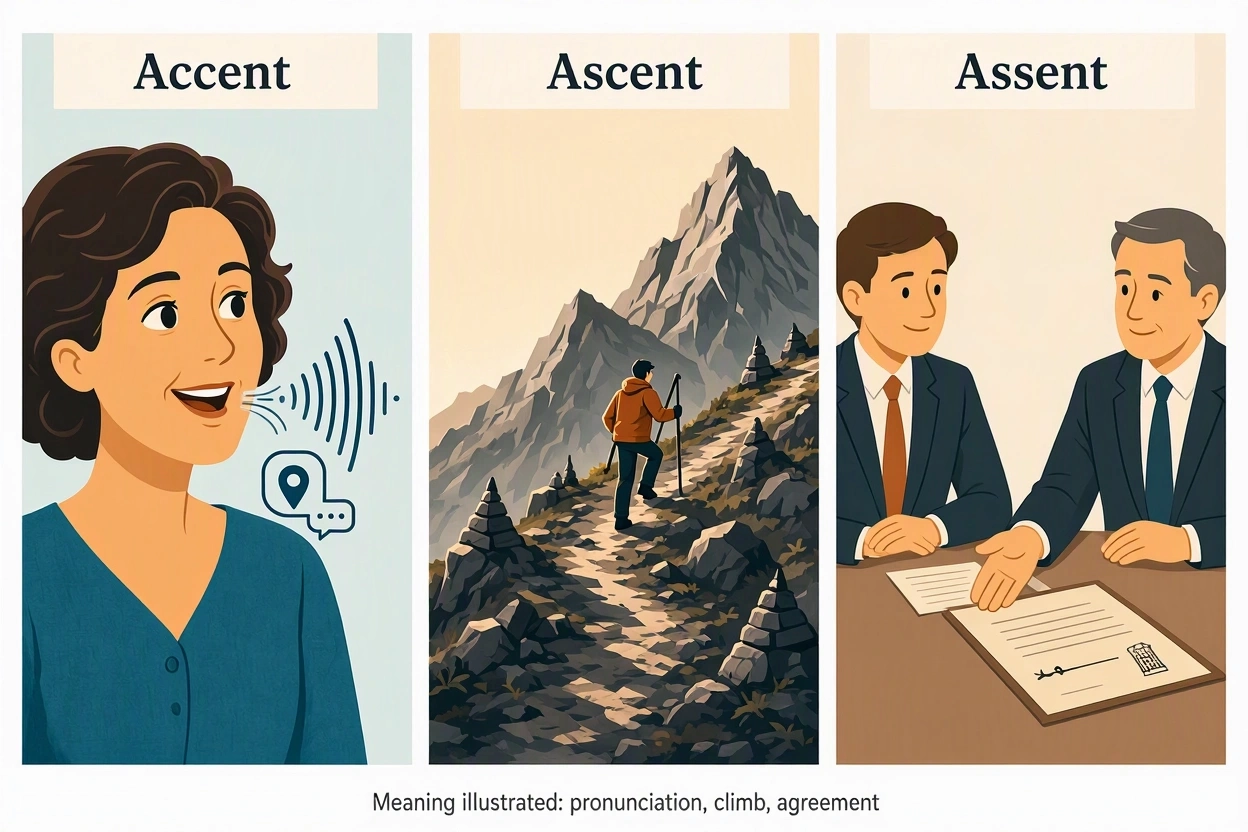
Have you ever confused accent vs ascent vs assent while writing an email, preparing an assignment, or improving your English vocabulary? These three words look and sound similar, but their meanings are completely different. A small spelling mistake can change the meaning of a sentence, especially when you are discussing pronunciation, climbing, or agreeing with a decision. Understanding the difference between these commonly confused English words will help you communicate more clearly and confidently.
The word accent refers to a particular way of pronouncing words or emphasizing a syllable. Ascent describes an upward movement, such as climbing a mountain or rising to a higher position. Meanwhile, assent means agreement or approval. Although the words are easy to mix up, each has a distinct purpose in everyday English. In this guide, you will learn their definitions, grammatical uses, pronunciation differences, and practical examples. By the end, you will know exactly when to use accent, ascent, and assent in both spoken and written English.
Quick Answer: Accent vs Ascent vs Assent
Accent means a way of pronouncing a language or emphasizing a syllable. Ascent means an upward climb or rise. Assent means agreement or approval. Remember the difference: you speak with an accent, make an ascent up a mountain, and give your assent when you agree with something.
Why People Confuse Accent, Ascent, and Assent
These words often cause confusion because they have similar spellings and closely related pronunciations. All three contain similar sounds, but their initial consonants and meanings distinguish them.
Here are the main reasons people mix them up:
- Similar pronunciation: Accent, ascent, and assent can sound alike in some accents of English.
- Nearly identical spelling: Each word contains six letters, making typing and spelling errors easy.
- Different meanings: One relates to speech, another to upward movement, and the third to agreement.
- Limited vocabulary practice: Learners may recognize the words without understanding how to use them in context.
The easiest way to avoid mistakes is to connect each word with a specific idea: speech, climbing, or agreement.
1. Accent: Meaning, Definition, and Usage
An accent is a distinctive way of pronouncing a language. It may reflect someone’s geographical region, native language, or social background. The word can also refer to the emphasis placed on a particular syllable in a word.
Definitions of Accent
As a noun, accent has several common meanings:
- Way of speaking: The pronunciation patterns associated with a region or group.
- Word stress: Special emphasis placed on a syllable.
- Emphasis or prominence: Particular attention given to an idea, feature, or detail.
In certain contexts, accent can also refer to a decorative feature that makes something stand out.
Examples of Accent in Sentences
- She speaks English with a British accent.
- His French accent became noticeable during the conversation.
- The teacher explained where the accent falls in the word.
- Her regional accent makes her speech distinctive.
- The designer added blue cushions to accent the living room.
When Should You Use Accent?
Use accent when discussing pronunciation, speech patterns, syllable stress, or emphasis.
For example:
- Correct: He has a strong Australian accent.
- Incorrect: He made a difficult accent up the mountain.
The second sentence should use ascent because it describes climbing.
2. Ascent: Meaning, Definition, and Usage
An ascent is an upward movement or climb. It can describe someone climbing a mountain, an aircraft gaining altitude, or a person rising to a higher professional or social position.
The word is commonly used as a noun, and its opposite is descent, which means downward movement.
Definitions of Ascent
The word ascent is used in several situations:
- Physical climbing: Moving upward on a hill, mountain, or staircase.
- Rising movement: An aircraft’s climb into the sky.
- Career advancement: Progress toward a higher position.
- Growth or rise: An increase in status, influence, or importance.
Examples of Ascent in Sentences
- The hikers began their ascent before sunrise.
- The aircraft’s ascent was smooth and steady.
- Her ascent to the position of director took several years.
- The steep ascent made the journey exhausting.
- His rapid ascent in the business world attracted attention.
When Should You Use Ascent?
Choose ascent whenever you mean climbing, rising, or progressing upward.
For example:
- Correct: The climbers completed their ascent of the mountain.
- Incorrect: The climbers gave their ascent to the proposal.
The second sentence requires assent because it describes agreement, not climbing.
3. Assent: Meaning, Definition, and Usage
Assent means agreement, approval, or acceptance of a suggestion, proposal, or decision. It can function as both a noun and a verb.
As a noun, it refers to the agreement itself. As a verb, it means to agree or express approval.
Definitions of Assent
The word assent commonly appears in formal, professional, legal, and academic contexts.
- Agreement: Accepting an idea or proposal.
- Approval: Expressing agreement with a decision.
- Formal consent: Giving agreement when approval is required.
Although assent and consent are similar, they are not always interchangeable. Assent emphasizes agreement, while consent often emphasizes permission or authorization.
Examples of Assent in Sentences
- The committee gave its assent to the new policy.
- She nodded in assent when the proposal was presented.
- The manager assented to the revised schedule.
- His silence was not necessarily a sign of assent.
- The proposal cannot proceed without the required assent.
When Should You Use Assent?
Use assent when someone agrees with an idea, accepts a proposal, or expresses approval.
For example:
- Correct: The board gave its assent to the plan.
- Incorrect: The board began its assent up the hill.
The second sentence needs ascent because the intended meaning is upward movement.
Accent vs Ascent vs Assent: Comparison Table
| Feature | Accent | Ascent | Assent |
| Main meaning | Pronunciation or emphasis | Upward movement | Agreement or approval |
| Part of speech | Noun; also a verb | Noun | Noun and verb |
| Common context | Speech and language | Climbing and progress | Decisions and proposals |
| Example phrase | A Scottish accent | A mountain ascent | Give your assent |
| Opposite or contrast | No direct universal opposite | Descent | Dissent |
| Memory word | Speak | Rise | Agree |
When to Use Each Word
Choosing the correct word becomes easier when you identify what your sentence is trying to communicate.
Use Accent When Talking About Speech
Choose accent when describing pronunciation, regional speech, syllable stress, or emphasis.
Examples:
- My English teacher has an American accent.
- The accent in this word falls on the first syllable.
- Warm lighting can accent the room’s natural colors.
Use Ascent When Describing Upward Movement
Choose ascent when something climbs, rises, or advances to a higher level.
Examples:
- Our ascent became harder as the trail grew steeper.
- The plane began its ascent after takeoff.
- Her ascent to leadership was impressive.
Use Assent When Expressing Agreement
Choose assent when someone agrees with or approves an idea or decision.
Examples:
- The members gave their assent to the proposal.
- He assented to the terms of the agreement.
- The plan received unanimous assent.
Quick decision rule: If your sentence concerns speaking, use accent. If it involves going up, use ascent. If it expresses agreement, use assent.
Examples of Accent vs Ascent vs Assent in Sentences
The following examples show how these words work in everyday and formal English.
- Accent: Her accent became stronger when she returned to her hometown.
- Ascent: The mountain ascent took nearly six hours.
- Assent: The director gave her assent to the proposed changes.
- Accent: The actor practiced an Irish accent for the role.
- Ascent: The balloon’s ascent was visible from miles away.
- Assent: Without the committee’s assent, the project could not move forward.
- Accent: The speaker’s accent made some words difficult to understand.
- Ascent: Their ascent toward the summit required careful preparation.
- Assent: The council expressed its assent through a formal vote.
- Accent: The singer placed the accent on the final syllable.
- Ascent: His professional ascent began with a junior position.
- Assent: She assented to the arrangement after reviewing the details.
- Accent: The bright artwork will accent the otherwise neutral room.
- Ascent: The hikers paused during their ascent to catch their breath.
- Assent: The agreement required the formal assent of all parties.
These examples demonstrate that the three words serve different purposes, even when they appear in similar grammatical structures.
Common Mistakes to Avoid
Even experienced English users occasionally confuse these words. The following mistakes are especially common.
1. Using Accent Instead of Ascent
Incorrect: The climbers started their accent at dawn.
Correct: The climbers started their ascent at dawn.
Why? The sentence describes climbing upward, not pronunciation.
2. Using Ascent Instead of Assent
Incorrect: The committee gave its ascent to the proposal.
Correct: The committee gave its assent to the proposal.
Why? The committee is agreeing with a proposal rather than moving upward.
3. Using Assent Instead of Accent
Incorrect: He speaks English with a strong assent.
Correct: He speaks English with a strong accent.
Why? The sentence describes a pronunciation pattern.
4. Assuming Assent Always Means Consent
Although assent and consent can overlap, they may have different implications depending on the situation. Assent generally emphasizes agreement, while consent often emphasizes permission or authorization.
5. Ignoring Context
A word may sound similar to another, but the sentence’s meaning determines which spelling is correct. Always consider whether you are describing speech, upward movement, or agreement.
Memory Trick: How to Remember the Difference
Use these three simple associations to remember the meanings.
- Accent = Articulation. Both relate to how speech sounds.
- Ascent = Above. Both suggest movement upward.
- Assent = Agreement. Both begin with the idea of accepting or agreeing with something.
You can also remember this sentence:
“I speak with an accent, climb an ascent, and give my assent.”
Each word has a separate role, so the sentence reinforces all three meanings at once.
For additional practice, fill in the blanks:
- The hikers began their ______ before sunrise.
- The judge gave her ______ to the request.
- He speaks with a noticeable regional ______.
Answers: 1. ascent, 2. assent, 3. accent.
American vs British English
The meanings of accent, ascent, and assent remain essentially the same in American and British English. Their spelling also stays the same in both varieties.
| Word | American English | British English |
| Accent | Pronunciation or emphasis | Pronunciation or emphasis |
| Ascent | Upward movement | Upward movement |
| Assent | Agreement or approval | Agreement or approval |
There can be slight differences in pronunciation depending on a speaker’s region and individual speech patterns. In some accents, these words may sound particularly similar, making context important.
For English learners, the main lesson is straightforward: do not change the spelling based on whether you are writing for an American or British audience. Choose the word that matches your intended meaning.
Similar Words: Accent, Ascent, Assent, Descent, and Dissent
Learning related words can help you improve your English vocabulary and avoid common spelling mistakes.
Accent vs Ascent
Accent relates to pronunciation or emphasis, whereas ascent refers to climbing or rising.
- Accent: She has a noticeable Spanish accent.
- Ascent: The ascent to the summit was challenging.
Ascent vs Descent
These words express opposite directions.
- Ascent means upward movement.
- Descent means downward movement.
Example: The aircraft’s ascent was smooth, but its descent was delayed.
Assent vs Dissent
These words express contrasting responses to an idea or proposal.
- Assent means agreement.
- Dissent means disagreement or a difference of opinion.
Example: Several members expressed assent, while others voiced dissent.
Assent vs Consent
Both words can refer to agreement, but their emphasis differs.
- Assent usually highlights agreement or approval.
- Consent often highlights permission or authorization.
Example: The committee gave its assent to the recommendation, while the participants provided consent to take part in the study.
Understanding these related terms will help you distinguish similar-looking English words more accurately.
Frequently Asked Questions
1. What is the difference between accent, ascent, and assent?
Accent means pronunciation or emphasis, ascent means upward movement, and assent means agreement or approval. Their similar spellings make them easy to confuse, but each word has a distinct meaning.
2. Is accent or ascent correct when talking about climbing a mountain?
Ascent is correct. It refers to the act of climbing or moving upward. For example, “The hikers completed their ascent before noon.”
3. Does assent mean agreement?
Yes. Assent means agreement, acceptance, or approval. It can be used as a noun, as in “give your assent,” or as a verb, as in “she assented to the proposal.”
4. How do you pronounce accent, ascent, and assent?
Pronunciation varies by accent, but commonly, accent begins with an initial vowel sound similar to “ack,” while ascent and assent begin with a short vowel sound. The latter two are often distinguished by their initial consonants: /s/ in ascent and /ə/ followed by /s/ in assent, depending on the speaker’s pronunciation. Listening to audio examples from a trusted dictionary can help you hear the differences.
5. What is the opposite of ascent?
The opposite of ascent is descent, which means downward movement. For example, a mountain ascent involves climbing up, while the descent involves coming down.
6. What is the opposite of assent?
The closest direct opposite of assent is dissent, meaning disagreement or opposition to an idea or decision.
7. Are accent, ascent, and assent homophones?
They are sometimes treated as near-homophones or confused sound-alike words, but they are not necessarily pronounced identically in every variety of English. Their pronunciation can vary by speaker and accent.
Final Verdict: Accent vs Ascent vs Assent
The difference between accent, ascent, and assent comes down to three distinct ideas. An accent describes how someone speaks or how emphasis is placed. An ascent describes climbing, rising, or progressing upward. Assent refers to agreement, approval, or acceptance of a proposal.
To choose the correct word, focus on the meaning of your sentence instead of relying only on how the word sounds. This approach will help you avoid spelling errors, write more naturally, and communicate effectively in academic, professional, and everyday situations.
Conclusion
English contains many words that look or sound alike but carry completely different meanings. Accent, ascent, and assent are excellent examples of why spelling and context matter. Once you associate each word with speech, upward movement, or agreement, distinguishing them becomes much easier.
Practice using all three words in your own sentences, and pay attention to how they appear in books, news articles, and conversations. With regular practice, you will develop a stronger vocabulary and feel more confident choosing the correct word whenever you write or speak English.
Remember This
- Accent: The way someone pronounces words or emphasizes a syllable.
- Ascent: The act of climbing, rising, or moving upward.
- Assent: Agreement, acceptance, or approval.
One sentence to remember them all: You speak with an accent, make an ascent, and give your assent.

I’m Micah Wheeler, a passionate author who enjoys exploring matching words, grammar, and language. I create clear, helpful content to make word choices and grammar easier for everyone.