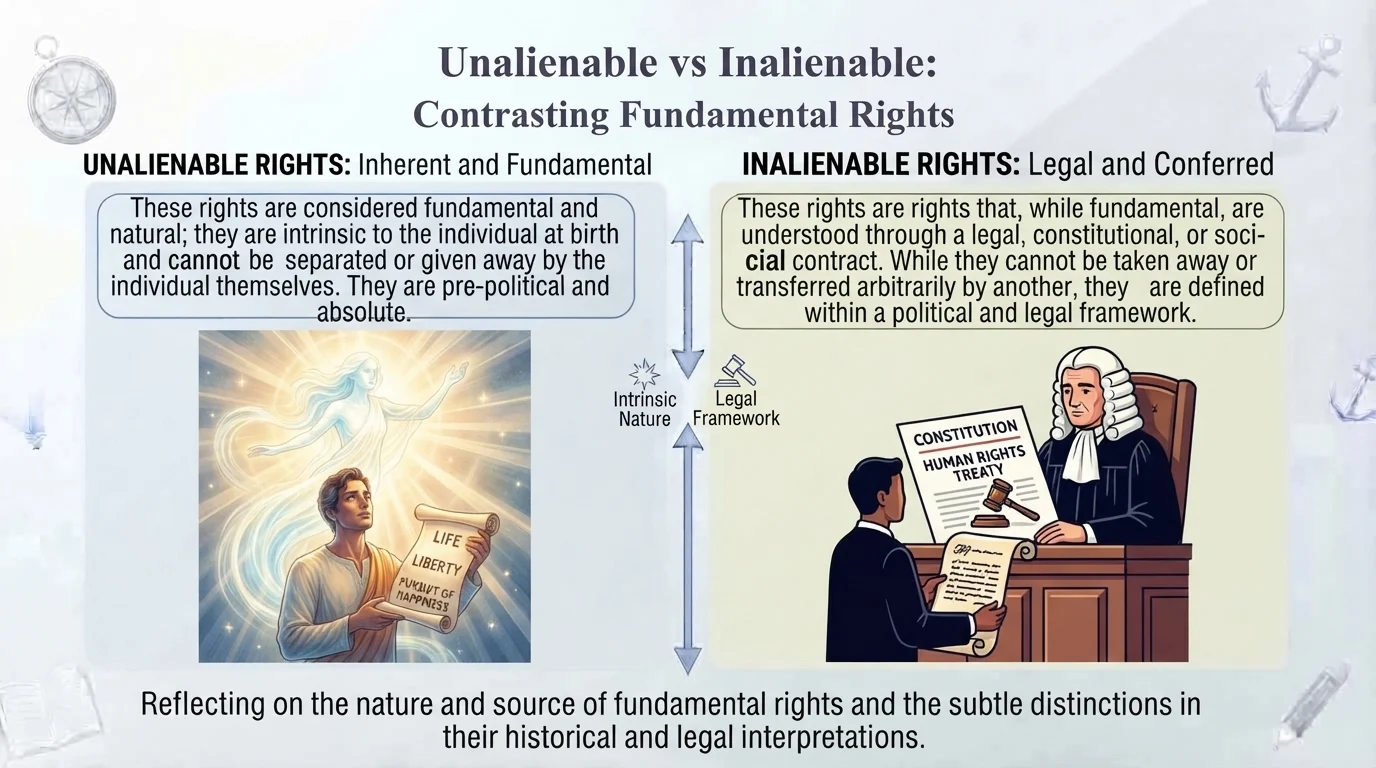
Unalienable vs inalienable is a common English usage question because the two words look and sound almost identical. Both describe something that cannot legally, morally, or practically be taken away, transferred, or surrendered. In most modern contexts, unalienable and inalienable have the same basic meaning, so choosing between them is usually a matter of style, tradition, and context rather than a difference in definition.
The word inalienable is more common in general modern English, while unalienable is strongly associated with the famous phrase “unalienable Rights” in the U.S. Declaration of Independence. Understanding this distinction can help you choose the most natural word for essays, legal writing, historical discussions, and everyday communication. In this guide, we’ll compare the meanings, usage, examples, spelling, American and British preferences, and related words so you can use both forms confidently.
Quick Answer
Unalienable and inalienable generally mean the same thing: something that cannot be taken away, transferred, or surrendered. Inalienable is more common in modern English, while unalienable is especially familiar from the U.S. Declaration of Independence. Both are correct.
Why People Confuse It
The confusion comes from the fact that unalienable and inalienable have nearly identical meanings and differ mainly in their prefixes.
Both words are formed around alienable, which means something can be transferred, surrendered, or given up.
- Alienable = capable of being transferred or surrendered
- Inalienable = not capable of being transferred or surrendered
- Unalienable = not capable of being transferred or surrendered
For example:
Human rights are often described as inalienable rights.
You may also see:
The Declaration of Independence refers to unalienable Rights.
Neither sentence is inherently wrong. The important difference is usage and context.
First Word: Unalienable
Unalienable means impossible or not permitted to be taken away, transferred, or surrendered.
It is especially well known because of the U.S. Declaration of Independence, which famously uses the expression “unalienable Rights.”
Meaning of Unalienable
Unalienable can describe rights, freedoms, principles, or possessions that cannot legitimately be given away or taken away.
Examples
- Every person has certain unalienable rights.
- The document protects citizens’ unalienable freedoms.
- They argued that education was an unalienable human right.
- The founders described certain liberties as unalienable.
- Freedom was presented as an unalienable principle.
Because of its historical association with American political language, unalienable can sometimes sound more formal, historical, or traditional.
Second Word: Inalienable
Inalienable has essentially the same meaning as unalienable.
It refers to something that cannot be transferred, surrendered, removed, or legitimately taken away.
Meaning of Inalienable
Inalienable is widely used in modern English, especially when discussing:
- Human rights
- Civil liberties
- Legal rights
- Personal freedoms
- Fundamental principles
- Moral rights
Examples
- Freedom of conscience is an inalienable right.
- Human dignity is considered inalienable.
- The constitution protects certain inalienable rights.
- Every individual possesses inalienable freedoms.
- The right to personal dignity is often described as inalienable.
In contemporary general writing, inalienable is often the more natural choice.
Comparison Table
| Feature | Unalienable | Inalienable |
| Basic meaning | Cannot be taken or transferred | Cannot be taken or transferred |
| Meaning difference | Generally none | Generally none |
| Commonness | Less common | More common |
| Historical association | Strongly associated with U.S. Declaration of Independence | Common in modern formal English |
| Typical context | Historical, American political language | Modern legal, academic, and general writing |
| Example | Unalienable rights | Inalienable rights |
| Correct spelling? | Yes | Yes |
When to Use Each
Use “Unalienable” When:
Choose unalienable when you are discussing historical American language or deliberately echoing the wording of the Declaration of Independence.
For example:
The Declaration of Independence describes certain rights as unalienable.
It can also work in formal writing when you simply want to use the word naturally.
Use “Inalienable” When:
Inalienable is generally the safer choice for modern English.
Use it when discussing:
- Human rights
- Legal rights
- Fundamental freedoms
- Individual dignity
- Moral principles
- Constitutional concepts
For example:
Every individual should be treated with inalienable dignity.
If you are unsure which form sounds more natural in contemporary writing, inalienable is usually a good choice.
Examples of Unalienable vs Inalienable
Here are examples showing how both forms can be used:
- Everyone deserves certain inalienable rights.
- The Declaration of Independence refers to unalienable Rights.
- Freedom is often described as an inalienable human right.
- The founders believed these liberties were unalienable.
- Human dignity is considered inalienable.
- The constitution recognizes certain inalienable freedoms.
- The writer described liberty as an unalienable principle.
- No government should violate a person’s inalienable rights.
- The historical document uses the term unalienable.
- The philosopher argued that certain rights were inalienable.
- The organization advocates for inalienable human rights.
- The speech used the older term unalienable to evoke historical language.
Notice the Pattern
In these examples, replacing unalienable with inalienable usually does not change the basic meaning.
The choice is primarily about context, style, and historical association.
Common Mistakes
1. Thinking One Word Is Incorrect
A common misconception is that one of these spellings must be wrong.
Both unalienable and inalienable are established English words.
2. Assuming They Have Opposite Meanings
They do not.
The words are essentially synonymous.
3. Using “Alienable” When You Mean “Inalienable”
These words have opposite meanings:
- Alienable = can be transferred
- Inalienable = cannot be transferred
For example:
This property is alienable.
means it can legally be transferred.
4. Confusing “Inalienable” With “Illegal to Transfer”
Inalienable often describes something that cannot legitimately be surrendered or transferred, particularly rights and freedoms. The precise legal meaning can depend on the jurisdiction and context.
5. Using the Historical Form Without Considering Context
If you are writing modern academic or general-purpose English, inalienable may sound more familiar to readers than unalienable.
Memory Trick
A simple way to remember the difference is:
INALIENABLE = modern and common
Think:
IN + alienable = not transferable
For unalienable, remember:
U + Declaration = Unalienable
This helps connect unalienable with the famous historical phrase “unalienable Rights.”
Most importantly, remember that the two words generally have the same meaning.
American vs British English
Both unalienable and inalienable can be found in American and British English.
However, their frequency and associations can differ depending on the context.
In American English, unalienable has a particularly strong historical association with the Declaration of Independence. The phrase “unalienable Rights” is widely recognized in American history and civic education.
Inalienable, meanwhile, is widely used in contemporary English, including American legal, academic, and general writing.
In British English, inalienable is generally the more familiar modern form.
So, for most contemporary writing, inalienable is a straightforward choice. Use unalienable when the historical or stylistic context makes it appropriate.
Similar Words
Several related words are useful when discussing rights, ownership, and transfer.
Alienable
Something that can be transferred or surrendered.
The property is alienable under the law.
Inalienable
Something that cannot be transferred, surrendered, or legitimately taken away.
Freedom is an inalienable right.
Unalienable
A synonym of inalienable, particularly notable in historical American usage.
The document refers to unalienable rights.
Indefeasible
A more specialized legal term describing something that cannot be defeated, revoked, or invalidated under certain legal circumstances.
Irrevocable
Something that cannot be reversed or canceled.
The agreement was irrevocable.
These words overlap in some contexts, but they are not interchangeable in every legal or everyday sentence.
Final Verdict
Unalienable vs inalienable is not really a battle between a correct and an incorrect spelling. Both are legitimate words with essentially the same meaning.
The main distinction is usage and context. Unalienable is strongly associated with historical American language, especially the Declaration of Independence, while inalienable is more common in contemporary general, academic, and formal English.
If you’re writing modern English and simply want the most familiar option, inalienable is usually the natural choice. If you’re discussing American history or deliberately referring to the wording of the Declaration of Independence, unalienable may be the better stylistic fit.
Frequently Asked Questions
Is “unalienable” a real word?
Yes. Unalienable is a legitimate English word meaning something that cannot be transferred, surrendered, or taken away. It is especially famous from the phrase “unalienable Rights” in the U.S. Declaration of Independence.
Is “inalienable” or “unalienable” correct?
Both are correct. They generally have the same meaning. Inalienable is more common in contemporary general English, while unalienable has a strong historical association with American political language.
Are unalienable and inalienable synonyms?
Yes. In most contexts, they are synonyms. Both can describe rights, freedoms, or other things that cannot legitimately be surrendered or transferred.
Which is more common: inalienable or unalienable?
Inalienable is generally more common in modern English. Unalienable is particularly recognizable because of its use in the Declaration of Independence.
What does “unalienable rights” mean?
Unalienable rights are rights considered impossible to legitimately surrender, transfer, or take away. The expression is famously associated with the U.S. Declaration of Independence.
What does “inalienable rights” mean?
Inalienable rights are fundamental rights regarded as incapable of legitimate transfer or surrender. The phrase is commonly used when discussing human rights, civil liberties, and fundamental freedoms.
Is “alienable” the opposite of “inalienable”?
Generally, yes. Alienable describes something that can be transferred or surrendered, while inalienable describes something that cannot be transferred or surrendered.
Conclusion
The difference between unalienable vs inalienable is mainly one of usage rather than meaning. Both words describe something that cannot legitimately be transferred, surrendered, or taken away. Unalienable carries a particularly strong historical connection to the language of the U.S. Declaration of Independence, while inalienable is widely used in modern formal, academic, legal, and general English.
When choosing between them, consider your audience and context. For contemporary writing, inalienable will usually feel more familiar. For historical American contexts, especially when discussing the Declaration of Independence, unalienable is highly appropriate. Whichever form you choose, the key idea remains the same: something inalienable or unalienable cannot simply be given away or legitimately taken away.
Remember This
Unalienable = inalienable in meaning.
- Unalienable → strongly associated with historical American wording
- Inalienable → more common in modern English
- Alienable → capable of being transferred
- Inalienable/Unalienable → not capable of being transferred or surrendered
When in doubt in modern writing, “inalienable” is usually the more familiar choice.

I’m Elliot Pierce, Administrator at Grammetics, dedicated to improving word matching and grammar. I help maintain useful content, support readers, and make language learning simple, clear, accurate, and engaging.