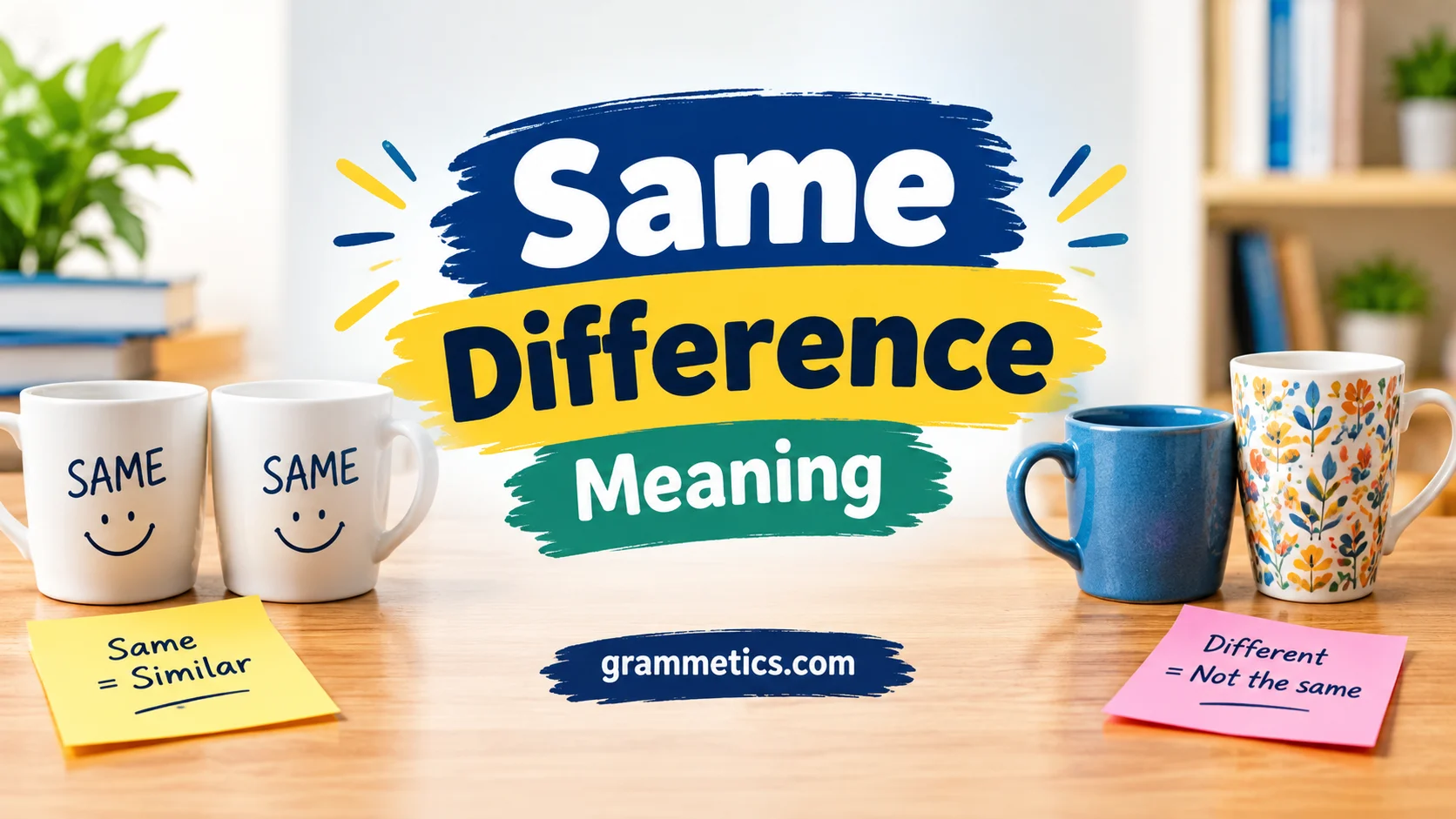
Have you ever heard someone say “same difference” and wondered what it actually means? At first, the phrase sounds contradictory. If two things are the same, how can there also be a difference? This unusual expression is commonly used in casual English, especially when someone wants to say that two choices or situations are effectively the same despite a minor difference. It can also carry a humorous, sarcastic, or dismissive tone depending on the context.
The phrase “same difference” is not normally used in formal writing. Instead, it appears mostly in everyday conversations, jokes, social media, and informal speech. Understanding its meaning can help you recognize conversational English more naturally and avoid taking the expression literally. In this guide, we’ll explain the same difference meaning, how the phrase is used, what it implies, common mistakes, and several real-life examples so you can confidently understand and use it.
Quick Answer
“Same difference” is an informal expression meaning that two things are essentially the same despite a small or unimportant difference. It is often humorous, sarcastic, or dismissive. For example, “Monday or Tuesday? Same difference” means that either day makes little practical difference.
Why People Confuse It
The confusion comes from the two words having apparently opposite meanings.
- Same means identical or alike.
- Difference means the way two things are not alike.
Put together, “same difference” seems logically impossible.
However, the phrase is generally not meant literally. It is an idiomatic expression used to communicate that a distinction exists, but that distinction doesn’t matter much.
For example:
“We can take the blue car or the black one. Same difference.”
The speaker acknowledges that the cars are different colors but considers that difference unimportant.
What Does “Same Difference” Mean in Conversation?
Depending on the situation, it can mean:
- “It doesn’t really matter.”
- “Either one is fine.”
- “They’re basically the same.”
- “There’s no important difference.”
- “The distinction isn’t significant.”
The speaker may use it seriously, jokingly, or sarcastically.
First Word: Same
The word same means identical or not different in a relevant way.
Examples of “Same”
- We have the same teacher.
- They bought the same phone.
- Both answers are the same.
- We arrived at the same conclusion.
In “same difference,” however, same does not necessarily mean that two things are completely identical.
Instead, it suggests that the difference between them doesn’t have enough importance to affect the situation.
Second Word: Difference
Difference refers to something that makes two people, objects, ideas, or situations unlike each other.
Examples of “Difference”
- There is a big difference between the two plans.
- Can you explain the difference between these words?
- The price difference is only $2.
- I can’t see much difference between them.
In the expression “same difference,” the word difference helps acknowledge that technically there is a distinction, but the speaker doesn’t consider it important.
Comparison Table
| Expression | Meaning | Typical Use | Formality |
| Same difference | Essentially the same; the difference doesn’t matter | Casual conversation | Informal |
| It doesn’t matter | The choice has little importance | Everyday speech and writing | Neutral |
| Either is fine | Both choices are acceptable | Everyday conversation | Neutral |
| Basically the same | Very similar in practical terms | Speech and writing | Neutral |
| No significant difference | The distinction is not important | Professional/academic contexts | Formal |
| Six of one, half a dozen of the other | Two choices are essentially equivalent | Informal/idiomatic | Informal |
When to Use Each
Use “Same Difference” in Casual Conversation
Use it when you’re talking informally with friends, family, or people you know well.
“Should we order pizza or burgers?”
“Same difference. I’m happy with either.”
Use “It Doesn’t Matter” for Neutral Situations
If you want to sound straightforward and natural, “it doesn’t matter” is usually better.
“Do you want to leave at 6:00 or 6:15?”
“It doesn’t matter to me.”
Use “Either Is Fine” When Both Options Work
This is useful when you’re genuinely comfortable with either choice.
“Would you prefer tea or coffee?”
“Either is fine.”
Use More Formal Language in Professional Writing
In an essay, report, or business document, consider:
- no significant difference
- essentially equivalent
- practically identical
- the distinction is insignificant
- there is little meaningful difference
“Same difference” can sound too casual for formal writing.
Examples of “Same Difference”
Here are more than ten examples showing how the phrase works in natural conversation.
- “Do you want the red one or the blue one?”
“Same difference. You choose.” - “We could meet at 2 or 2:30.”
“Same difference to me.” - “Is it called a soda or a soft drink?”
“Same difference. Everyone knows what you mean.” - “Should I send it today or tomorrow?”
“Same difference. It isn’t urgent.” - “You can sit here or over there.”
“Same difference.” - “Did he arrive at eight or eight fifteen?”
“Same difference. He was still on time.” - “Would you rather walk or take the bus?”
“Same difference. It’s only a short trip.” - “Is this the first version or the second version?”
“Same difference for what we’re doing.” - “Should we watch the movie tonight or tomorrow?”
“Same difference. I’m free both nights.” - “Do you call it a mistake or an error?”
“Same difference in this context.” - “Is the meeting online or virtual?”
“Same difference. We’ll be attending remotely.” - “Should I use this word or that one?”
“Same difference if the meaning stays clear.” - “You can pay by card or cash.”
“Same difference to me.” - “Is he your colleague or coworker?”
“Same difference. We work together.”
Notice the Tone
The expression can sometimes sound dismissive:
“You said Tuesday, but I said Wednesday.”
“Same difference.”
Here, the speaker may be saying that the distinction isn’t worth arguing about.
Common Mistakes
1. Taking It Literally
A common mistake is assuming that “same difference” means two things are literally identical.
Usually, it means the difference isn’t important.
2. Using It in Formal Writing
Avoid it in academic essays, formal reports, or professional documents unless you’re deliberately discussing informal language.
Instead, write:
“There is no significant difference between the two options.”
3. Assuming It Always Sounds Polite
The phrase can sometimes sound dismissive or sarcastic.
For example:
“You were supposed to call me at 5, not 6.”
“Same difference.”
Depending on the relationship and tone, this could sound as though the speaker doesn’t care about the correction.
4. Confusing It With “Same Thing”
“Same thing” usually means two things are identical or equivalent.
“Same difference” focuses more specifically on the idea that a difference exists but isn’t important.
Memory Trick
Think of “same difference” as:
Different in detail, same in result.
That’s the easiest way to remember the phrase.
If two choices produce essentially the same outcome, someone might say:
“Same difference.”
For example:
Option A: Leave at 7:00
Option B: Leave at 7:05
Result: You arrive at almost the same time.
So:
“Seven or seven-oh-five? Same difference.”
American vs British English
“Same difference” can be understood in both American and British English, but it is generally an informal conversational expression, rather than a standard formal phrase.
In American English, you may hear it used casually or humorously to dismiss a minor distinction.
British speakers can also understand and use the expression, although other phrases may be preferred depending on the context.
For example:
- Same difference.
- It makes no difference.
- It doesn’t really matter.
- Either way.
- Six of one, half a dozen of the other.
The exact choice often depends on the speaker’s personality and the situation.
Similar Words and Expressions
Several expressions have a similar meaning to “same difference.”
“It makes no difference”
This means that the distinction has no meaningful effect.
“Morning or afternoon?”
“It makes no difference to me.”
“It doesn’t matter”
This is one of the simplest alternatives.
“Should we go today?”
“It doesn’t matter.”
“Either way”
This means the result is acceptable regardless of the choice.
“We can drive or take the train.”
“Either way is fine.”
“Basically the same”
This emphasizes similarity rather than indifference.
“The two models are basically the same.”
“Six of one, half a dozen of the other”
This idiom means that two alternatives are effectively equivalent.
“Should we take Route A or Route B?”
“Six of one, half a dozen of the other.”
Final Verdict
The same difference meaning is essentially “the difference doesn’t matter” or “the two options are effectively the same.” It is an informal expression that often appears in everyday conversation.
Although the words same and difference seem contradictory, the phrase makes sense idiomatically. It acknowledges that two things may technically differ while suggesting that the distinction has little practical importance.
FAQs About “Same Difference”
1. What does “same difference” mean?
“Same difference” means that two things may be technically different, but the difference is considered unimportant or irrelevant.
2. Is “same difference” grammatically correct?
It is an established informal expression. However, it is not normally appropriate for formal or academic writing.
3. Is “same difference” sarcastic?
It can be. The tone depends on context. Sometimes it is humorous, while other times it can sound dismissive.
4. Is “same difference” rude?
Not necessarily. Among friends, it can be harmless and playful. In a serious conversation, however, it may sound dismissive.
5. What is another way to say “same difference”?
You can say “it doesn’t matter,” “either way,” “it makes no difference,” or “they’re basically the same.”
6. Can I use “same difference” in an essay?
It is better to avoid it in formal essays. Use phrases such as “there is no significant difference” or “the distinction is insignificant.”
7. What is an example of “same difference”?
“Should we meet at 3:00 or 3:15?”
“Same difference to me.”
This means that either time works equally well.
Conclusion
The phrase “same difference” is a good example of how everyday English isn’t always meant to be interpreted word for word. Although same and difference appear contradictory, together they communicate a simple idea: there may be a difference, but it isn’t important enough to matter. That’s why the phrase is common in casual conversations and informal situations.
When you hear someone say “same difference,” think about the practical outcome rather than the literal words. If the choices are close enough that the distinction doesn’t matter, the phrase makes perfect conversational sense. For formal English, however, choose clearer alternatives such as “it makes no significant difference” or “the two options are essentially equivalent.”
Remember This
“Same difference” = Different in small details, but essentially the same in practical effect.
It is informal, often humorous or dismissive, and best suited to casual conversation rather than formal writing.

I’m Elliot Pierce, Administrator at Grammetics, dedicated to improving word matching and grammar. I help maintain useful content, support readers, and make language learning simple, clear, accurate, and engaging.