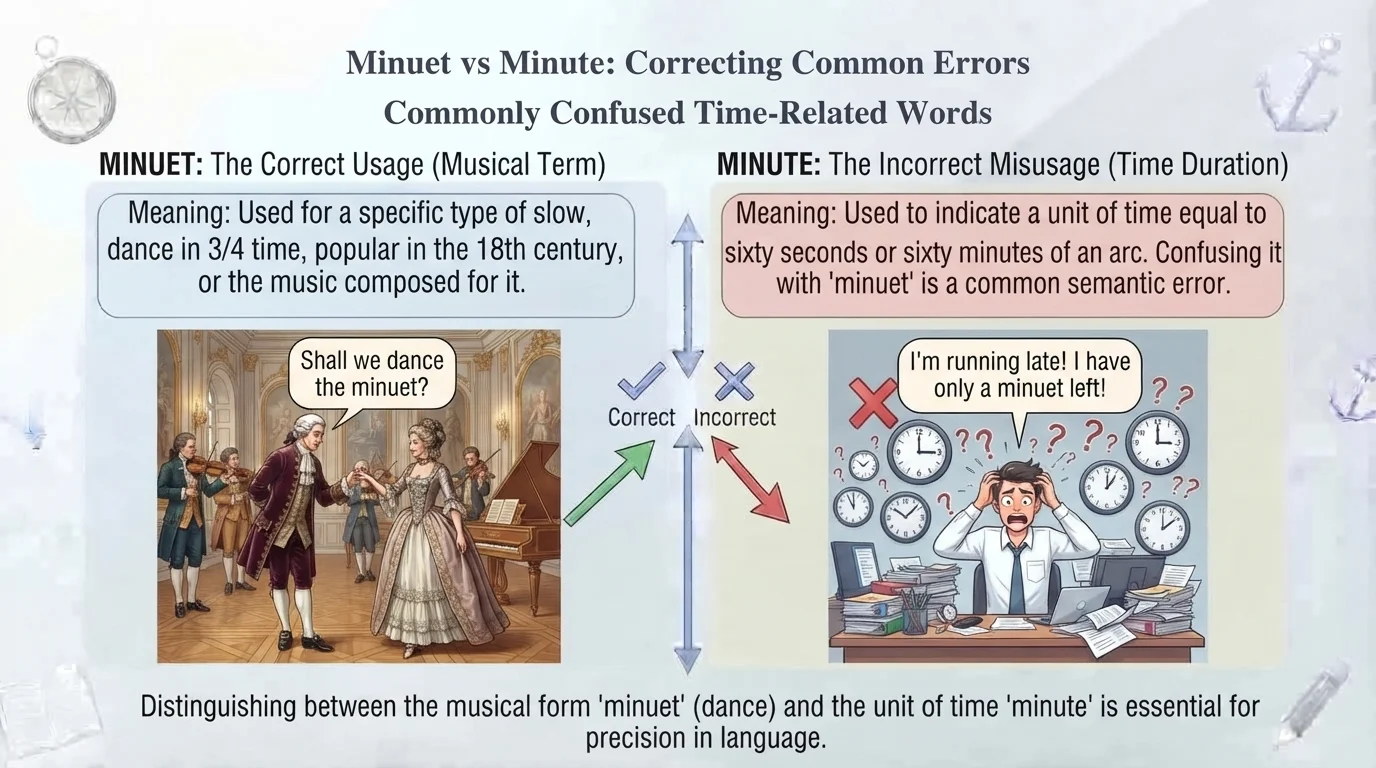
If you have ever seen the words minuet and minute and wondered whether they are related, you are not alone. They look remarkably similar, but they have completely different meanings and uses. One refers to a traditional dance and musical form, while the other is commonly used to talk about time or something extremely small. Understanding the difference can help you avoid spelling mistakes and choose the right word confidently.
The confusion becomes even easier to understand because minuet and minute can sound somewhat similar in certain contexts. However, their pronunciation, meanings, and grammatical roles are different. In this guide, we will explain minuet vs minute in simple language, compare their definitions, provide practical examples, and show you an easy memory trick. Whether you are improving your English vocabulary, writing professionally, or simply trying to understand these commonly confused words, this article will make the distinction clear.
Quick Answer
Minuet is a slow, graceful traditional dance and a type of musical composition. Minute usually means a unit of time equal to 60 seconds, but it can also mean extremely small. Although the words look similar, they have different meanings, pronunciations, and uses.
Why People Confuse It
People often confuse minuet and minute because their spellings are almost identical:
- Minuet → m-i-n-u-e-t
- Minute → m-i-n-u-t-e
Both words contain the letters minu, which makes them easy to mix up when writing quickly.
Another reason is that minute has two different pronunciations depending on its meaning. When it refers to time, it is pronounced roughly MIN-it. When it means extremely small, it is pronounced roughly my-NOOT.
Minuet, meanwhile, is generally pronounced min-yoo-ET.
The meanings are completely separate, so context is important.
First Word: Minuet
Minuet is a noun referring to a slow, graceful dance that originated in Europe, particularly associated with the 17th and 18th centuries.
The word can also refer to a piece of music written in the style or rhythm of this dance.
Minuet meaning
Minuet = a traditional graceful dance or a musical composition based on that dance.
The minuet became especially popular in European courts and later became an important form in classical music.
Examples of “minuet”
- The dancers performed a graceful minuet.
- The orchestra played a beautiful minuet.
- The students learned the basic steps of the minuet.
- The composer included a minuet in the musical piece.
- The historical performance featured costumes and a traditional minuet.
So, whenever you are talking about dance, classical music, historical performances, or musical forms, minuet may be the word you need.
Second Word: Minute
Minute has two major meanings.
Minute meaning: 60 seconds
As a noun, a minute is a unit of time equal to 60 seconds.
Examples:
- Wait one minute.
- The meeting starts in five minutes.
- I will call you in a minute.
- It took twenty minutes to finish the task.
Minute meaning: extremely small
As an adjective, minute can mean extremely small or tiny.
In this meaning, it is pronounced differently: roughly my-NOOT.
Examples:
- There was a minute crack in the glass.
- The scientist observed minute changes in the sample.
- Even a minute amount of dust can affect the experiment.
This second meaning is less common in everyday conversation but appears frequently in formal, scientific, and academic writing.
Comparison Table
| Word | Part of Speech | Meaning | Common Context | Example |
| Minuet | Noun | A traditional dance or musical form | Dance, classical music, history | They performed a minuet. |
| Minute | Noun | 60 seconds | Time | Give me a minute. |
| Minute | Adjective | Extremely small | Science, formal writing | A minute difference was detected. |
When to Use Each
Choosing between minuet and minute becomes easy when you focus on the meaning.
Use “minuet” when talking about:
- A traditional dance
- Classical music
- Historical European dances
- Musical compositions
- Graceful dance movements
Example:
The musicians performed a traditional minuet.
Use “minute” when talking about:
- Time
- Seconds
- Short periods
- Extremely small things
- Tiny differences or amounts
Example:
Please wait a minute.
Example:
The researcher noticed a minute change in temperature.
A useful rule is:
Dance or music = minuet. Time or tiny = minute.
Examples of Minuet vs Minute
Here are more examples to make the difference clear:
- The dancers performed a beautiful minuet at the historical event.
- Please wait a minute while I finish this.
- The composer wrote a graceful minuet.
- The train will arrive in ten minutes.
- They practiced the minuet for the evening performance.
- I only need a minute to get ready.
- The orchestra played a famous minuet.
- The scientist detected a minute change in pressure.
- The ballroom performance ended with a minuet.
- She returned after a few minutes.
- The museum displayed information about the traditional minuet.
- Even a minute error could affect the final result.
Notice how minuet is connected with dance or music, while minute is connected with time or small size.
Common Mistakes
Mistake 1: Using “minuet” for time
Incorrect:
I will be there in five minuets.
Correct:
I will be there in five minutes.
The word for a unit of time is minute, not minuet.
Mistake 2: Using “minute” when discussing the dance
Incorrect:
The performers practiced the minute.
Correct:
The performers practiced the minuet.
When referring to the traditional dance, use minuet.
Mistake 3: Confusing the spelling
Because the words are visually similar, it is easy to accidentally switch the e and u.
Remember:
minuet → dance
minute → time/tiny
Mistake 4: Ignoring pronunciation
“Minute” has different pronunciations depending on meaning:
- minute = 60 seconds → MIN-it
- minute = extremely small → my-NOOT
- minuet = dance → min-yoo-ET
Understanding pronunciation can help you recognize the intended meaning in spoken English.
Memory Trick
Here is a simple way to remember minuet vs minute:
Minuet = Music
Both minuet and music can remind you of a traditional dance.
Think:
MINUET → MUSIC → DANCE
Minute = Time
Think:
MINUTE → 60 SECONDS → TIME
And for the adjective:
MINUTE → TINY
So remember:
Minuet dances, minute counts.
That simple association will help you choose the correct spelling.
American vs British English
There is essentially no major difference in the basic meanings of minuet and minute between American and British English.
In both varieties of English:
- minuet refers to the traditional dance or musical form.
- minute refers to a unit of time.
- minute can also mean extremely small.
The pronunciation may vary slightly depending on the speaker’s accent, but the spelling and core meanings remain the same.
For example, both American and British speakers would naturally say:
The meeting will begin in five minutes.
And both would understand:
The orchestra performed a minuet.
Similar Words
Several words can also cause confusion because they look or sound similar.
Minute vs Minuet
- Minute = 60 seconds or extremely small
- Minuet = traditional dance or musical form
Minute vs Moment
- Minute = a specific unit of 60 seconds
- Moment = a short or indefinite period of time
Example:
Wait a minute.
Wait a moment.
Minuet vs Waltz
Both are types of dance and can appear in discussions of classical music, but they are not the same dance.
- Minuet = traditional, graceful dance associated with European court culture
- Waltz = a dance typically performed in triple meter with a characteristic turning movement
Final Verdict
The difference between minuet and minute is straightforward once you connect each word with its meaning.
Minuet is a traditional dance or a musical composition based on that dance. Minute usually refers to a period of 60 seconds, but it can also describe something extremely small.
If you are talking about dance or classical music, choose minuet. If you are talking about time, choose minute. If you mean extremely small, you also need minute, with a different pronunciation.
FAQs
1. What is the difference between minuet and minute?
Minuet is a traditional dance or musical form. Minute means 60 seconds or, as an adjective, extremely small.
2. Is “minuet” a type of dance?
Yes. A minuet is a traditional slow and graceful dance that became popular in European court culture.
3. Does minute mean 60 seconds?
Yes. As a noun, a minute is equal to 60 seconds.
4. Can minute also mean very small?
Yes. Minute can be an adjective meaning extremely small or tiny. In this sense, it has a different pronunciation.
5. How do you pronounce minuet?
Minuet is generally pronounced approximately min-yoo-ET.
6. How do you pronounce minute?
When meaning 60 seconds, minute is pronounced approximately MIN-it. When meaning extremely small, it is pronounced approximately my-NOOT.
7. Is minuet used in American English?
Yes. Minuet is used in both American and British English when referring to the traditional dance or musical form.
Conclusion
Although minuet and minute look almost identical, they describe completely different things. Minuet belongs to the world of traditional dance and classical music, while minute is commonly associated with time and can also describe something extremely small. Paying attention to context makes the distinction much easier.
When writing, remember the simple rule: a minuet is a dance, while a minute is time or something tiny. Once you associate each spelling with its meaning, you will be much less likely to confuse these two commonly mixed-up words.
Remember This
Minuet = dance or musical form.
Minute = 60 seconds or extremely small.
Easy memory trick: “Minuet moves; minute measures.”

I’m Micah Wheeler, a passionate author who enjoys exploring matching words, grammar, and language. I create clear, helpful content to make word choices and grammar easier for everyone.