When comparing two people, things, ideas, or situations, choosing between “better than” and “better then” can be confusing. The two phrases sound almost identical when spoken, but they have completely different meanings and grammatical functions. If you are writing an email, essay, social media post, or professional document, using the correct form matters.
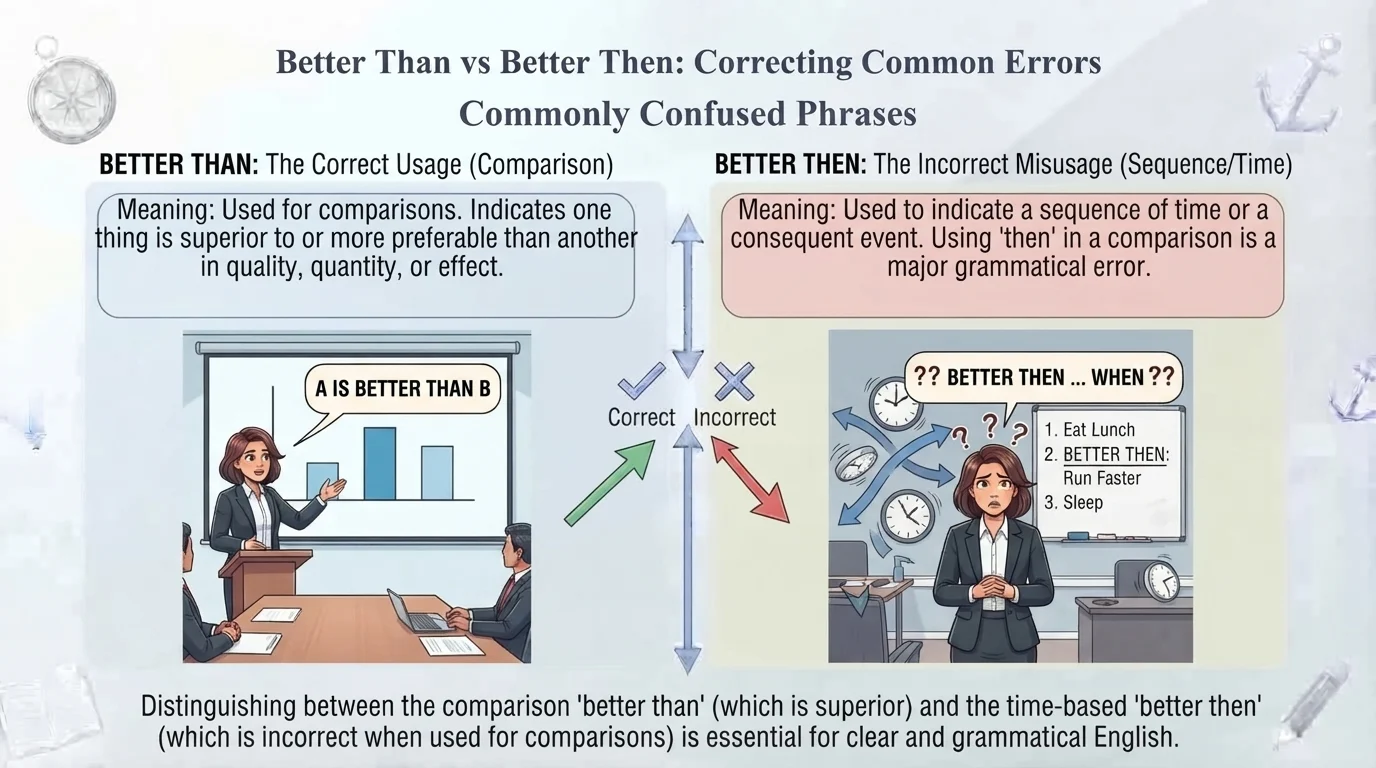
The correct expression for making a comparison is “better than.” Here, than is a conjunction or preposition used to compare two things. Then, on the other hand, relates to time, sequence, or what happens next. Understanding this small difference can help you avoid one of the most common English spelling and grammar mistakes. In this guide, we will explain better than vs better then, show you when to use each word, provide clear examples, and give you a simple memory trick so you can remember the difference.
Quick Answer
“Better than” is correct when you are comparing two things.
For example: This book is better than that one.
“Better then” is usually incorrect because then refers to time or sequence, not comparison. Use than for comparisons and then for “next” or “at that time.”
Why People Confuse It
The main reason people confuse than and then is pronunciation. In many accents, the words sound very similar in everyday speech.
There is also a spelling difference of only one letter:
- Than → used for comparisons
- Then → used for time or sequence
For example:
This restaurant is better than the other one.
Here, you are comparing two restaurants, so than is required.
Compare that with:
We had dinner, and then we went home.
Here, then describes what happened next.
The confusion becomes especially common when people write quickly or rely on how a word sounds rather than its grammatical function.
First Word: Better
Better is the comparative form of good. It means something is of higher quality, more suitable, more effective, or preferable than something else.
Examples:
- This solution is better.
- She feels better today.
- This phone is better than my old one.
- Practice can make you better at English.
When better is followed by a comparison, it normally takes than.
Correct:
My new laptop is better than my old laptop.
Incorrect:
My new laptop is better then my old laptop.
Second Word: Then
Then is a completely different word. It generally refers to time, sequence, or a result.
It can mean:
- At that time
- Next
- After that
- In that case
Examples:
I lived there then.
Finish your homework, then watch TV.
If you are tired, then you should rest.
So, although better then may appear in informal writing because of a spelling mistake, then does not normally belong after better when you are making a comparison.
Comparison Table
| Expression | Meaning | Use | Example |
| Better than | Higher quality or preferable compared with something | Comparison | This car is better than mine. |
| Better then | Usually a spelling/grammar error | Not normally used for comparison | ❌ This car is better then mine. |
| Then | At that time or next | Time/sequence | We ate, then we left. |
| Than | Used to introduce a comparison | Comparison | She is taller than me. |
When to Use Each
Use “Better Than” for Comparisons
Use better than whenever you want to say that one thing is superior, preferable, or more effective than another.
Examples:
- This method is better than the old one.
- Tea is better than coffee for me.
- Your second draft is better than the first.
- Walking is often better than sitting all day.
A useful formula is:
A + is better than + B
For example:
Summer is better than winter.
Use “Then” for Time or Sequence
Use then when you are talking about what happened next or what happened at a particular time.
Examples:
- We finished work and then went home.
- I didn’t understand it then.
- First, read the instructions; then start the exercise.
- If you agree, then we can begin.
Remember that then is not the comparative word.
Examples of “Better Than”
Here are more examples showing the correct use of better than:
- This book is better than the movie.
- She is better than me at tennis.
- Today feels better than yesterday.
- This restaurant is better than the one downtown.
- Learning from mistakes is better than avoiding challenges.
- His second presentation was better than his first.
- This computer is much better than my previous one.
- It is better to ask than to guess.
- Fresh food is often better than processed food.
- Your new idea is better than the original.
- Walking is better than driving for short distances.
- This explanation is better than the one I found online.
Notice that than introduces the thing being compared.
Examples of “Then”
Although better then is incorrect for normal comparisons, then itself is perfectly correct in other sentences.
- We ate dinner and then watched a movie.
- I was younger then.
- First, mix the ingredients, then bake the cake.
- If you don’t want it, then give it to someone else.
- She lived in London then.
- Finish this task, then take a break.
- He arrived late and then apologized.
- Back then, phones were much simpler.
- Think about it, then make your decision.
- We can discuss the details then.
These examples demonstrate that then is associated with time, order, or consequence.
Common Mistakes
Mistake 1: Using “Then” for Comparisons
❌ My car is better then yours.
✅ My car is better than yours.
Because this sentence compares two cars, use than.
Mistake 2: Choosing Based on Pronunciation
Because than and then sound similar, writers sometimes spell them incorrectly.
Instead of relying on sound, ask yourself:
Am I comparing something?
If yes, choose than.
Mistake 3: Confusing “Then” With “Than” Everywhere
This can work in reverse too.
❌ First we went shopping, than we went home.
✅ First we went shopping, then we went home.
Here, the sentence describes a sequence, so then is correct.
Mistake 4: Writing “Better Then” in Formal Content
In academic, professional, or SEO writing, spelling this phrase incorrectly can reduce credibility.
Always check whether you are expressing:
- A comparison → than
- Time or sequence → then
Memory Trick
Here’s an easy way to remember the difference:
THAN = Comparison
Think:
Better THAN something else.
My phone is better than yours.
THEN = Time
Think:
What happens THEN?
We had lunch, then we left.
A simple rule:
THAN compares. THEN continues.
If you remember that one sentence, you will rarely confuse these words again.
American vs British English
There is no meaningful American vs British English difference in the basic distinction between than and then.
Both American English and British English use:
- than for comparisons
- then for time and sequence
For example, both varieties use:
This option is better than the other one.
And:
We finished work and then went home.
The pronunciation may vary slightly between speakers and accents, but the spelling and grammatical distinction remain the same.
Similar Words
Several English words are commonly confused because they sound alike or look similar.
Than vs Then
- Than → comparison
- Then → time or sequence
Your vs You’re
- Your → possession
- You’re → you are
There vs Their vs They’re
- There → place
- Their → possession
- They’re → they are
Affect vs Effect
- Affect → usually a verb meaning to influence
- Effect → usually a noun meaning a result
Learning these commonly confused words can significantly improve your English writing accuracy.
Final Verdict
The correct phrase is “better than” when you are comparing two things.
✅ This option is better than the other one.
The phrase “better then” is generally incorrect when used to express a comparison. Then should be used for time, sequence, or consequence.
A quick way to remember the rule is:
Than = comparison.
Then = time or sequence.
Once you identify what the sentence is doing, choosing the correct word becomes much easier.
Frequently Asked Questions
1. Is “better than” correct?
Yes. Better than is the correct expression when comparing two people, things, ideas, or situations.
This method is better than the old one.
2. Is “better then” grammatically correct?
Usually, no. Better then is normally a spelling error when the writer intends to make a comparison. The correct phrase is better than.
3. What is the difference between than and then?
Than is used for comparisons, while then refers to time, sequence, or what happens next.
4. Should I say “better than me” or “better then me”?
The correct form is “better than me.”
She is better than me at tennis.
In more formal constructions, you may also see “better than I am.”
5. How can I remember than vs then?
Remember:
THAN = comparison
THEN = time or sequence
For example, This is better than that uses than, while We ate, then we left uses then.
6. Is “better than” used in American and British English?
Yes. The distinction is the same in both American and British English.
7. Why do people write “better then”?
The two words sound very similar, especially in fast speech. This makes than/then one of the most common spelling and grammar confusions in English.
Conclusion
Understanding better than vs better then is simple once you focus on meaning rather than pronunciation. Than belongs to comparisons, so phrases such as “better than,” “faster than,” “stronger than,” and “more useful than” all use than. Then, meanwhile, describes time, order, or what happens next.
If you are unsure which word to choose, ask yourself whether you are comparing two things. If you are, use than. If you are talking about what happened next or what was true at a particular time, use then. This small distinction can make your writing clearer, more accurate, and more professional.
Remember This
Better THAN = comparison
THEN = time or sequence
✅ This is better than that.
❌ This is better then that.
Simple rule: THAN compares; THEN tells when or what happens next.

I’m Elliot Pierce, Administrator at Grammetics, dedicated to improving word matching and grammar. I help maintain useful content, support readers, and make language learning simple, clear, accurate, and engaging.