Have you ever wondered whether the correct spelling is hassle or hastle? These two words look similar, so it is easy to type the wrong one when writing a message, email, blog post, or school assignment. However, only one is the standard spelling in modern English. Understanding the difference will help you avoid spelling errors and communicate more confidently.
The word hassle is commonly used to describe trouble, inconvenience, difficulty, or an annoying situation. For example, dealing with a delayed delivery can be a hassle. On the other hand, hastle is a common misspelling of hassle and is not accepted as the standard spelling of the word. Although the two forms may look alike, using the correct spelling matters in professional writing, academic work, and everyday communication. In this guide, you will learn the meaning of hassle, why people misspell it as hastle, how to use it in sentences, and which related words can help you express the same idea.
Quick Answer: Hassle vs. Hastle
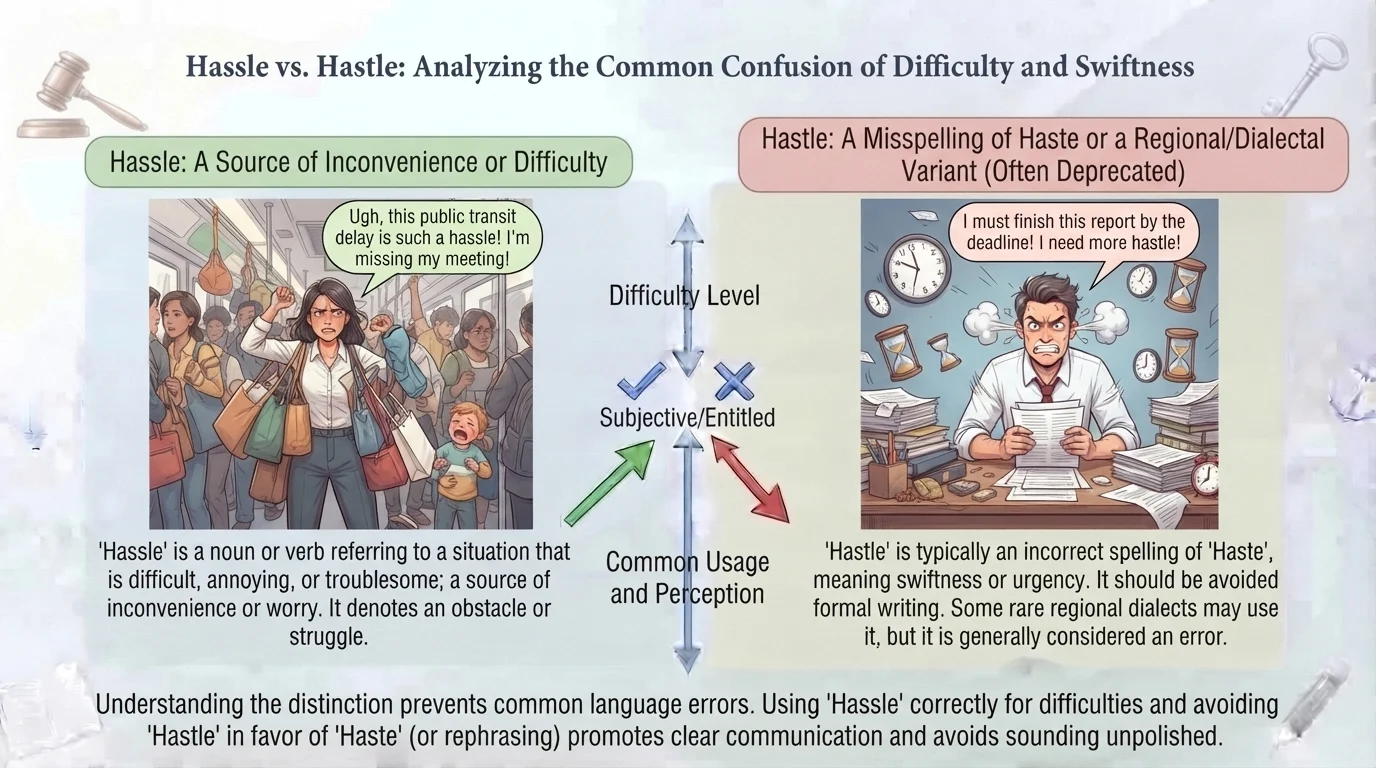
Hassle is the correct spelling. It means trouble, inconvenience, or an annoying task or situation. Hastle is a misspelling and should generally be avoided in standard English writing. For example, “Returning the product was a hassle” is correct because it describes an inconvenient experience.
Why People Confuse Hassle and Hastle
People often confuse hassle and hastle because the words look similar and contain nearly the same letters. When typing quickly, writers may accidentally replace the second s in hassle with a t.
Another reason is pronunciation. In many English accents, the middle consonant sounds in hassle may not be pronounced clearly enough for an unfamiliar learner to remember the spelling immediately.
Here are the main reasons for this common spelling mistake:
- Similar appearance: Both forms begin with “has” and end with “le.”
- Typing errors: People may hit the wrong key while writing quickly.
- Spelling uncertainty: English learners may not have encountered the word often enough to remember its spelling.
- Autocorrect issues: Spell-checking tools do not always catch every mistake, particularly in informal writing.
The easiest solution is to remember that hassle is the standard spelling, whether you use it as a noun or a verb.
1. Hassle: Meaning, Definition, and Examples
Hassle is a noun and a verb in English. As a noun, it refers to trouble, inconvenience, difficulty, or an annoying situation. As a verb, it means to bother, annoy, or repeatedly pressure someone.
Hassle as a Noun
When used as a noun, hassle describes something that causes unnecessary effort, stress, or frustration.
Examples:
- Getting a refund can be a real hassle.
- I want to avoid the hassle of changing hotels.
- The traffic made our journey a hassle.
- Buying tickets online saves time and hassle.
- Moving to a new apartment is often a hassle.
In these examples, the word refers to an inconvenience or troublesome experience.
Hassle as a Verb
As a verb, hassle means to bother, annoy, or pressure someone persistently.
Examples:
- Please stop hassling me while I work.
- The salesperson kept hassling customers outside the store.
- My brother hassled me about borrowing his car.
- Don’t hassle the staff over a minor mistake.
- The reporters hassled the celebrity with repeated questions.
Notice that the verb changes form depending on the sentence:
- Present: hassle
- Third-person singular: hassles
- Past tense: hassled
- Present participle: hassling
Synonyms for Hassle
Depending on the context, synonyms include:
- Trouble
- Inconvenience
- Annoyance
- Nuisance
- Difficulty
- Irritation
- Bother
For example, “The paperwork was a hassle” could be rewritten as “The paperwork was an inconvenience.”
2. Hastle: Meaning, Definition, and Examples
Hastle is not the standard spelling of the English word hassle. In ordinary writing, it should be treated as a spelling error rather than a separate word with an established meaning.
People sometimes type hastle when they intend to write hassle. This mistake may appear in text messages, online comments, search queries, or informal posts.
Incorrect Examples Using Hastle
Here are examples of the misspelling and the correct versions.
- Incorrect: Getting a refund is a hastle.
Correct: Getting a refund is a hassle. - Incorrect: I don’t want the hastle of moving.
Correct: I don’t want the hassle of moving. - Incorrect: Stop hastling me about the decision.
Correct: Stop hassling me about the decision. - Incorrect: The process was too much hastle.
Correct: The process was too much hassle. - Incorrect: Online shopping saves me a lot of hastle.
Correct: Online shopping saves me a lot of hassle.
Should You Ever Use Hastle?
In standard English writing, use hassle, not hastle. You may encounter hastle as a typo, username, brand name, or other deliberately chosen name, but those special uses do not make it a standard spelling variant of hassle.
For school assignments, professional emails, articles, and website content, always choose hassle.
Hassle vs. Hastle: Comparison Table
| Feature | Hassle | Hastle |
| Spelling status | Correct standard spelling | Common misspelling |
| Meaning | Trouble, inconvenience, or annoyance | No standard meaning as a variant of hassle |
| Part of speech | Noun and verb | Not a standard spelling of the intended word |
| Example | The delay was a hassle. | The delay was a hastle. (Incorrect) |
| Verb form | Hassle, hassled, hassling | Hastle is incorrect when hassle is intended |
| Suitable for formal writing | Yes | No, unless used as a proper name |
| Best choice | Use this spelling | Avoid this spelling |
When to Use Each
Choosing between hassle and hastle is straightforward because only one is the standard spelling for the intended meaning.
Use Hassle When Describing Trouble
Use hassle when you want to describe an annoying situation, an inconvenient process, or something that requires unnecessary effort.
Examples:
- Renewing my passport was a hassle.
- I don’t want the hassle of cooking tonight.
- The company made the refund process a hassle.
Use Hassle When Describing Annoying Someone
Use hassle as a verb when someone repeatedly bothers or pressures another person.
Examples:
- Don’t hassle your sister about her homework.
- The customer hassled the employee for a refund.
- He kept hassling me to change my decision.
Avoid Hastle in Standard Writing
Do not use hastle when you mean inconvenience or bother.
Incorrect: “Planning the event was a hastle.”
Correct: “Planning the event was a hassle.”
Writing tip: If you are unsure about the spelling, remember the double s in hassle.
Examples of Hassle vs. Hastle in Sentences
The following examples show the correct spelling in everyday situations.
- Traveling with too much luggage can be a hassle.
- I prefer online banking because it saves me the hassle of visiting a branch.
- Don’t make a simple task into a major hassle.
- Finding parking downtown was a real hassle.
- She wanted to avoid the hassle of returning the shoes.
- The new software reduces the hassle of managing appointments.
- Moving to another country involves paperwork and other hassles.
- My neighbor keeps hassling me about the noise.
- The manager hassled the staff about meeting the deadline.
- I don’t want to hassle you with unnecessary questions.
- Getting the documents signed turned out to be more of a hassle than expected.
- He was tired of being hassled by telemarketers.
- Preparing meals in advance helps me avoid the daily hassle of deciding what to cook.
- The airline apologized for the hassle caused by the cancellation.
- She asked the shop assistant not to hassle customers while they were browsing.
In every example, hassle is the correct spelling. If you see hastle used with the same intended meaning, it should generally be corrected.
Common Mistakes
Even though the spelling difference is small, a few common mistakes are worth avoiding.
1. Writing Hastle Instead of Hassle
Incorrect: “The application process was a hastle.”
Correct: “The application process was a hassle.”
Remember that the correct word contains ss, not st.
2. Thinking Hassle Is Only a Noun
Incorrect assumption: Hassle can only describe a troublesome situation.
Correct understanding: Hassle can be both a noun and a verb.
- Noun: “The delay was a hassle.”
- Verb: “Please stop hassling me.”
3. Confusing Hassle With Hustle
These words look and sound somewhat similar, but their meanings differ.
- Hassle: Trouble, inconvenience, or bother.
- Hustle: To move quickly, work energetically, or pursue something actively.
Example: “I had to hustle to finish the project, but dealing with the paperwork was a hassle.”
4. Using the Wrong Verb Form
The standard forms are hassle, hassles, hassled, and hassling.
Examples:
- Present: They hassle me every day.
- Past: They hassled me yesterday.
- Continuous: They are hassling me now.
Avoid forms such as hastled or hastling when you mean the verb hassle.
5. Assuming Spell-Check Will Catch Every Error
Spell-checking tools are helpful, but they are not a substitute for proofreading. A typo can sometimes remain in a document if the software does not recognize the intended word or context.
Better approach: Read the sentence carefully and confirm that hassle is spelled correctly.
Memory Trick: How to Remember Hassle vs. Hastle
Here is an easy way to remember the correct spelling.
Hassle has two S’s for Stressful Situations.
Think of a hassle as something stressful, inconvenient, or annoying. The double s in hassle can remind you of the word’s meaning.
Remember these points:
- Hassle: Correct spelling.
- Hastle: Common spelling mistake.
- Hassle: Can be a noun or a verb.
- Hassling: The correct -ing form.
- Hassled: The correct past-tense form.
For example, “Filling out these forms is a hassle” uses the correct spelling because the forms are causing inconvenience.
American vs. British English
The spelling distinction between hassle and hastle does not change between American and British English.
Both varieties use hassle as the standard spelling for trouble, inconvenience, or bothering someone. Hastle is not the standard alternative in either variety.
| Usage | American English | British English |
| Correct spelling | Hassle | Hassle |
| Incorrect spelling for the intended word | Hastle | Hastle |
| Noun example | Parking is a hassle. | Parking is a hassle. |
| Verb example | Stop hassling me. | Stop hassling me. |
There may be differences in vocabulary or expressions between American and British English, but this is not one of them.
Whether you are writing for readers in the United States, the United Kingdom, Pakistan, Australia, or another English-speaking region, hassle is the spelling to use.
Similar Words: Hassle, Hustle, Hassled, and Nuisance
Learning related words can help you express yourself more accurately.
1. Hassle vs. Hustle
Hassle refers to inconvenience or annoyance. Hustle often means moving quickly, working energetically, or making determined efforts to achieve something.
Examples:
- “The paperwork was a hassle.”
- “She had to hustle to catch the train.”
2. Hassle vs. Nuisance
A nuisance is a person, thing, or situation that causes annoyance or inconvenience. It is similar to hassle, but the words do not fit every sentence equally well.
Examples:
- “The constant delays were a hassle.”
- “The loud noise was a nuisance.”
3. Hassle vs. Trouble
Trouble is a broad word that can describe difficulty, problems, danger, or inconvenience. Hassle often emphasizes the irritating effort involved in a situation.
Examples:
- “I had trouble opening the file.”
- “Getting technical support was a hassle.”
4. Hassle vs. Bother
Bother can mean annoyance, inconvenience, or the act of disturbing someone. It can be used as a noun or a verb.
Examples:
- “Don’t bother me while I’m working.”
- “I don’t want the hassle of organizing another meeting.”
5. Hassle vs. Hassled
Hassle is the base form, while hassled is its past-tense and past-participle form.
Examples:
- “People sometimes hassle the staff.”
- “The staff were hassled by impatient customers.”
Understanding these related terms helps you choose words that accurately communicate the situation.
Frequently Asked Questions
1. Is it hassle or hastle?
Hassle is correct. Hastle is a common misspelling and should not be used as the standard spelling of the word meaning trouble or inconvenience.
2. What does hassle mean?
Hassle means trouble, inconvenience, difficulty, or annoyance. It can also mean to bother or pressure someone repeatedly when used as a verb.
3. Is hastle a real word?
Hastle is not the standard spelling of hassle. It may appear as a proper name or an intentional spelling in a particular context, but it should not replace hassle in ordinary English writing.
4. How do you spell hassle correctly?
The correct spelling is h-a-s-s-l-e: hassle. Remember the two consecutive s letters in the middle.
5. What is the plural of hassle?
The plural is hassles. For example, “Moving to a new house comes with several hassles.”
6. What is the past tense of hassle?
The past tense is hassled. For example, “The customer hassled the employee about the delayed order.”
7. Is hassle informal or formal?
Hassle is common in everyday conversation and is also acceptable in many professional contexts. In highly formal writing, words such as inconvenience, difficulty, or administrative burden may sometimes be more appropriate.
8. What are some synonyms for hassle?
Common synonyms include trouble, inconvenience, annoyance, nuisance, bother, and difficulty. Choose the synonym that best matches your sentence.
Final Verdict: Hassle vs. Hastle
The difference between hassle and hastle is simple: hassle is the correct standard spelling, while hastle is a misspelling when you intend to describe trouble, inconvenience, or annoyance. The correct word works as both a noun and a verb, making it useful in everyday conversation, business communication, and online writing.
Whenever you write about an annoying task, a difficult process, or someone bothering another person, choose hassle. Remember the double s, proofread your writing, and avoid using hastle as a substitute. This small spelling improvement will make your English clearer and more professional.
Conclusion
Learning the difference between hassle vs. hastle is an easy way to improve your English spelling. Although the two forms look similar, only hassle is the standard spelling of the word used to describe inconvenience, trouble, or annoyance. It can also function as a verb meaning to bother or pressure someone.
The best way to remember this distinction is to associate hassle with stressful situations and its double s. Use the correct spelling in emails, articles, schoolwork, and everyday messages. With a little practice, you will recognize the correct form quickly and avoid this common spelling mistake.
Remember This
- Hassle: The correct spelling for trouble, inconvenience, or bothering someone.
- Hastle: A common misspelling when hassle is intended.
- Noun example: The journey was a hassle.
- Verb example: Stop hassling me.
- Memory trick: Hassle has two S’s for stressful situations.

I’m Elliot Pierce, Administrator at Grammetics, dedicated to improving word matching and grammar. I help maintain useful content, support readers, and make language learning simple, clear, accurate, and engaging.